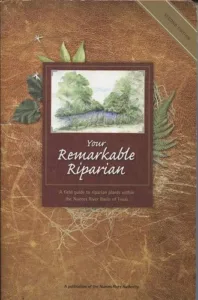
Your Remarkable Riparian A Field Guide to Riparian Plants Within the Nueces River Basin of Texas

Steve Nelle

Publisher:

Nueces River Authority

Publication Date:

January 1, 2010

Category:

Reference, Regional

This user-friendly guide introduces the most commonly observed riparian vegetation in
the Edwards Plateau and Rio Grande Plains. However, most of the plants presented
herein occur in riparian areas all across Texas, including the Cross Timbers, Trans-Pecos
and Rolling Plains. The riparian principles described apply to all creeks and rivers.
We’ve included images and details on plants that truly provide the heavy lifting when
it comes to holding and cleaning water within the riparian landscape.

This field guide is a tool that you can refer to again and again. Keep it on the dashboard,
take it to the creek, or leave it on the kitchen table so you can consult it regularly. It’s up to
you to learn to read your riparian areas and determine if they’re gaining or losing function.
With this knowledge and appreciation, you can successfully assess and monitor your
riparian areas and help manage them in ways that conserve and enhance their function.

The Purchase button links to a FREE PDF eBook.

About the Region

2026 Fall Symposium Logo

This low-elevations region of Texas extends inland from the barrier islands, about 60 or so miles, and stretches from Brownsville to Louisiana. In total, it covers about 9.5 million acres, with a high point of 150 feet in elevation. More than 1000 species of plants can be found in this region. On the southern end, species more common in Mexico (such as Sabal mexicana) and Central America occur.

The barrier islands provide us with dune systems, and clay flats to the inland side, which have species found in these areas alone. Many plants here, such as Ipomoea pes-caprae (beach morning glory), can be found throughout tropical regions of the globe. I’ve encountered the same species on the beaches of Guam.

Once inland, vast marshes and wet prairies occur. Occasionally, oak (Quercus fusiformis) groves can be found. Common grasses include species of Bothriochloa, Paspalum, and Sporobolus; eastern gamagrass (Tripsacum dactyloides); and switchgrass (Panicum species). Many rivers and creeks cut through the Gulf Prairies, and along these riparian areas various species of trees, Sabal minor, and other plants adapted to clay soils can be found. Due to overgrazing, farming, and fire suppression, woody species such as mesquite (Prosopis glandulosa) and huisache (Acacia farnesiana), and invasive species such as chinaberry (Melia azedarach), Brazilian pepper (Schinus terebinthifolius), and Chinese tallow (Sapium sebiferum) have increased and displaced our native flora.

Source: Wildflowers of Texas by Michael Eason