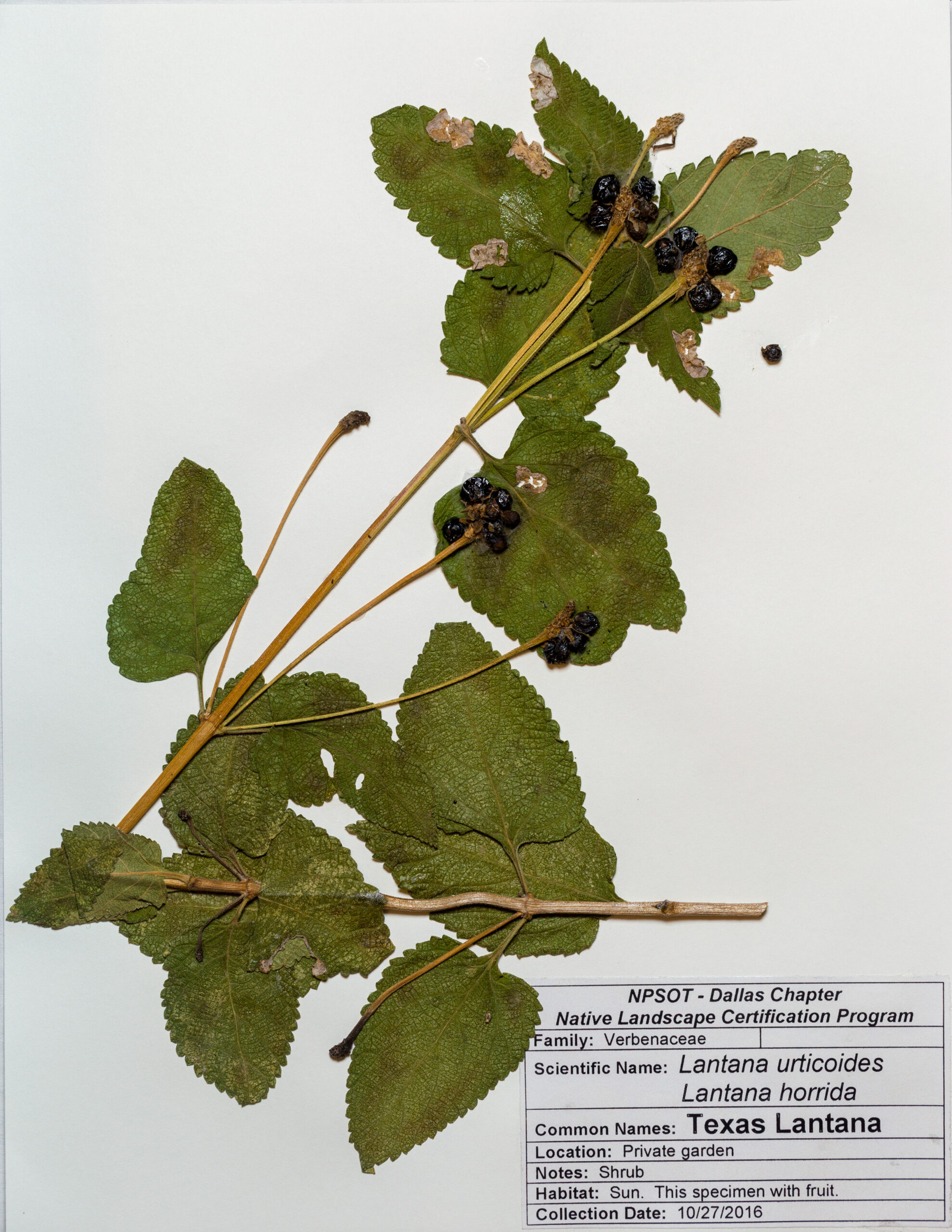


Texas Lantana

Lantana horrida

Other common name(s):

Calico Bush

Family:

Verbenaceae (Verbena Family)

Plant Ecoregion Distribution Map

This map uses data from the US EPA. EPA  servers have been offline frequently so maps may not display. We are working on a solution.

Central Great Plains, Chihuahuan Deserts, Cross Timbers, East Central Texas Plains, Edwards Plateau, Gulf Coast Prairies and Marshes, Southern Texas Plains, Texas Blackland Prairies, Western Gulf Coastal Plain
Broken Red Plains
Low Mountains and Bajadas, Stockton Plateau
Eastern Cross Timbers, Grand Prairie, Limestone Cut Plain
Bastrop Lost Pines, San Antonio Prairie, Southern Post Oak Savanna
Balcones Canyonlands, Edwards Plateau Woodland, Llano Uplift, Semiarid Edwards Plateau
Coastal Sand Plain, Floodplains and Low Terraces4, Laguna Madre Barrier Island and Coastal Marshes, Lower Rio Grande Alluvial Floodplain, Lower Rio Grande Valley, Mid-Coast Barrier Islands and Coastal Marshes, Northern Humid Gulf Coastal Prairies, Southern Subhumid Gulf Coastal Prairies, Texas-Louisiana Coastal Marshes
Northern Nueces Alluvial Plains, Rio Grande Floodplain and Terraces, Semiarid Edwards Bajada, Texas-Tamaulipan Thornscrub
Floodplains and Low Terraces1, Northern Blackland Prairie, Southern Blackland Prairie
Flatwoods, Tertiary Uplands

Plant Characteristics

Growth Form

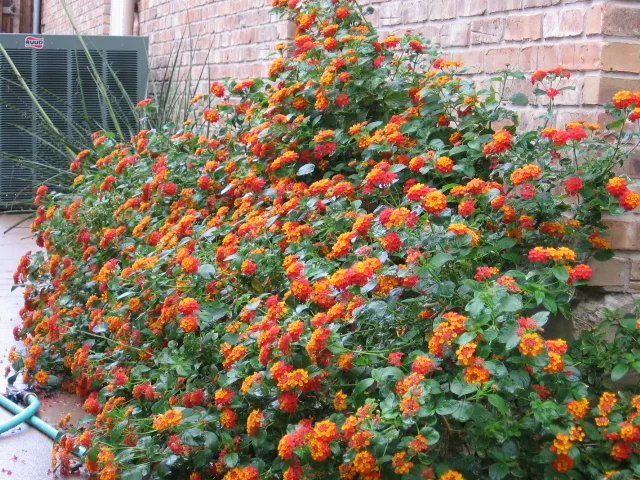
Shrub

Height

3
to
5
ft.

Spread

4
to
5
ft.

Leaf Retention

Deciduous

Lifespan

Perennial

Habitat and Care Requirements

Soil Type(s)

Sand, Loam, Clay, Caliche, Well Drained, Dry

Light Requirement

Sun

Water Requirement

Very Low, Low

Native Habitat

Grassland, Woodland, Wetland or Riparian

Bloom and Attraction

Bloom Color

Orange, Yellow

Bloom Season

Spring, Summer, Fall

Seasonal Interest

Fruit, Nectar

Wildlife Benefit

Butterflies, Birds, Nectar Insects

Maintenance

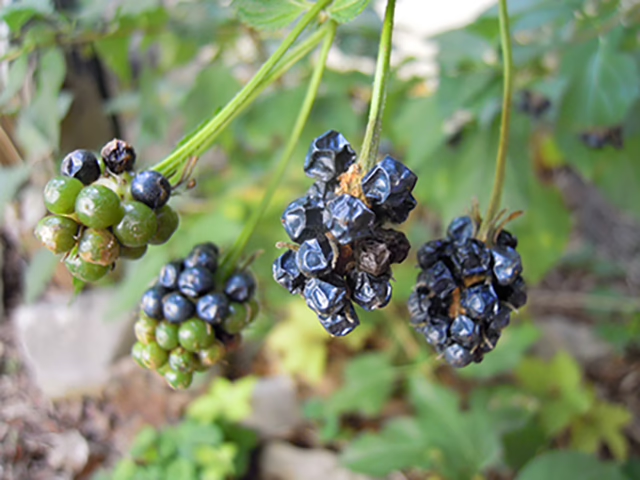
Drought tolerant. Adapts to a variety of growing conditions. May be pruned back in winter to keep plants from getting too leggy. Can be grown in container gardens. Native habitat: fields, thickets, swamps, rich sandy woods, scrub, gravelly hills, flats. Widely distributed throughout much of Texas. WARNING: fruit is poisonous to humans and pets. Propagation: seed, clump division.

Comments

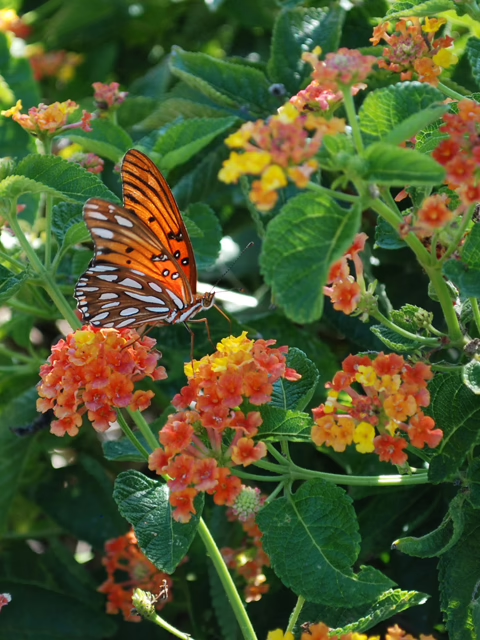
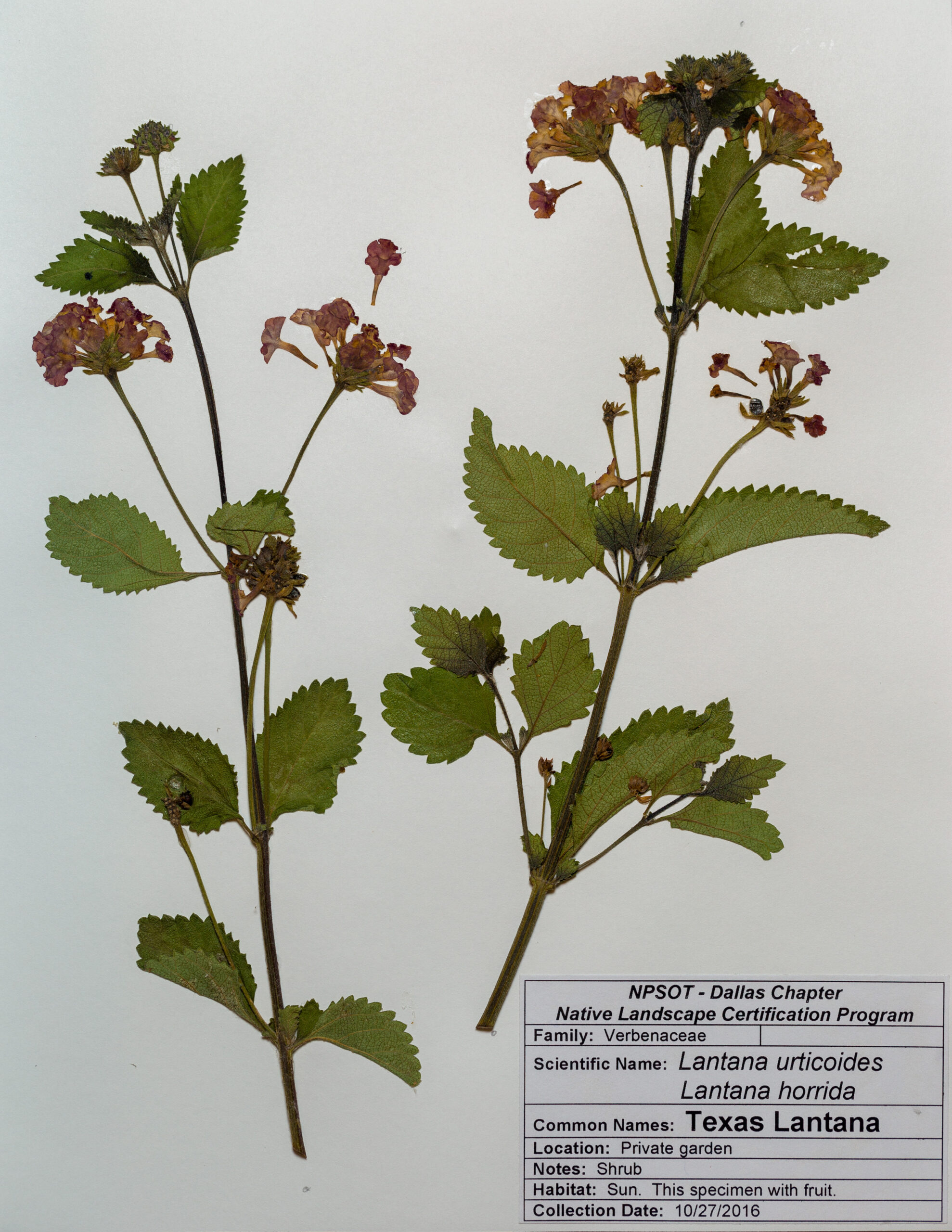
Blooms April-November. A spreading shrub, with many branches that sometimes have prickles with age. Leaves are oval, pointed at the tip, with rough upper surface, and margins coarsely toothed. Flowers are red, orange, and yellow, tubular with four flared lobes, occurring in dense, rounded clusters. Fruit are round, fleshy, dark blue to black berries. Replaces non-natives: Largeleaf Lantana. NOTE ON SCIENTIFIC NAME FOR THIS PLANT: there is a great deal of discussion about the scientific name of this plant. NPSOT uses itis.gov as the source of all scientific names in this database. Follow this link for more details https://www.itis.gov/servlet/SingleRpt/SingleRpt?search_topic=TSN&search_value=503324#null
Previous Scientific Name(s): Lantana scorta, Lantana urticoides, Lantana hispida, Lantana notha, Lantana horrida var. latibracteata, Lantana urticoides var. hispidula

References

1) Griffith, Bryce, Omernick & Rodgers (2007). Ecoregions of Texas. 2) Miller, George O., Landscaping with Native Plants of Texas 2nd Ed., 2013, pg 48., 52. 3) Wasowski and Wasowski, Native Texas Plants Landscaping Region by Region, 1991, pg. 248. 4) https://www.wildflower.org/plants/result.php?id_plant=LAUR2. 5) http://bonap.net/TDC/Image/Map?taxonType=Species&taxonId=23836&locationType=County&mapType=Normal, 6) https://www.itis.gov/servlet/SingleRpt/SingleRpt?search_topic=TSN&search_value=832818#null, 7) Native and Adapted Landscape Plants, City of Austin and Texas A&M, 2014.
Material Treatment Method Collection References
Seed No Treatment Start lantana seeds indoors 6 to 8 weeks before you plan to transplant them outdoors. Soak seeds for 12-24 hours in clean, warm water to soften the seed coat. Fill small, individual pots to within ½ inch (1 cm) of the top with soilless seed starting medium and moisten the medium with water. Lay one or two seeds in the center of each pot and cover them with 1/8 inch (3 mm) of soil. If more than one seedling emerges, clip out the weakest plant with a pair of scissors. Keep the soil consistently moist and at a steady temperature between 70 and 75 F (21-24 C) day and night. A good way to maintain the moisture is to place the pots in a clear plastic bag. You can keep temperatures steady with a heat mat. While the pots are in the bag, keep them away from direct sunlight. Check the pots often and remove the bag as soon as the seedlings emerge. Be patient, and don't give up hope if your seedlings don't sprout right away. Even under ideal conditions, you can expect germination to take 6 to 8 weeks. Collect seeds as soon as the fruit has filled out and turned dark. Air dry with pulp on or clean before storage. Store in sealed, refrigerated containers. 1) https://www.wildflower.org/plants/result.php?id_plant=LAUR2 2) https://www.gardeningknowhow.com/ornamental/flowers/lantana/how-to-propagate-lantana.htm
Stem Cutting Prepare a small pot of seed starting mix or a half-and-half mixture of peat moss and perlite. Moisten the mix with water and make a hole 2 inches (5 cm) deep in the center of the pot with a pencil. Coat the lower 2 inches (5 cm) of the cutting with rooting hormone. (Though rooting hormone is not essential, it may help to speed the process). Place the cutting in the hole, firming the medium around the base so it stands up straight. Place three or four craft sticks in the soil near the edge of the pot. Space them evenly around the pot. Put the potted cutting in a plastic bag and seal the top. The craft sticks will keep the bag from touching the cutting. Each cutting should be watered well at planting, and kept consistently moist throughout the following weeks. Check occasionally to make sure the soil is moist, but otherwise leave the cutting undisturbed until you see signs of new growth. Rooting takes three to four weeks. After two weeks, you can check the plants by gently tugging at the base of each cutting. Any resistance will indicate that the plants have been successfully rooted. Remove the cutting from the bag and place it in a sunny window until you are ready to transplant it outdoors. Take cuttings of new growth in spring. Cut 4-inch (10 cm) tips from the stems and remove the lower leaves from the cutting, leaving only the uppermost 1-2 sets of true leaves at the top. https://www.gardeningknowhow.com/ornamental/flowers/lantana/how-to-propagate-lantana.htm
Bud Division Texas Lantana may also be propagated by digging the root ball and dividing it into smaller sections for re-planting. https://dallascountymastergardeners.org/texas-lantana/#:~:text=Minimal%20care%20is%20required%20for,require%20staking%20or%20other%20support.

About the Region

Fall Symposium 2025 Logo - Teach for the Future

Salado, the location of our Fall 2025 Symposium, lies at the intersection of two ecoregions: the Edwards Plateau (Limestone Cut Plain) and Blackland Prairie (Northern Blackland Prairie).

The Edwards Plateau area is also called the Hill Country; however, this general term covers a much larger area extending farther north. Spring-fed creeks are found throughout the region; deep limestone canyons, rivers, and lakes (reservoirs) are common. Ashe juniper is perhaps the most common woody species found throughout the region. Additional woody species include various species of oak, with live oak (Quercus fusiformis) being the most common. Sycamores (Platanus occidentalis) and bald cypress (Taxodium distichum) border waterways. This area is well known for its spring wildflower displays, though they may be viewed in spring, late summer, and fall, as well. According to Texas Parks and Wildlife, average annual rainfall in the Edwards Plateau ranges from 15 to 34 inches.

The Blackland Prairie extends from the Red River south to San Antonio, bordered on the west by the Edwards Plateau and the Cross Timbers, and on the east by the Post Oak Savannah. Annual rainfall averages 30 to 40 inches, with higher averages to the east. This region is dominated by prairie species. The most common grass species include little bluestem (Schizachyrium scoparium) and Indian grass (Sorghastrum nutans) in the uplands and switchgrass (Panicum virgatum) in the riparian areas and drainages. Common herbaceous flowering plants include salvias, penstemons, and silphiums. This area has suffered greatly from overgrazing and agricultural use. Few intact areas remain, though many of the plants can be found along county roadsides throughout the region.

Our fall Symposium host chapter, the Tonkawa Chapter, includes both of these ecoregions.

Source: Wildflowers of Texas by Michael Eason