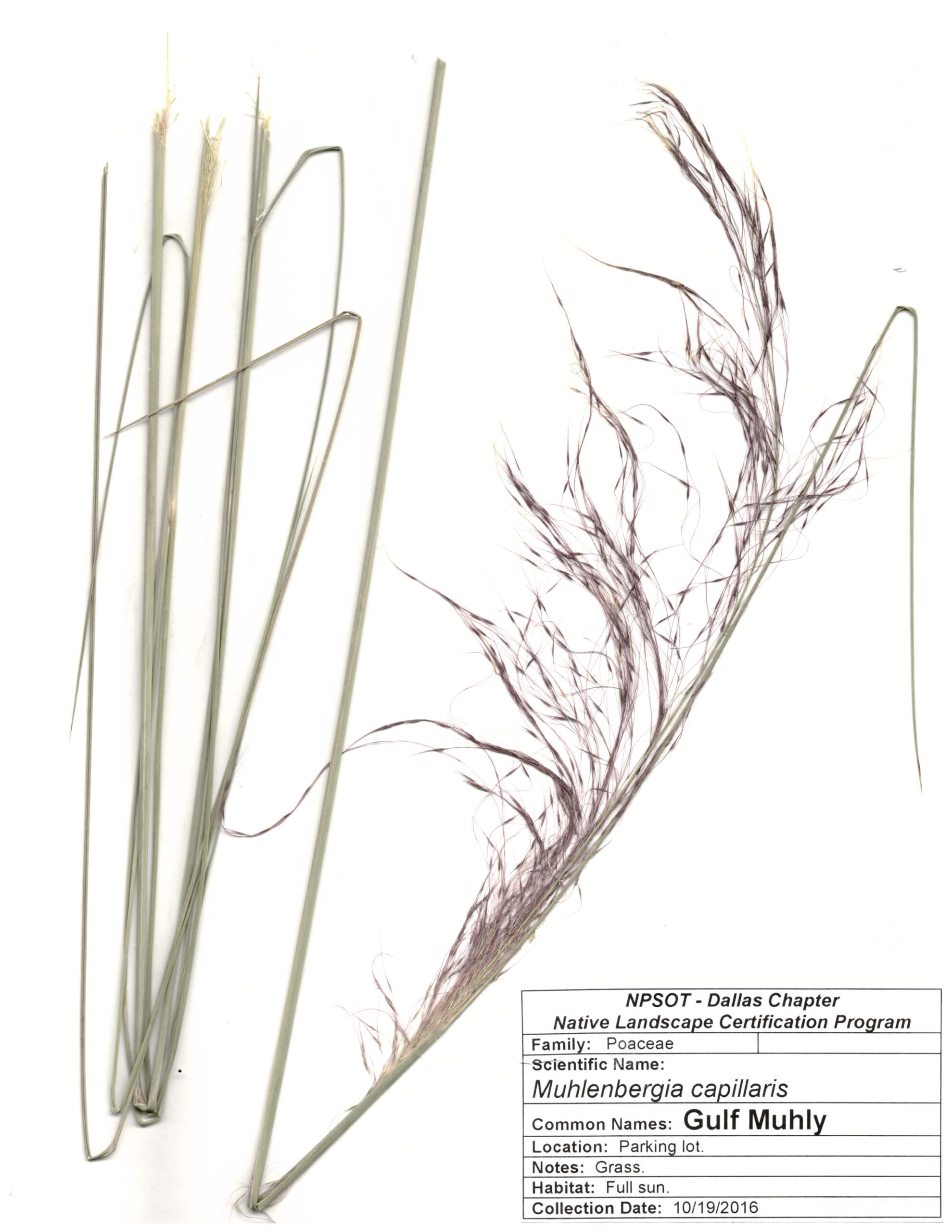
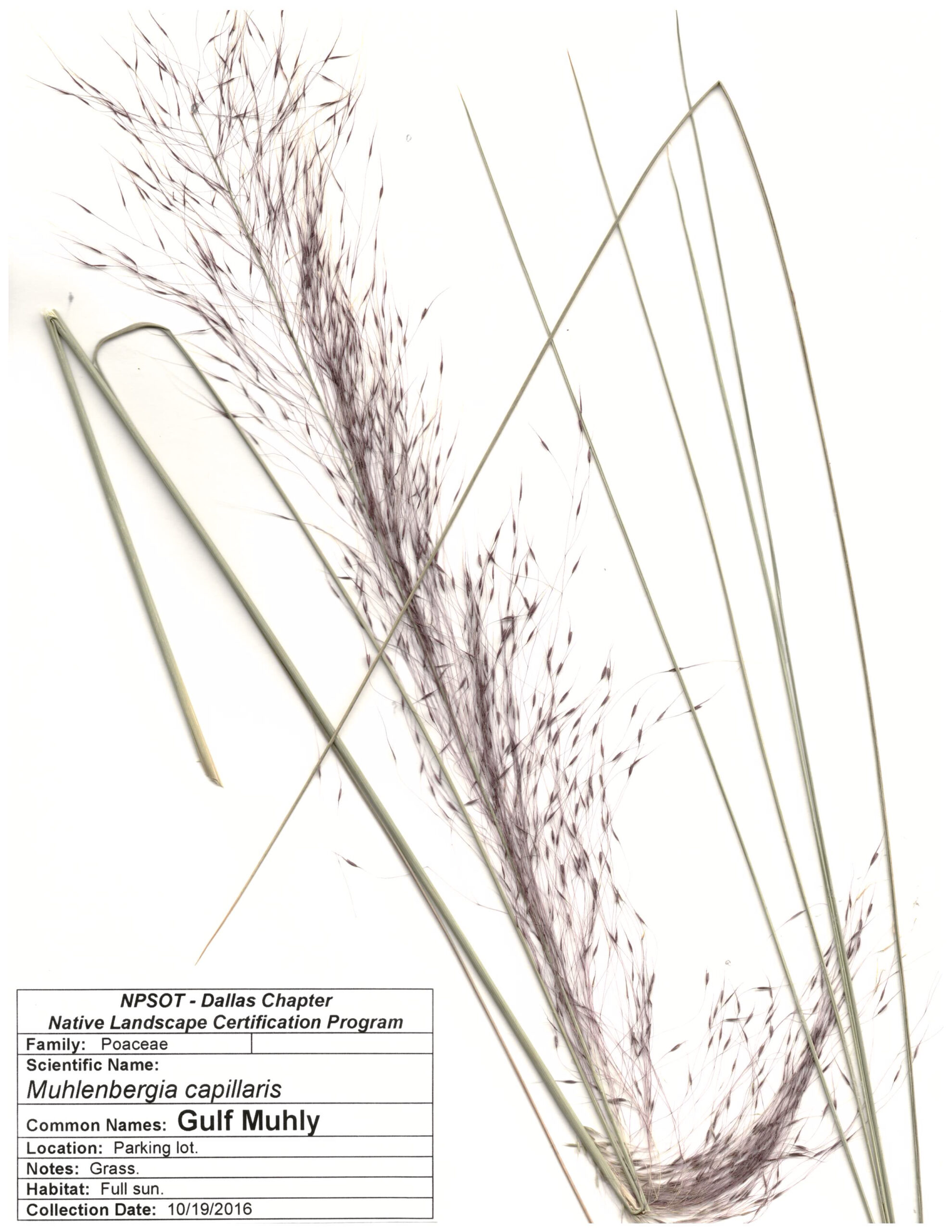

Gulf Muhly

Muhlenbergia capillaris

Other common name(s):

Hairawn Muhly, Hair Grass, Pink Muhly

Family:

Poaceae (Grass Family)

Plant Ecoregion Distribution Map

This map uses data from the US EPA. EPA  servers have been offline frequently so maps may not display. We are working on a solution.

East Central Texas Plains, Gulf Coast Prairies and Marshes, Texas Blackland Prairies, Western Gulf Coastal Plain
Southern Post Oak Savanna
Coastal Sand Plain, Floodplains and Low Terraces4, Laguna Madre Barrier Island and Coastal Marshes, Lower Rio Grande Valley, Mid-Coast Barrier Islands and Coastal Marshes, Northern Humid Gulf Coastal Prairies, Southern Subhumid Gulf Coastal Prairies, Texas-Louisiana Coastal Marshes
Floodplains and Low Terraces1, Northern Blackland Prairie, Southern Blackland Prairie
Flatwoods, Southern Tertiary Uplands

Plant Characteristics

Growth Form

Grass & Sedge

Height

1
to
3
ft.

Spread

1.5
to
2
ft.

Leaf Retention

Deciduous

Lifespan

Perennial

Habitat and Care Requirements

Soil Type(s)

Sand, Loam, Clay, Well Drained, Moist, Dry

Light Requirement

Sun

Water Requirement

Low, Medium

Native Habitat

Grassland

Bloom and Attraction

Bloom Color

Pink, Purple

Bloom Season

Fall

Seasonal Interest

Fall Color, Seeds, Larval Host, Nesting Material

Wildlife Benefit

Butterflies, Birds, Small Mammals

Maintenance

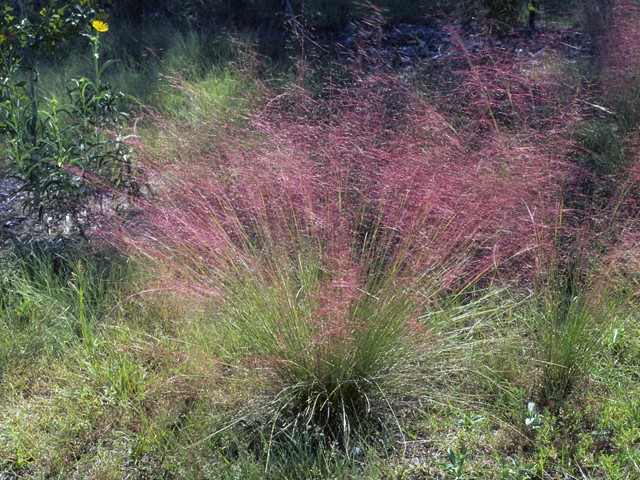
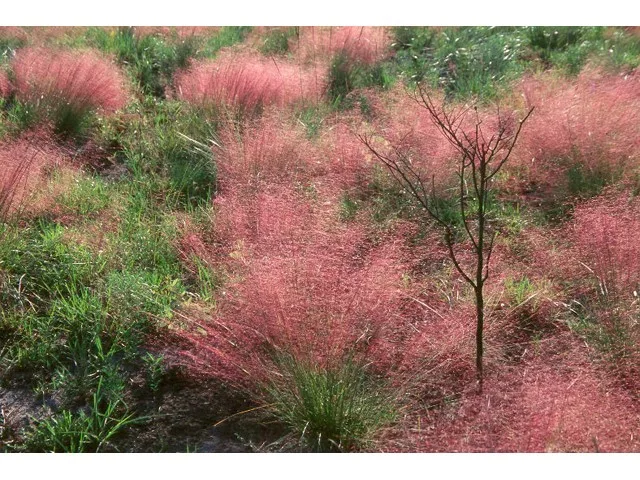
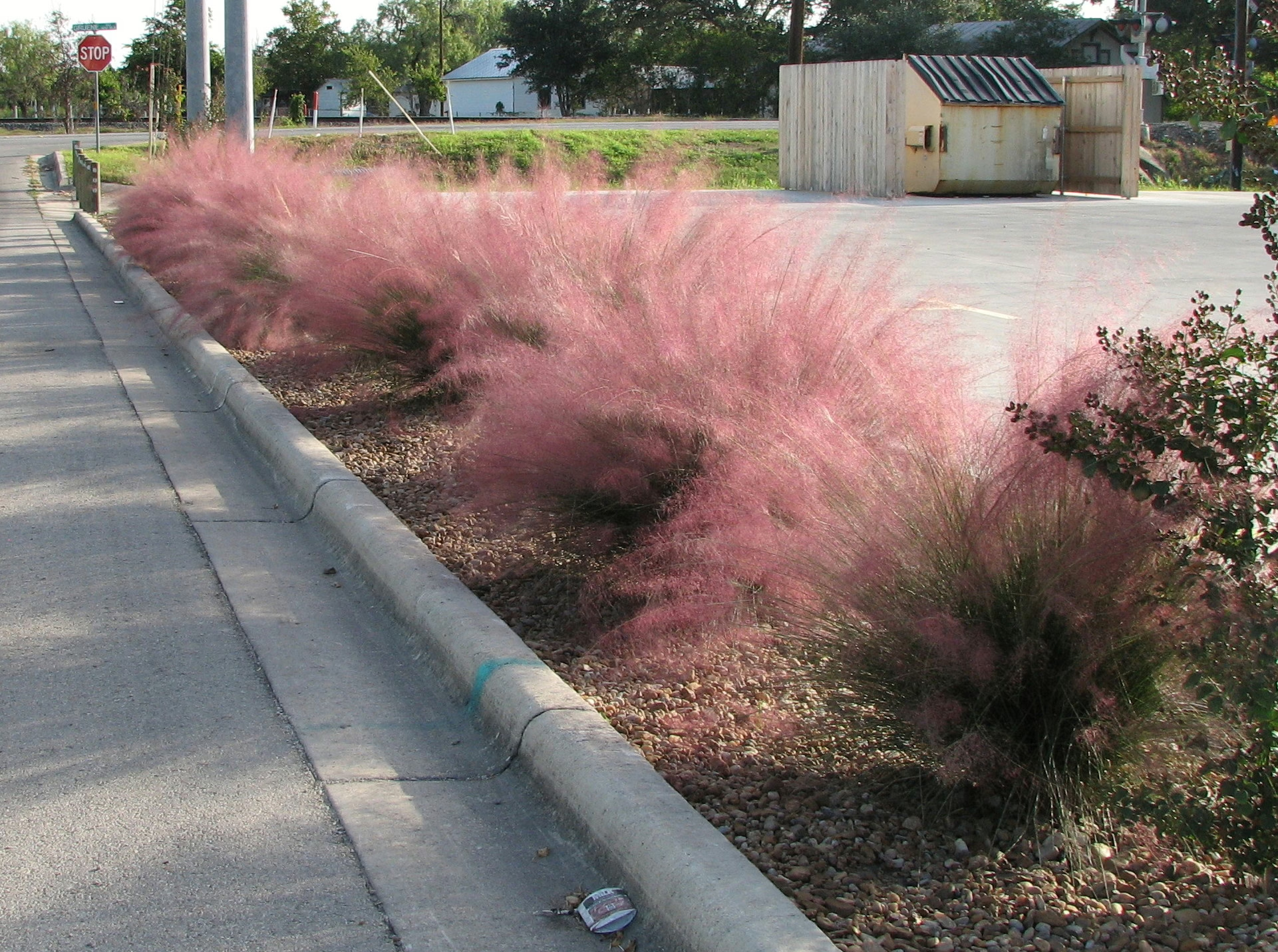
Drought tolerant. Creates a beautiful pink to lavender floral display in the fall. Popular in mass plantings, borders, and meadow gardens. Dormant in winter. Can be used for land reclamation. Propagation: seed.

Comments

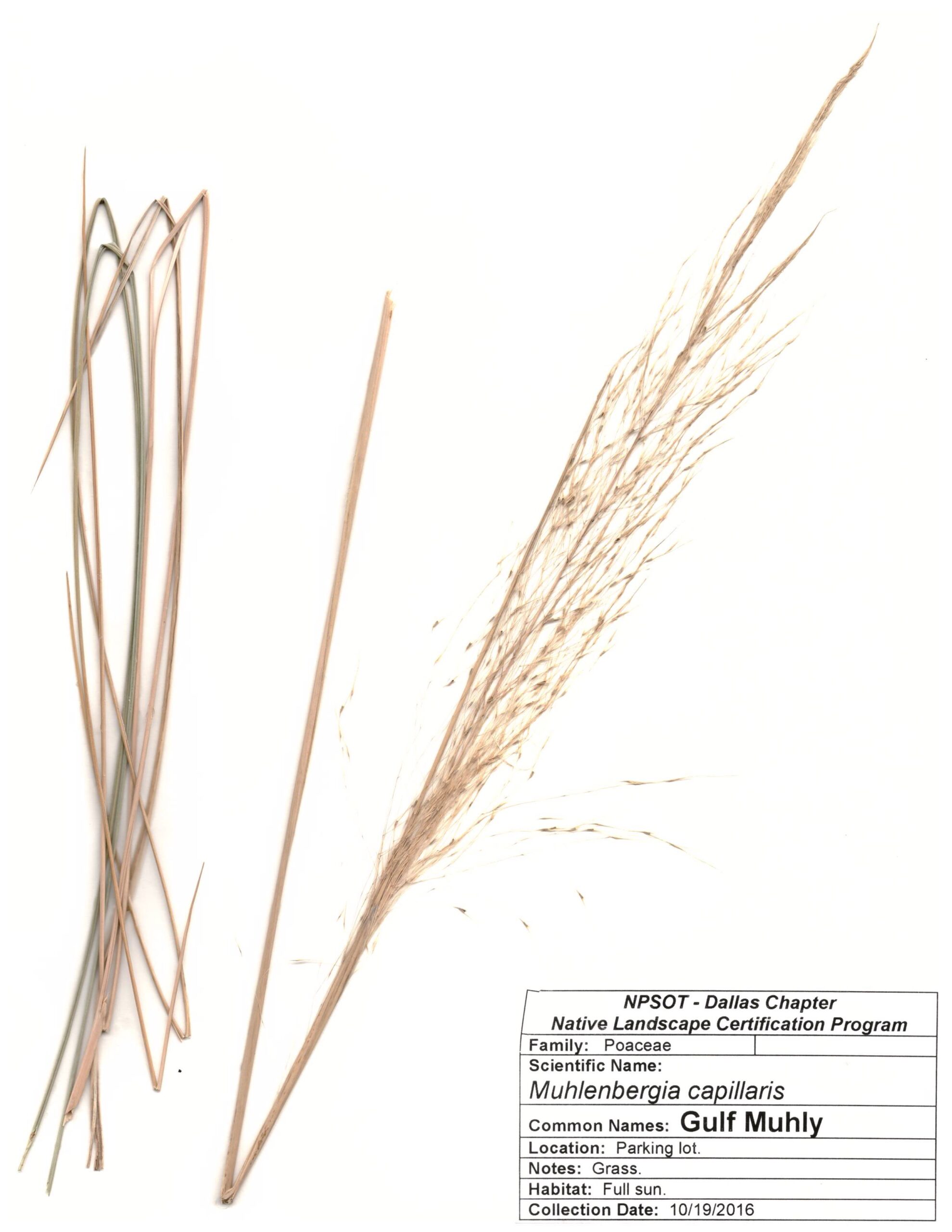
Blooms October. A warm-season, clumping grass with a large, airy, much-branched seed head. The spikelets are purple. Larval host: Orange Skipperling.
Previous Scientific Name(s): Muhlenbergia capillaris var. capillaris

References

1) Griffith, Bryce, Omernick & Rodgers (2007). Ecoregions of Texas. 2) Wasowski and Wasowski, Native Texas Plants Landscaping Region by Region, 1991, pg. 129. 3) https://www.wildflower.org/plants/result.php?id_plant=MUCA2. 4) https://portal.torcherbaria.org/portal/taxa/index.php?taxon=Muhlenbergia+capillaris&formsubmit=Search+Terms. 5) http://bonap.net/TDC/Image/Map?taxonType=Species&taxonId=18558&locationType=County&mapType=Normal. 6) https://www.itis.gov/servlet/SingleRpt/SingleRpt?search_topic=TSN&search_value=41902#null, 7) Native and Adapted Landscape Plants, City of Austin and Texas A&M, 2014. 8) Hatch, Umphres, Ardoin, 2015, Field Guide to Common Texas Grasses, pg 190, 9) https://www.coastalpoint.com/lifestyle/pinkly-muhly-grass-a-must-have-for-native-fall-color/article_7af89124-535c-11ee-ac65-4fa036eac6ca.html#:~:text=Songbirds%2C%20turkeys%20and%20small%20animals,insects%20and%20birds%20from%20predators.&text=Attracts%20butterflies%20and%20is%20a%20host%20plant%20for%20moths%20and%20butterflies., 10) chrome-extension://efaidnbmnnnibpcajpcglclefindmkaj/https://plants.usda.gov/DocumentLibrary/factsheet/pdf/fs_muca2.pdf, 11) https://hgic.clemson.edu/factsheet/rain-garden-plants-muhlenbergia-capillaris-muhly-grass/#:~:text=These%20seed%20plumes%20are%20a,provides%20habitat%20for%20other%20wildlife. 12) Weber, Jim; Weber, Lynne; Wauer, Roland H. Native Host Plants For Texas Butterflies. Texas A&M University Press. 2018 Weber, Jim; Weber, Lynne. Native Host Plants For Texas Moths. Texas A&M University Press. 2022
Material Treatment Method Collection References
Clump Division Choose a mature and robust pink muhly grass that is free from pests and diseases. This ensures the best chance of successful propagation. Clean and sterilize all tools such as shovels or spades, pots, and potting soil to prevent the spread of disease. Set up a workspace with good lighting and access to water. Thoroughly water the pink muhly grass the day before dividing to ensure it is well-hydrated which makes the division process less stressful for the plant. Gently dig around the outskirts of pink muhly grass's root system, being careful to minimize damage. Lift the entire plant from the soil using a spade or fork. Using your hands or a sharp knife that has been sterilized, divide the root ball into sections. Ensure each division has a good amount of roots and several shoots. Trim any excessively long or damaged roots to promote healthy growth. However, be sure to leave enough roots to sustain the divided plants. Fill pots with a well-draining potting mix or prepare a spot in the garden with similar conditions to the original planting site. Make sure the site has good drainage and airy soil. Plant each division of pink muhly grass at the same depth it was originally growing. The crown of the plant should be at soil level, not buried deeply. Water thoroughly after planting. Keep the soil around pink muhly grass divisions consistently moist but not waterlogged. Provide shade if necessary for the first few weeks to reduce stress on the new plants. Keep an eye on the pink muhly grass divisions for signs of new growth, typically within a few weeks. Watch for any pests or disease and treat as necessary. Can propagate by division every three years. The optimal time periods to propagate pink muhly grass through division are early spring and autumn. These seasons offer cooler temperatures and sufficient light for root establishment, avoiding the stress of summer heat. Spring propagation allows a full growing season ahead, while autumn gives the plant time to establish before winter. Both periods have typically higher soil moisture, which aids in root development for new pink muhly grass plants. 1) https://www.wildflower.org/plants/result.php?id_plant=MUCA2 2) https://www.picturethisai.com/care/propagate/Muhlenbergia_capillaris.html#:~:text=What%20Is%20the%20Best%20Time,new%20pink%20muhly%20grass%20plants. 3) https://dallascountymastergardeners.org/muhlenbergia-capillaris-pink-muhly-grass/
Seed Seeds can be sown directly outdoors in late winter or early spring when the risk of frost has passed, as Pink Muhly Grass germinates best with some exposure to cold temperatures. Alternatively, start seeds indoors in seed trays filled with a well-draining germination mix, placing them on the surface of the soil and lightly pressing them in without covering them, as they need light to germinate. Keep the soil moist but not waterlogged. begin with seed collection in late fall or early winter once the seeds have matured. Collect seeds by gently clipping the seed heads from the plant and allow them to dry. Once dry, thresh the seeds to separate them from chaff. https://dallascountymastergardeners.org/muhlenbergia-capillaris-pink-muhly-grass/

About the Region

Fall Symposium 2025 Logo - Teach for the Future

Salado, the location of our Fall 2025 Symposium, lies at the intersection of two ecoregions: the Edwards Plateau (Limestone Cut Plain) and Blackland Prairie (Northern Blackland Prairie).

The Edwards Plateau area is also called the Hill Country; however, this general term covers a much larger area extending farther north. Spring-fed creeks are found throughout the region; deep limestone canyons, rivers, and lakes (reservoirs) are common. Ashe juniper is perhaps the most common woody species found throughout the region. Additional woody species include various species of oak, with live oak (Quercus fusiformis) being the most common. Sycamores (Platanus occidentalis) and bald cypress (Taxodium distichum) border waterways. This area is well known for its spring wildflower displays, though they may be viewed in spring, late summer, and fall, as well. According to Texas Parks and Wildlife, average annual rainfall in the Edwards Plateau ranges from 15 to 34 inches.

The Blackland Prairie extends from the Red River south to San Antonio, bordered on the west by the Edwards Plateau and the Cross Timbers, and on the east by the Post Oak Savannah. Annual rainfall averages 30 to 40 inches, with higher averages to the east. This region is dominated by prairie species. The most common grass species include little bluestem (Schizachyrium scoparium) and Indian grass (Sorghastrum nutans) in the uplands and switchgrass (Panicum virgatum) in the riparian areas and drainages. Common herbaceous flowering plants include salvias, penstemons, and silphiums. This area has suffered greatly from overgrazing and agricultural use. Few intact areas remain, though many of the plants can be found along county roadsides throughout the region.

Our fall Symposium host chapter, the Tonkawa Chapter, includes both of these ecoregions.

Source: Wildflowers of Texas by Michael Eason