
Sycamore

Platanus occidentalis

Other common name(s):

American Sycamore

Family:

Platanaceae (Planetree Family)

Plant Ecoregion Distribution Map

This map uses data from the US EPA. EPA  servers have been offline frequently so maps may not display. We are working on a solution.

Cross Timbers, East Central Texas Plains, Edwards Plateau, Gulf Coast Prairies and Marshes, Southern Texas Plains, Texas Blackland Prairies, Western Gulf Coastal Plain
Eastern Cross Timbers, Limestone Cut Plain
Bastrop Lost Pines, Floodplains and Low Terraces2, San Antonio Prairie, Southern Post Oak Savanna
Balcones Canyonlands, Edwards Plateau Woodland, Llano Uplift, Semiarid Edwards Plateau
Northern Humid Gulf Coastal Prairies, Texas-Louisiana Coastal Marshes
Northern Nueces Alluvial Plains, Semiarid Edwards Bajada
Floodplains and Low Terraces1, Northern Blackland Prairie, Southern Blackland Prairie
Flatwoods, Southern Tertiary Uplands, Tertiary Uplands

Plant Characteristics

Growth Form

Tree

Height

75
to
100
ft.

Spread

30
to
50
ft.

Leaf Retention

Deciduous

Lifespan

Perennial

Habitat and Care Requirements

Soil Type(s)

Clay, Loam, Moist, Sand

Light Requirement

Sun, Part Shade, Shade

Water Requirement

High

Native Habitat

Riparian, Woodland

Bloom and Attraction

Bloom Color

Brown, Green, Red, Yellow

Bloom Season

Spring

Seasonal Interest

Larval Host, Nesting Material, Seeds

Wildlife Benefit

Birds, Butterflies, Small Mammals

Maintenance

Fast growth rate. Excellent shade tree. Sycamores prefer moist conditions and thrive in areas with lots of rainfall. In drier areas, water regularly to prevent the tree from drying out and becoming weaker. Not very cold tolerant. Can be pruned for shape or to raise canopy, but don’t remove more than 25% of the canopy in any five-year period. Native habitat: low, moist woods, floodplains, rich bottomlands, border of streams and lakes, moist ravines.

Description

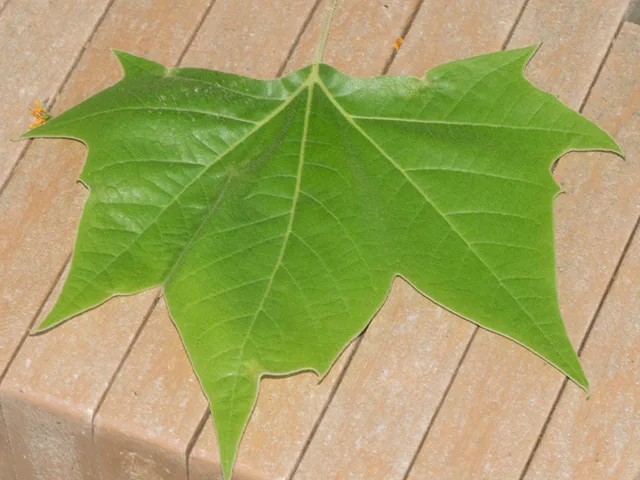
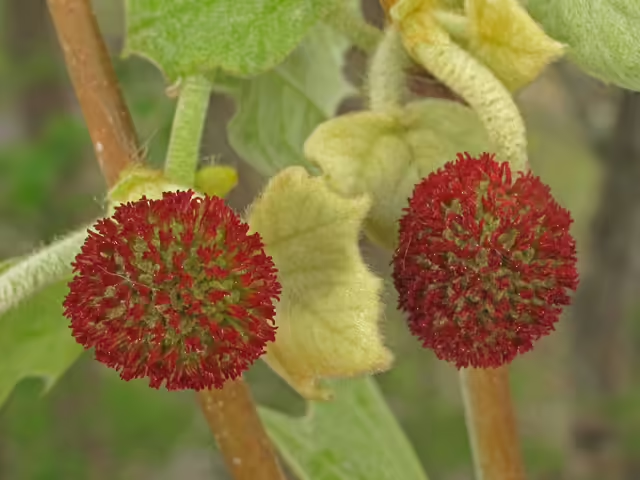
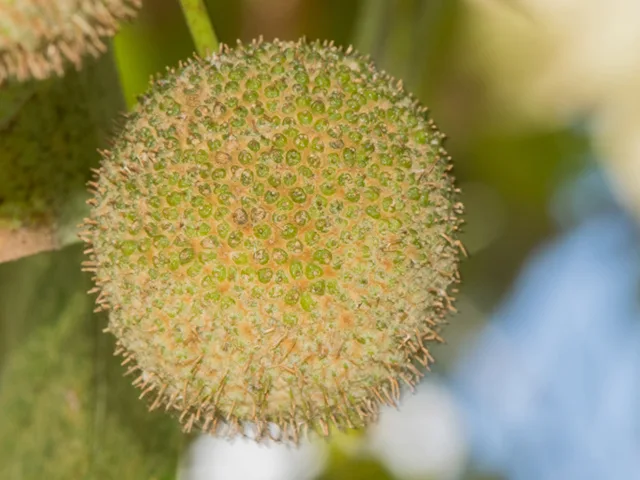
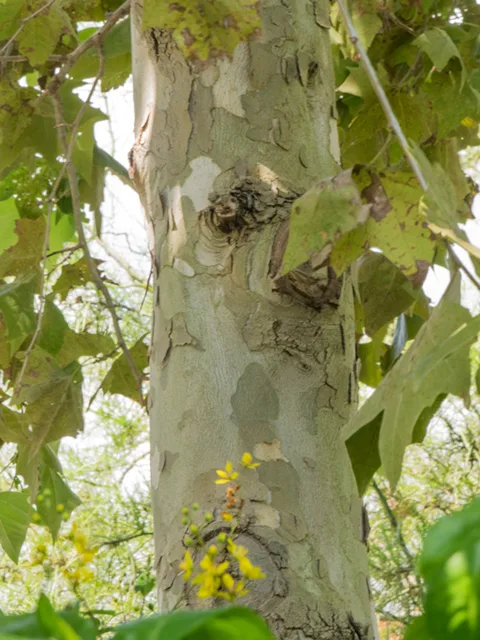
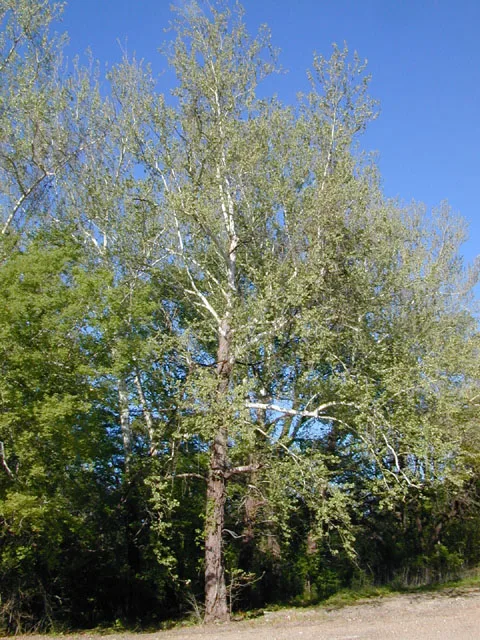
Blooms March-April. A very large, wide canopied tree with striking peeling, grey bark. Large, maple-shaped leaves turn brown in fall. Many tiny flowers occur in dense, spherical heads: the male flower heads short-stalked and dark red; the female flower heads long-stalked and greenish. The fruit is a small, brown, burr-like seed ball that hangs from a branch on a stalk. Provides nesting sites. Larval host: Great Purple Hairstreak, Tiger Swallowtail.
Previous Scientific Name(s): Platanus occidentalis var. glabrata
Material Treatment Method Collection References
Seed No Treatment Seeds which over-winter on tree and are planted in spring germinate quickly. Fruit is most easily collected after leaf drop. Dry heads, then place in bags and crush to separate seeds. https://www.wildflower.org/plants/result.php?id_plant=PLOC
Seed Stratification Stored seeds must be stratified. Two months cold stratification, at 41 degrees, improves germination. Sow it immediately in a cold frame. When they are large enough to handle, prick the seedlings out into individual pots and grow them on in the greenhouse for their first winter. Plant them out into their permanent positions in late spring or early summer, after the last expected frosts. It is best to harvest the seed in late winter or spring 1) https://pfaf.org/user/Plant.aspx?LatinName=Platanus+occidentalis 2) https://www.wildflower.org/plants/result.php?id_plant=PLOC
Softwood Cutting Get a planting container ready by filling it with potting soil. Using a pencil, poke a hole into this soil. Take off any leaves growing out of the bottom of the branch (but keep the buds). Dip the bottom of the cutting in a rooting hormone. Insert it into the hole. Water the potting soil. Place the cutting in a warm, sheltered spot in indirect light. Keep the potting soil moist until the cutting roots. The best way to do this is with a plastic "tent." Stick a small stake into the planting container and hang a clear plastic bag over it. Lift the plastic to mist the potting soil regularly. Once the cutting has put out roots about 1 inch long, take off the plastic tent. Continue to maintain an evenly moist soil. Transplant the rooted cutting to your yard next spring after frost danger has passed. Use a sharp knife to make your cut. Select a new-growth branch (it should have a pair of buds on the bottom and two pairs of leaves). Cut a shoot 6 to 8 inches long. https://www.thespruce.com/sycamore-tree-guide-5195579
Seed Scarification Break a pod open to remove its seed. Take off the fuzz attached to the seed. Pre-soak for 24 hours. Fill a planting container with seed-starting medium and moisten it. Sow seed and cover with 1/4 inch of seed-starting medium. Keep the medium moist. The seed will germinate in 15 days. Plant outdoors after the danger of frost has passed. Wait until the pods drop in spring so that nature takes care of any required stratification. https://www.thespruce.com/sycamore-tree-guide-5195579

About the Region

2026 Fall Symposium Logo

This low-elevations region of Texas extends inland from the barrier islands, about 60 or so miles, and stretches from Brownsville to Louisiana. In total, it covers about 9.5 million acres, with a high point of 150 feet in elevation. More than 1000 species of plants can be found in this region. On the southern end, species more common in Mexico (such as Sabal mexicana) and Central America occur.

The barrier islands provide us with dune systems, and clay flats to the inland side, which have species found in these areas alone. Many plants here, such as Ipomoea pes-caprae (beach morning glory), can be found throughout tropical regions of the globe. I’ve encountered the same species on the beaches of Guam.

Once inland, vast marshes and wet prairies occur. Occasionally, oak (Quercus fusiformis) groves can be found. Common grasses include species of Bothriochloa, Paspalum, and Sporobolus; eastern gamagrass (Tripsacum dactyloides); and switchgrass (Panicum species). Many rivers and creeks cut through the Gulf Prairies, and along these riparian areas various species of trees, Sabal minor, and other plants adapted to clay soils can be found. Due to overgrazing, farming, and fire suppression, woody species such as mesquite (Prosopis glandulosa) and huisache (Acacia farnesiana), and invasive species such as chinaberry (Melia azedarach), Brazilian pepper (Schinus terebinthifolius), and Chinese tallow (Sapium sebiferum) have increased and displaced our native flora.

Source: Wildflowers of Texas by Michael Eason