
Hackberry

Celtis laevigata

Other common name(s):

Sugarberry

Family:

Cannabaceae (Hemp Family)

Plant Ecoregion Distribution Map

This map uses data from the US EPA. EPA  servers have been offline frequently so maps may not display. We are working on a solution.

Cross Timbers, East Central Texas Plains, Edwards Plateau, Gulf Coast Prairies and Marshes, Southern Texas Plains, Southwestern Tablelands, Texas Blackland Prairies, Western Gulf Coastal Plain
Carbonate Cross Timbers, Eastern Cross Timbers, Grand Prairie, Limestone Cut Plain, Western Cross Timbers
Bastrop Lost Pines, Floodplains and Low Terraces2, Northern Post Oak Savanna, Northern Prairie Outliers, San Antonio Prairie, Southern Post Oak Savanna
Balcones Canyonlands, Edwards Plateau Woodland, Llano Uplift
Coastal Sand Plain, Floodplains and Low Terraces4, Laguna Madre Barrier Island and Coastal Marshes, Lower Rio Grande Alluvial Floodplain, Lower Rio Grande Valley, Northern Humid Gulf Coastal Prairies, Southern Subhumid Gulf Coastal Prairies, Texas-Louisiana Coastal Marshes
Northern Nueces Alluvial Plains, Rio Grande Floodplain and Terraces, Semiarid Edwards Bajada, Texas-Tamaulipan Thornscrub
Caprock Canyons Badlands Breaks
Floodplains and Low Terraces1, Northern Blackland Prairie, Southern Blackland Prairie
Flatwoods, Floodplains and Low Terraces3, Southern Tertiary Uplands

Plant Characteristics

Growth Form

Tree

Height

60
to
80
ft.

Spread

20
to
30
ft.

Leaf Retention

Deciduous

Lifespan

Perennial

Habitat and Care Requirements

Soil Type(s)

Caliche, Clay, Loam, Rich, Rocky, Sand

Light Requirement

Sun, Part Shade

Water Requirement

Low, Medium

Native Habitat

Riparian, Woodland Edge

Bloom and Attraction

Bloom Color

Green

Bloom Season

Spring

Seasonal Interest

Berry, Fall Color, Larval Host, Seeds

Wildlife Benefit

Birds, Butterflies

Maintenance

Some consider this a trash tree: the wood can become weak when infected with parasitic mistletoe and fallen branches damage buildings. On the other hand, it adapts well to poor-quality soils common in urban areas and is heat and drought tolerant. They provide shade that reduces electric bills; filtration of air pollution; and control of storm water and flooding. Prune weak limbs away from buildings. Remove Mistletoe from limbs. Add mulch to improve drought tolerance. Native habitat: thickets, open woodlands, stream and river banks, rich bottomland, flood plains, rocky slopes.

Description

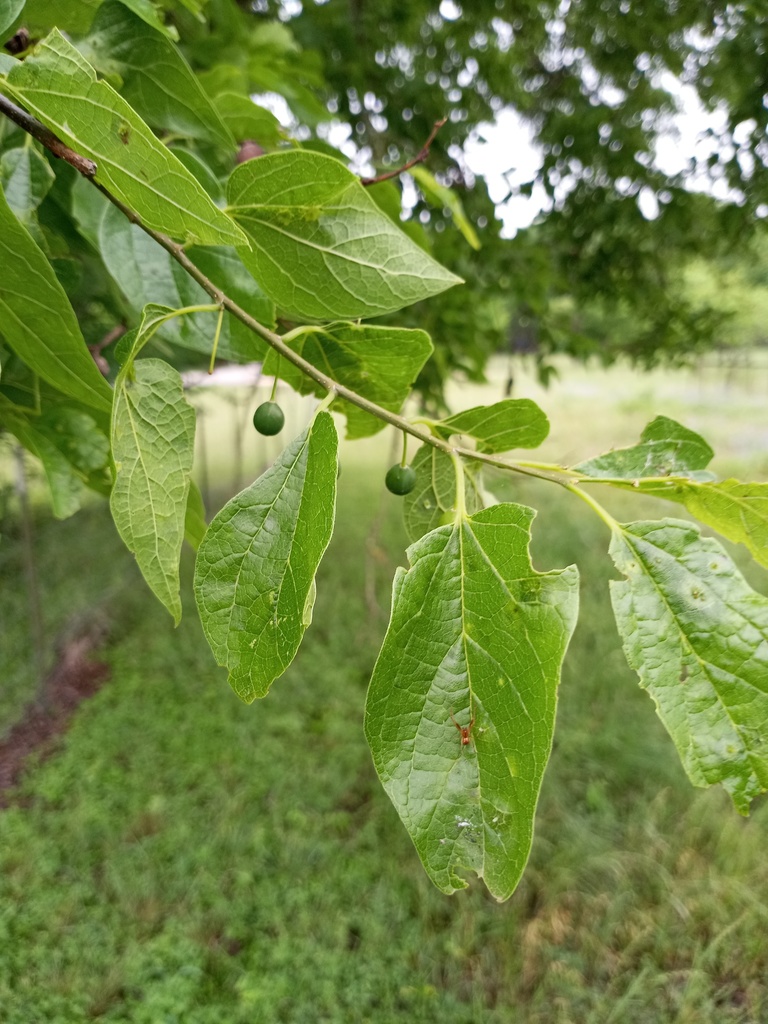
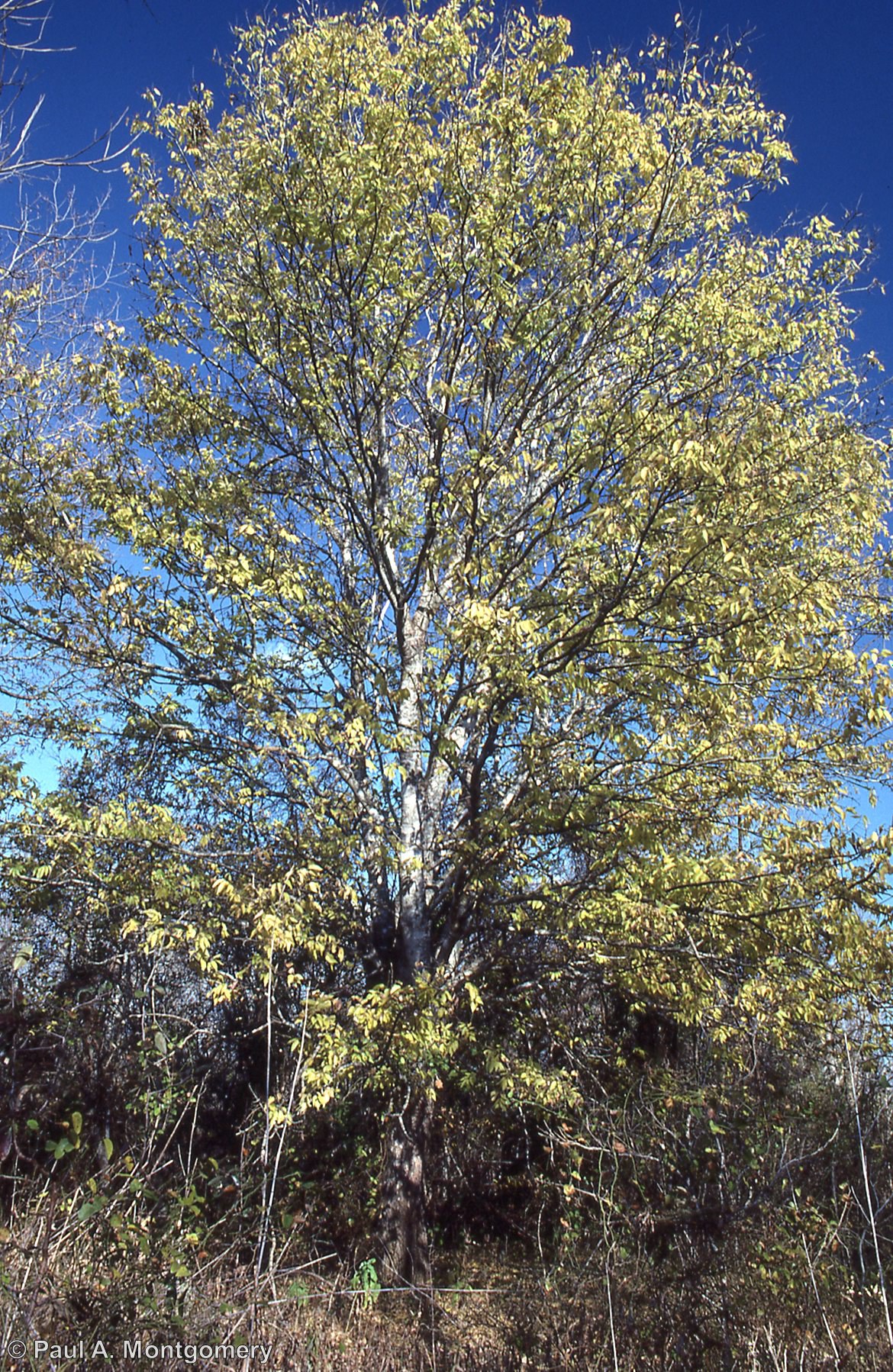
Blooms February-April. A medium-sized tree with light gray, smooth bark, covered with knobby warts as the tree ages. Leaves are lance-shaped, with a tapering tip and unequal base, which is narrow on one side and rounded on the other. Flowers are solitary or in small clusters at the base of leaves. The small, round fruit is reddish-brown, with a leathery coating. Larval host: Hackberry Emperor, American Snout, Morning Cloak, Question Mark butterflies. Replaces non-natives: Chinaberry.

References

Material Treatment Method Collection References
Seed Stratification Stratify 60-90 days at 41 degrees. Plant seeds ½ inch deep in a moist, loose, and well-drained bed.6 It is beneficial to mulch the seedbed with straw and leaves. If planted directly in the fall, establishment is between 3-5 months. If stratified seeds are planted in the spring or summer, establishment is about 12 weeks. Pick mature fruits in late summer until winter. Air-dry with pulp on or soak overnight and rub pulp off on screen. The seeds can be depulped by wet maceration. Depulping is not essential, but it has been reported to aid germination (1). Average germinative capacity is reported to be 55 percent for sugarberry. 1) https://www.wildflower.org/plants/result.php?id_plant=CELA 2) https://www.srs.fs.usda.gov/pubs/misc/ag_654/volume_2/celtis/laevigata.htm#:~:text=Seeds%20should%20be%20stratified%20in,fire%2Ddamaged%20seedlings%20and%20saplings. 3) chrome-extension://efaidnbmnnnibpcajpcglclefindmkaj/https://courses.washington.edu/esrm412/protocols/2011/CELA.pdf
Stem Cutting Sugarberry can be propagated by cuttings (7). Small stumps sprout readily, and there is some sprouting from root collars of fire-damaged seedlings and saplings. https://www.srs.fs.usda.gov/pubs/misc/ag_654/volume_2/celtis/laevigata.htm#:~:text=Seeds%20should%20be%20stratified%20in,fire%2Ddamaged%20seedlings%20and%20saplings.

About the Region

2026 Fall Symposium Logo

This low-elevations region of Texas extends inland from the barrier islands, about 60 or so miles, and stretches from Brownsville to Louisiana. In total, it covers about 9.5 million acres, with a high point of 150 feet in elevation. More than 1000 species of plants can be found in this region. On the southern end, species more common in Mexico (such as Sabal mexicana) and Central America occur.

The barrier islands provide us with dune systems, and clay flats to the inland side, which have species found in these areas alone. Many plants here, such as Ipomoea pes-caprae (beach morning glory), can be found throughout tropical regions of the globe. I’ve encountered the same species on the beaches of Guam.

Once inland, vast marshes and wet prairies occur. Occasionally, oak (Quercus fusiformis) groves can be found. Common grasses include species of Bothriochloa, Paspalum, and Sporobolus; eastern gamagrass (Tripsacum dactyloides); and switchgrass (Panicum species). Many rivers and creeks cut through the Gulf Prairies, and along these riparian areas various species of trees, Sabal minor, and other plants adapted to clay soils can be found. Due to overgrazing, farming, and fire suppression, woody species such as mesquite (Prosopis glandulosa) and huisache (Acacia farnesiana), and invasive species such as chinaberry (Melia azedarach), Brazilian pepper (Schinus terebinthifolius), and Chinese tallow (Sapium sebiferum) have increased and displaced our native flora.

Source: Wildflowers of Texas by Michael Eason