
Water Oak

Quercus nigra

Other common name(s):

Possum Oak, Duck Oak, Punk Oak, Spotted Oak

Family:

Fagaceae (Beech Family)

Plant Ecoregion Distribution Map

This map uses data from the US EPA. EPA  servers have been offline frequently so maps may not display. We are working on a solution.

East Central Texas Plains, Gulf Coast Prairies and Marshes, Western Gulf Coastal Plain
Northern Post Oak Savanna, Northern Prairie Outliers
Texas-Louisiana Coastal Marshes
Flatwoods, Floodplains and Low Terraces3, Pleistocene Fluvial Terraces, Red River Bottomlands, Southern Tertiary Uplands, Tertiary Uplands

Plant Characteristics

Growth Form

Tree

Height

80
to
100
ft.

Spread

50
to
60
ft.

Leaf Retention

Deciduous

Lifespan

Perennial

Habitat and Care Requirements

Soil Type(s)

Clay, Deep, Loam, Moist, Poor Drainage, Sand

Light Requirement

Sun, Part Shade

Water Requirement

High

Native Habitat

Riparian, Sand Dunes & Beaches, Woodland

Bloom and Attraction

Bloom Color

Yellow

Bloom Season

Spring

Seasonal Interest

Fall Color, Larval Host, Nesting Material, Nuts, Pollen

Wildlife Benefit

Birds, Butterflies, Small Mammals

Maintenance

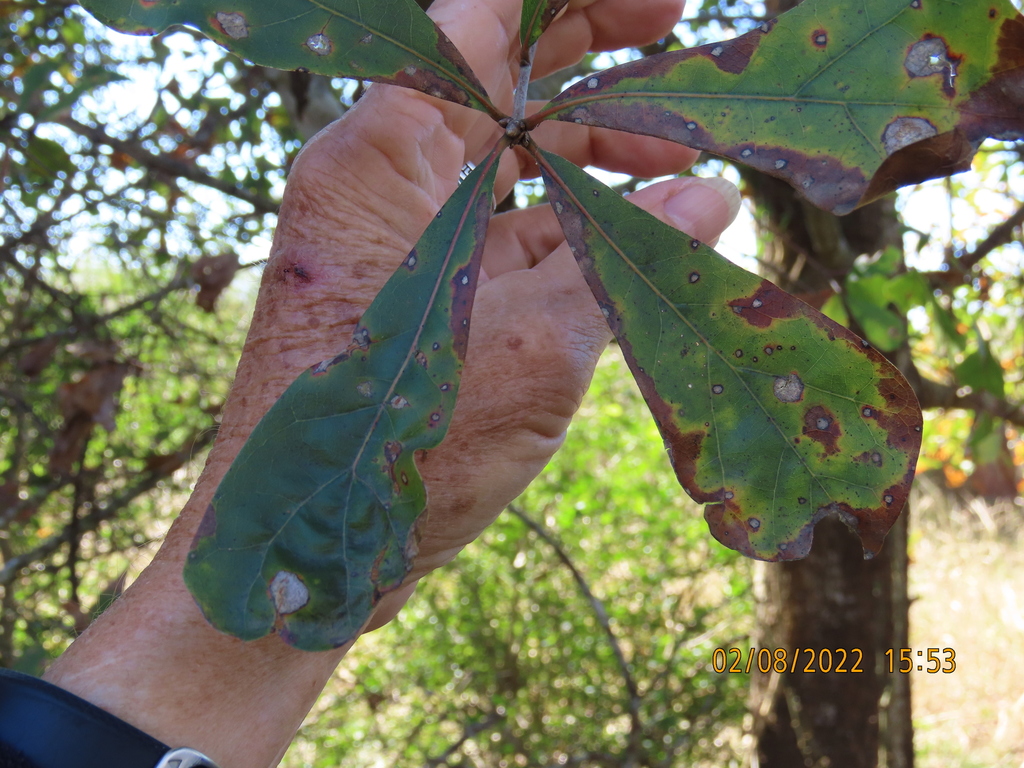
Fast growth rate, easily transplantable shade tree, but short-lived. Weak limbed and vulnerable to wind and ice damage. Also subject to Pine-oak rusts and leaf blister. Leaves provides yellow color in the fall. It is in the red oak group and therefore more susceptible to oak wilt. Prune only during the hottest and coldest months. Paint pruning wounds to help prevent oak wilt. Native habitat: moist forests, waterways, dunes, hammocks, and low ridges to steep slopes.

Description

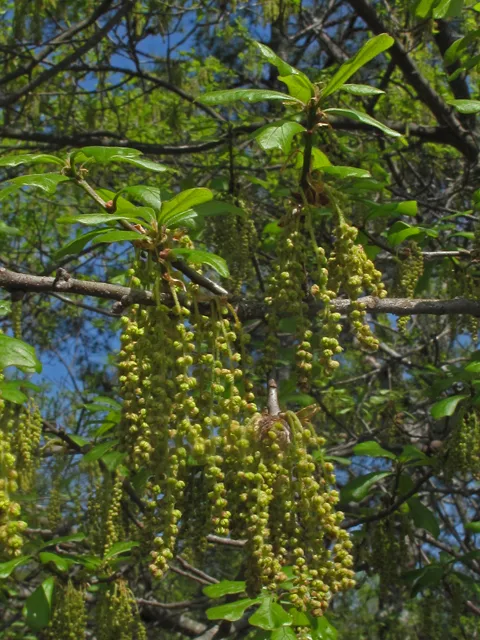
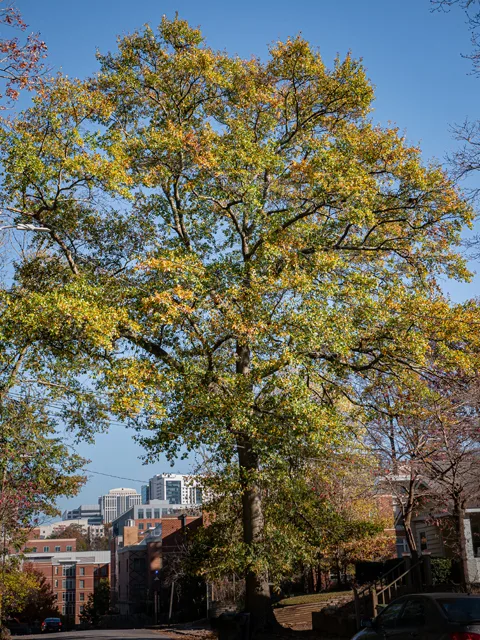
Blooms March-May. The tree has a nice conical shape. Leaves are dark green and wedge-shaped. Tiny flowers are clustered on catkins. The fruit is an acorn that develops in two years. Larval host: Horace’s Duskywing, White M hairstreak, Northern Hairstreak.
Previous Scientific Name(s): Quercus microcarya, Quercus nigra var. heterophylla
Material Treatment Method Collection References
Seed No Treatment Best if sown immediately as acorns lose viability quickly in storage. Plant immediately outdoors or in deep containers to accomodate long initial taproot. Best quality acorns are picked or shaken from the tree. Collect when color has changed to brown. Trees bear seed at about age 20 and production seems to alternate between prolific and lean years. Generally, viable acorns sink in water, while those that float probably will not germinate. 1) https://www.wildflower.org/plants/result.php?id_plant=QUNI 2) https://www.srs.fs.usda.gov/pubs/misc/ag_654/volume_2/quercus/nigra.htm#:~:text=Under%20natural%20conditions%2C%20they%20germinate,a%20shallow%2C%20spreading%20rooting%20habit.
Seed Stratification Under controlled conditions, water oak acorns require a pregermination treatment to overcome dormancy. Under natural conditions, they germinate the spring following maturation. They may be induced to germinate by stratification for 30 to 40 days in moist sand at 30° to 32° C (86° to 90° F) during light cycles and for a 52- to 73-day period at 20° to 21° C (68° to 70° F) during dark cycles. Expect 60 to 94 percent germination after 31 to 73 days. Seedlings require abundant moisture the entire growing season but do not tolerate prolonged submersion. Under optimum conditions water oak grows at a rate of 60 cm (24 in) per year for the first 25 years. Best quality acorns are picked or shaken from the tree. Collect when color has changed to brown. Trees bear seed at about age 20 and production seems to alternate between prolific and lean years. Generally, viable acorns sink in water, while those that float probably will not germinate. 1) https://www.srs.fs.usda.gov/pubs/misc/ag_654/volume_2/quercus/nigra.htm#:~:text=Under%20natural%20conditions%2C%20they%20germinate,a%20shallow%2C%20spreading%20rooting%20habit. 2) https://npn.rngr.net/renderNPNProtocolDetails?selectedProtocolIds=fagaceae-quercus-2022

About the Region

2026 Fall Symposium Logo

This low-elevations region of Texas extends inland from the barrier islands, about 60 or so miles, and stretches from Brownsville to Louisiana. In total, it covers about 9.5 million acres, with a high point of 150 feet in elevation. More than 1000 species of plants can be found in this region. On the southern end, species more common in Mexico (such as Sabal mexicana) and Central America occur.

The barrier islands provide us with dune systems, and clay flats to the inland side, which have species found in these areas alone. Many plants here, such as Ipomoea pes-caprae (beach morning glory), can be found throughout tropical regions of the globe. I’ve encountered the same species on the beaches of Guam.

Once inland, vast marshes and wet prairies occur. Occasionally, oak (Quercus fusiformis) groves can be found. Common grasses include species of Bothriochloa, Paspalum, and Sporobolus; eastern gamagrass (Tripsacum dactyloides); and switchgrass (Panicum species). Many rivers and creeks cut through the Gulf Prairies, and along these riparian areas various species of trees, Sabal minor, and other plants adapted to clay soils can be found. Due to overgrazing, farming, and fire suppression, woody species such as mesquite (Prosopis glandulosa) and huisache (Acacia farnesiana), and invasive species such as chinaberry (Melia azedarach), Brazilian pepper (Schinus terebinthifolius), and Chinese tallow (Sapium sebiferum) have increased and displaced our native flora.

Source: Wildflowers of Texas by Michael Eason