The hint of fall in the morning air makes me want to get back outside with the native plants. A few plants that didn’t survive the exceptional drought in our yard need to be replaced, and October will be a good time to plant wildflower seeds in hopes that a few autumn rains will bring a pretty spring in 2010. Also, fall is the best time to plant native shrubs and trees.
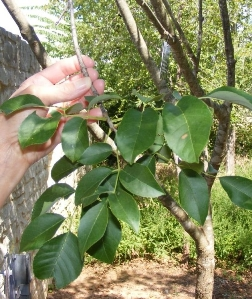
For our October Plant of the Month, the Boerne Chapter’s Operation NICE! (Natives Instead of the Common Exotics!) is highlighting the small tree Texas ash (Fraxinus texensis or F. americana var. texensis). This is a handsome shade tree getting up to 30-45 feet high. Once established, Texas ash is drought-tolerant.
The dark-green leaves are opposite and compound with five to seven leaflets. During fall the foliage has nice color. “With redder shades on the outside and yellows on the inside, the whole tree looks like a candle flame” (Sally Wasowski, “Native Texas Plants, Landscaping Region by Region”).
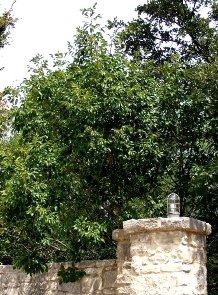
Many botanists believe Texas ash is a variety of white ash (Fraxinus americana), from which it is hard to distinguish. Texas ash has five to seven leaflets, typically 5, while white ash has five to nine elongate leaflets, typically 7. White ash, native to the eastern part of the state, can grow to be a larger tree than Texas ash.
Texas ash is endemic to limestone areas of southern Oklahoma down through North Central Texas and across the Edwards Plateau, including Kendall County. Some Texas ash trees also grow in the Ft. Davis area. Texas ash should do very well in Boerne-area yards.
This tree is adapted to well-drained calcareous soils. It is hardy, fairly fast growing, long-lived and fairly resistant to pests and disease, and it is the most drought-tolerant of the ashes usually available at nurseries.
The Boerne Chapter of the Native Plant Society of Texas provides free planting and care instructions for Texas ash at nurseries participating in Operation NICE! (Hill Country African Violets & Nursery and Maldonado Landscape & Nursery) and at Cibolo Nature Center.
The most commonly planted (some say overplanted) ash in local landscapes is the non-indigenous Mexican or “Arizona ash” (F. berlandandieriana), which requires a lot of irrigation, is susceptible to pests and disease, does not have fall color, and is short-lived. Texas ash is a better choice for home gardeners as well as for landscapers and developers in this area.
What’s blooming in our yard now?
It seemed that within hours of the first rains the week before last, several of our backyard plants burst into bloom. They had been waiting out the drought long enough.
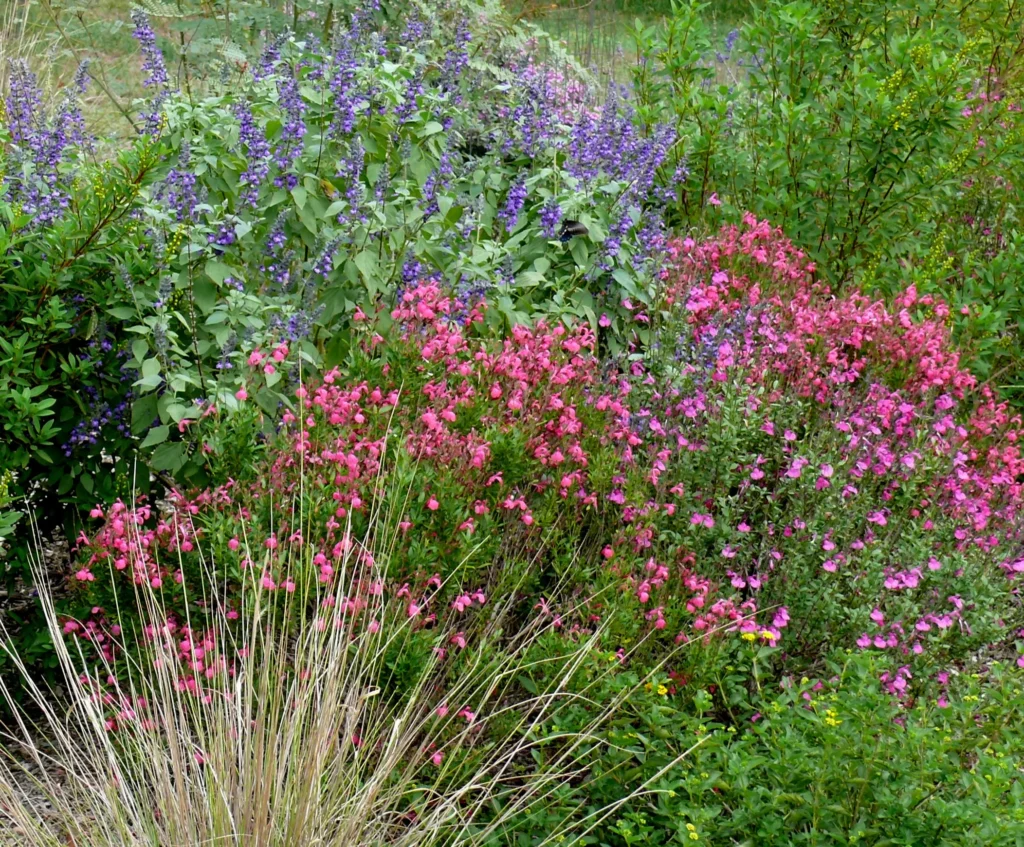
Rain lilies and both the blue and white common wild petunias were the first. Salvia greggii was close behind. Also blooming now are mealy sage, tropical sage, giant blue sage, Salvia leucantha, indigo spires, Barbados cherry, pigeon berry, turk’s cap, cenizo, snow-on-the mountain, greeneyes, Lindheimer’s senna, esperanza, evergreen sumac, beebrush, snapdragon vine, and chile piquin.
The butterflies and hummingbirds have some nectar now! What a difference in two weeks!