

By Delmar Cain
Desert willow. Isn’t that a wonderful name for a tree in the Southwest? It evokes a cool and refreshing spot to find relief from the sun in a hot dry climate. But it was more than just a cool name that induced the Boerne Chapter of NPSOT to select the Desert willow (Chilopsis linearis), as the NICE (Natives Instead of Common Exotics) plant of the month for May.
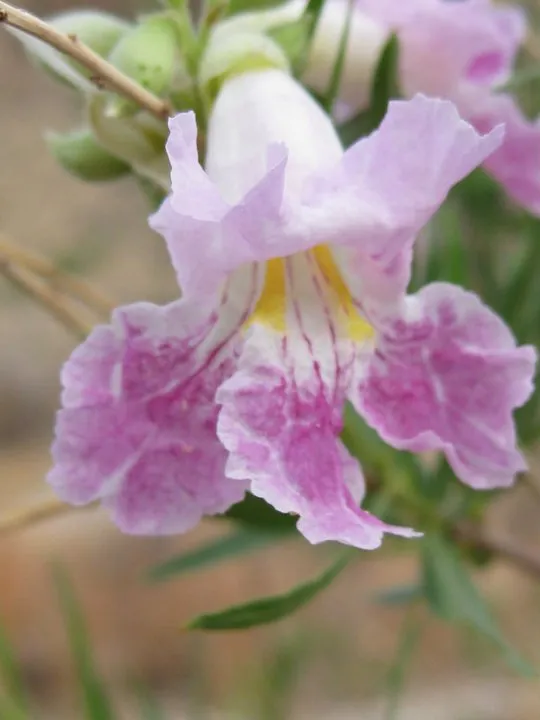
Some of its other names may provide a clue. Also called flowering willow and willow-leaved catalpa, the desert willow is a flowering fast-growing small tree that is native to the dry streambeds and arroyos of West Texas into California and Mexico. Its showy flowers, its ability to tolerate poor soils and its tolerance for drought, when established, should put it on everyone’s list in this time of climate uncertainty.
In spite of its names it is not a willow or in the Salix Genus, which includes willows. Its leaves, which are long and narrow, are willow-like and may be, along with its native habitat in dry streambeds, one of the better explanations for its common names. But desert willow is actually in the Trumpet-creeper Family (Bignoniacea), which also includes a relative, the catalpa tree (Catalpa bignonioides).
Like the catalpa tree, the desert willow produces showy, fragrant trumpet-shaped flowers. (In spite of the flowers the true reason that my dad planted catalpa trees at our home in East Texas was because the “catalpa worms” on the trees, actually caterpillars of the Catalpa Sphinx moth (Deratomia catalpae) were considered the best catfish bait around.) Unlike the catalpa, the desert willow has supple, flexible willow like limbs.
The desert willow is deciduous, fast growing and may reach a mature height of 25 feet. It is found growing in its native habitat in well-drained limestone soil. It will tolerate other soils, including loams and clays. But it appears to bloom better in places where its roots can dry between infrequent watering, as it would have in its western environment. Its blooms will attract hummingbirds, butterflies and the White-winged moth, for which it is a host plant.
What color are the flowers? There are some choices, according to Jill Nokes, as discussed in her book, How To Grow Native Plants of Texas and of the Southwest. Some of the more attractive specimens have been cloned for the nursery trade. Benny Simpson at the Texas A&M Research and Extension Center in Dallas developed two for ornamental use. White Storm has pure white blossoms; and Dark Storm has dark pink-magenta flowers. Paul Cox found one in San Antonio that has dark purple flowers and a more robust trunk, now appropriately named Bubba.
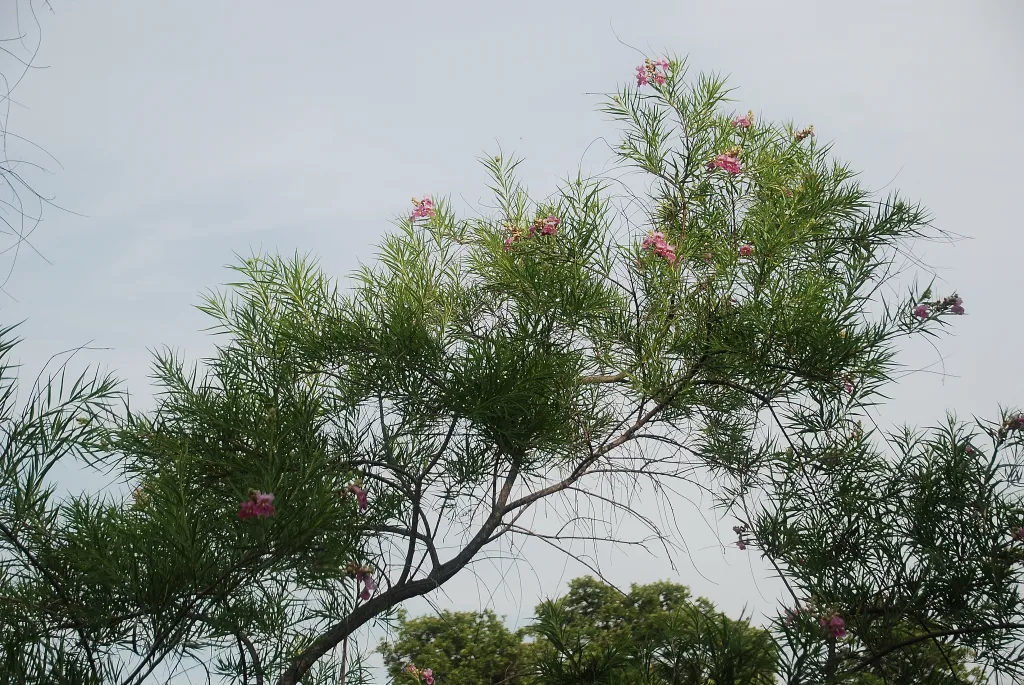
Others that might be available include one with a two-toned white and magenta flower, one with light lavender flowers in large clusters and one that produces a light crop of seed pods. If you have a definite color in mind, just be certain that you do research on the variety that is on hand where you are shopping.
Don’t worry about the cold hardiness of the desert willow. It can stand temperatures down to 10 degrees Fahrenheit. I guess that it is still possible to see that kind of low temperature in our area. Other than an occasional watering in drought conditions, the only other care needed is a careful pruning from time to time, if you are interested in having a single trunk tree. Some trees will develop a single trunk on their own, but others may develop into a more bushy form with several stems. Either form will give your yard esthetic appeal. For more detailed planting instructions visit the Boerne NPSOT website at: http://www.npsot.org/wp/boerne/
Speaking of esthetic appeal, it is hard to imagine a county in Texas that can compare with the natural beauty of Kendall County. But I do sometimes wonder if we take full advantage of that natural beauty. For instance, along the public right-of-ways, some wildflowers get mowed while others are allowed to grow and be glorious. I think if I were in charge, which certainly I am not, having our visitors say that our roads, both state and county, are the prettiest in Texas would by one of my highest priorities.
I know that there are many things to consider. Invasive plants along the road need to be discouraged, sight distances are important for safety and dead plants can provide fuel for wildfires. But irregular and patchwork mowing by landowners on the public shoulders leaves inconsistent and uneven results. Leaving beautiful flowers on public property seems like a good idea to me. If you want to compare the difference in mowing and letting nature beautify a road, drive the 474 from Boerne to the intersection of 473. That short trip on a state maintained road might help you decide which is more attractive.
