

by Les Barnes – Boerne Chapter, Native Plant Society of Texas
Published in the Boerne Star on October 17, 2014
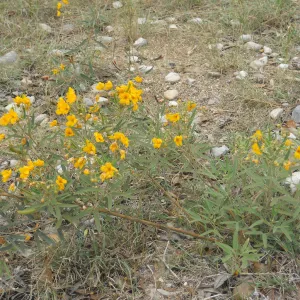
About six years ago while walking near the road shoulder by my place at Fair Oaks Ranch, I noticed a small bush with bright yellow-gold flowers.
Twoleaf senna (Senna roemariana), named for German geologist/botanist Ferdinand Roemer who collected specimens in the New Braunfels area in the 1840’s, grows normally from 12 to 18 inches tall with a 12 to 18 inch spread and flowers throughout the summer with bloom cycles extending into the early fall.
One would not consider the roadside with rocky road base an environment for any plant, but this one seems to thrive there. It receives no supplemental water, gets chopped down periodically by the city mowers and yet comes back year after year covered in those brilliant yellow flowers. Some folks say that cutting back (did I mention mowers?) in late summer can also produce fall blooms but just doing nothing and letting the plant do its thing has seemed to work just fine.
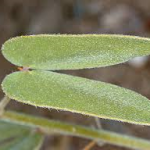
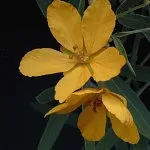
The flowers are smallish, one to two inches, but their abundance and brightness make the plant stand out. The foliage is dull green with the leaves being two to three inches long and uniquely divided into two scissor-like leaflets along a long stalk.
Twoleaf senna grows natively in the Texas Hill Country and absolutely loves the limestone soil. It is also found in Central Texas and West Texas growing predominately on limestone outcroppings. It must have loose, well-drained soil preferring direct sun but will grow in partial shade and is very drought tolerant. Detrimental to its growth is too much TLC in a garden setting. As the Beatles said — let it be!
Twoleaf senna spreads by seeds without any additional help. In fact attempts to collect seeds and propagate through plantings have not proven successful for me. Just collecting seeds and broadcasting them in late spring seems to work well, and I now have several stands of Twoleaf senna throughout my place.
Collecting seeds that will have a high rate of propagation requires a bit of vigilance and patience. Seed pods must be allowed to turn brown and dry but must be collected before the pods have split open. Local plant stores in Boerne and San Antonio do not have this plant, much less seeds, but they can be ordered online.
The plant beside the road at my place self-sows freely. To control spreading, just deadhead after blooming. Unless you want to scatter seeds in a new area or keep it contained to a specific area, my advice is just to enjoy the beauty of the plant and leave everything to nature.
A word of advice: senna may be poisonous to livestock (cattle and goats) causing diarrhea, loss of appetite, and weakness. In very severe cases some ranchers have reported deaths but there is very little documentation concerning these allegations. However, at Fair Oaks Ranch, with its well-known large population of white tail and axis deer, I have noticed no grazing of this plant. That being said, senna is collected for its medicinal uses, its seeds are a food source for birds, and it is the larval host to various “Sulphur” butterflies.
We are currently experiencing severe heat and drought, but take a look along the roadways and rocky hillsides near you. There’s a good chance you will see this little beauty standing tall.
Les Barnes is a long-time member of the Boerne Chapter of the Native Plant Society of Texas. Meetings are held the first Tuesday of each month September through June beginning at 6:30pm. Public is welcome. For more information and meeting details, visit www.www.npsot.org/boerne.
