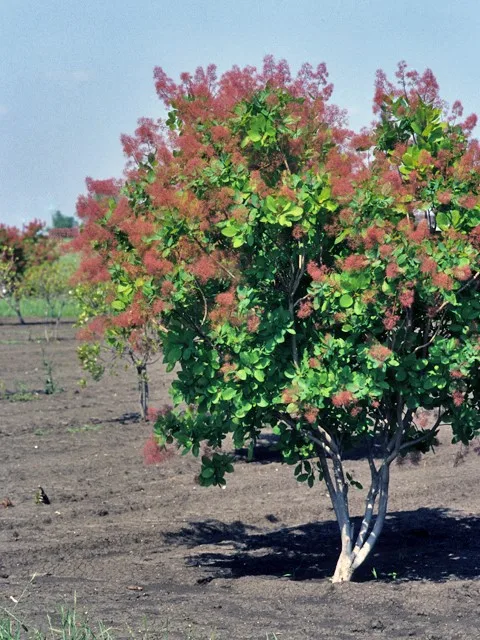


American Smoketree

Cotinus obovatus

Other common name(s):

Texas Smoke Tree, Wild Smoke Tree, Smoke Tree, Smokebush, Chittamwood

Family:

Anacardiaceae (Sumac Family)

Plant Ecoregion Distribution Map

This map uses data from the US EPA. EPA  servers have been offline frequently so maps may not display. We are working on a solution.

Edwards Plateau
Balcones Canyonlands

Plant Characteristics

Growth Form

Tree

Height

15
to
25
ft.

Spread

15
to
25
ft.

Leaf Retention

Deciduous

Lifespan

Perennial

Habitat and Care Requirements

Soil Type(s)

Clay, Dry, Limestone, Loam, Rocky, Sand, Well Drained

Light Requirement

Sun, Part Shade

Water Requirement

Low

Native Habitat

Woodland

Bloom and Attraction

Bloom Color

Pink, Purple, Yellow

Bloom Season

Spring

Seasonal Interest

Berry, Fall Color, Forage, Nesting Material

Wildlife Benefit

Birds, Browsers

Maintenance

Slow growing. This is an excellent small, ornamental tree that thrives in tough conditions and neglect and makes an excellent small yard tree. Rich soil and too much water may create a weak plant. It is drought tolerant, but needs supplemental water to get established. Native habitat: hillsides; limestone outcrops, rocky woods, east-facing slopes or on the protected side of Ashe Junipers.

Description

Blooms April-May. A small tree or multi-trunked shrub. Has a short trunk, open crown of spreading branches, and resinous sap with a strong odor. Spring leaves are silky pink, turning bluish-to-dark green. Fall leaves turn vibrant shades of red, orange, yellow and purple. Smoketree gets its common name from the billowy hairs attached to elongated stalks on the spent flower clusters. These hairs turn a smoky-pink to purplish-pink in summer, covering the tree with fluffy, hazy, smoke-like puffs. Berries occur on pinkish stems and then dry to small dark seeds.
Previous Scientific Name(s): Cotinus americanus
Material Treatment Method Collection References
Seed No Treatment Sow direct in soil in the spring. May take two springs to sprout. To collect seeds before wind dispersion, clip the entire fruiting panicle from the tree in late April. Collect enough to compensate for a high percentage of infertile seed. Air-dry before storing or planting. When dried, fuzzy panicle are easily detached. https://www.wildflower.org/plants/result.php?id_plant=COOB2
Seed Scarification Scarify in a 20-40 minute concentrated sulfuric acid treatment. Or soak them for 12 hours, change the water, then soak them for another 12 hours. After that, allow the seeds to dry in the open air. After all danger of frost is over, plant the seeds in well-drained, sandy soil in a sunny spot in the garden. Press each seed 3/8 inch (1 cm.) into the soil, a good distance apart. Irrigate gently and keep the soil moist. Be patient. Propagating a smoke tree by seed can take up to two years before you see growth. 1) https://www.wildflower.org/plants/result.php?id_plant=COOB2 2) https://www.gardeningknowhow.com/ornamental/trees/smoke-tree/smoke-tree-propagation-methods.htm
Seed Stratification Moist stratification for 150 days. Follow with 60-80 days of stratification at 38-41 degrees. https://www.wildflower.org/plants/result.php?id_plant=COOB2
Semi-harwood Cutting Remove the lower leaves, then strip off a little bark on the bottom end of the cutting and dip the wound in root hormone. Prepare a pot with a good draining growing medium. Place stakes in the corners of your pot then cover it with a plastic bag. Keep the medium moist. When they start rooting, transfer them to a larger pot. Taken in spring after flowering. The wood should not be the new growth. It should snap cleanly when you bend it. Take cuttings about the length of your palm during summer. Take them early in the day when the plant is full of water. 1) https://www.wildflower.org/plants/result.php?id_plant=COOB2 2) https://www.gardeningknowhow.com/ornamental/trees/smoke-tree/smoke-tree-propagation-methods.htm

About the Region

2026 Fall Symposium Logo

This low-elevations region of Texas extends inland from the barrier islands, about 60 or so miles, and stretches from Brownsville to Louisiana. In total, it covers about 9.5 million acres, with a high point of 150 feet in elevation. More than 1000 species of plants can be found in this region. On the southern end, species more common in Mexico (such as Sabal mexicana) and Central America occur.

The barrier islands provide us with dune systems, and clay flats to the inland side, which have species found in these areas alone. Many plants here, such as Ipomoea pes-caprae (beach morning glory), can be found throughout tropical regions of the globe. I’ve encountered the same species on the beaches of Guam.

Once inland, vast marshes and wet prairies occur. Occasionally, oak (Quercus fusiformis) groves can be found. Common grasses include species of Bothriochloa, Paspalum, and Sporobolus; eastern gamagrass (Tripsacum dactyloides); and switchgrass (Panicum species). Many rivers and creeks cut through the Gulf Prairies, and along these riparian areas various species of trees, Sabal minor, and other plants adapted to clay soils can be found. Due to overgrazing, farming, and fire suppression, woody species such as mesquite (Prosopis glandulosa) and huisache (Acacia farnesiana), and invasive species such as chinaberry (Melia azedarach), Brazilian pepper (Schinus terebinthifolius), and Chinese tallow (Sapium sebiferum) have increased and displaced our native flora.

Source: Wildflowers of Texas by Michael Eason