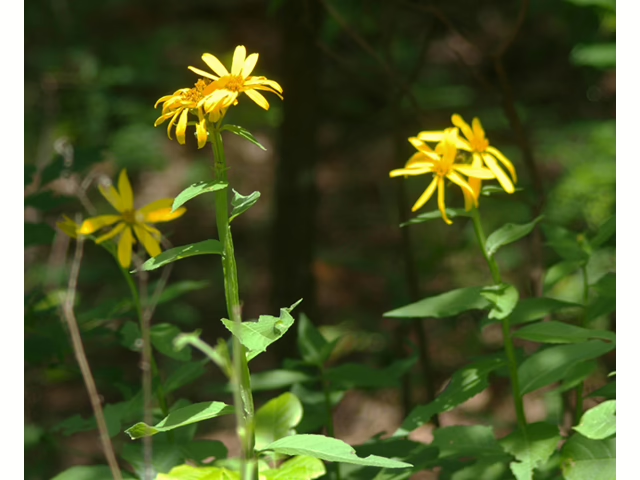

Gravelweed

Verbesina helianthoides

Other common name(s):

Gravelweed Crownbeard, Yellow Crownbeard

Family:

Asteraceae (Aster Family)

Plant Ecoregion Distribution Map

This map uses data from the US EPA. EPA  servers have been offline frequently so maps may not display. We are working on a solution.

East Central Texas Plains, Western Gulf Coastal Plain
Northern Post Oak Savanna, Northern Prairie Outliers
Flatwoods, Pleistocene Fluvial Terraces, Red River Bottomlands, Southern Tertiary Uplands, Tertiary Uplands

Plant Characteristics

Growth Form

Herbaceous

Height

2
to
4
ft.

Spread

1
to
2
ft.

Leaf Retention

Deciduous

Lifespan

Perennial

Habitat and Care Requirements

Soil Type(s)

Dry, Moist, Rocky, Sand

Light Requirement

Sun, Part Shade

Water Requirement

Low

Native Habitat

Disturbed Areas, Woodland

Bloom and Attraction

Bloom Color

Yellow

Bloom Season

Spring, Summer

Seasonal Interest

Larval Host, Nectar, Pollen

Wildlife Benefit

Bees, Butterflies, Moths

Maintenance

Drought tolerant and hardy wildflower, Because it spreads by underground rhizomes, it is not suitable for conventional flower bed, but rather for naturalization in meadows, as erosion control, in woodland edges, light woodland gardens or places with shallow or infertile soils. Native habitat: moist places in sandy, pine woodlands, post-oak woodlands, disturbed places

Description

Blooms May-July. Clump forming. Winged stems with somewhat fuzzy, oval to lance-shaped leaves, and toothed margins. Yellow daisy-like flowers. Larval host: Silvery Checkerspot Butterfly and Gold Moth.
Previous Scientific Name(s): Actinomeris helianthoides, Actinomeris helianthoides var. elliottii, Actinomeris helianthoides var. nuttallii, Actinomeris oppositifolia, Phaethusa helianthoides, Pterophyton helianthoides
Material Treatment Method Collection References
Seed No Treatment WhilDirectly sow seeds into the garden after the last frost. Or start seeds indoors 6-8 weeks before the last frost to give them a head start. Use a seed starting mix and sprinkle the seeds on the surface, pressing them in lightly. These seeds need light to germinate, so avoid burying them deep. Keep the soil consistently moist and place the seed tray in a warm, brightly lit location, out of direct sunlight. Germination can take a while, sometimes up to 4 weeks, so don’t lose hope. Once your seedlings have developed a couple of sets of true leaves and the risk of frost has passed, it’s time to acclimate them to outdoor conditions. This process involves gradually introducing them to sunlight and wind over a week or two. Choose a sunny location with well-draining soil. Space your seedlings about 1 to 2 feet apart to allow for their mature size. Water well after planting and keep the soil consistently moist as they establish themselves. 1) https://propagate.one/how-to-propagate-verbesina-helianthoides/ 2) https://earthone.io/plant/verbesina%20occidentalis
Clump Division Use a sharp, clean garden knife or spade to divide the plant into smaller sections, making sure each section has a good amount of roots and shoots. Replant the divisions at the same depth they were previously growing, spacing them according to their mature size. Water thoroughly and keep the soil moist until new growth emerges. Carefully dig up a mature plant, ensuring you get as much of the root system as possible. 1) https://propagate.one/how-to-propagate-verbesina-helianthoides/ 2) https://earthone.io/plant/verbesina%20occidentalis

About the Region

2026 Fall Symposium Logo

This low-elevations region of Texas extends inland from the barrier islands, about 60 or so miles, and stretches from Brownsville to Louisiana. In total, it covers about 9.5 million acres, with a high point of 150 feet in elevation. More than 1000 species of plants can be found in this region. On the southern end, species more common in Mexico (such as Sabal mexicana) and Central America occur.

The barrier islands provide us with dune systems, and clay flats to the inland side, which have species found in these areas alone. Many plants here, such as Ipomoea pes-caprae (beach morning glory), can be found throughout tropical regions of the globe. I’ve encountered the same species on the beaches of Guam.

Once inland, vast marshes and wet prairies occur. Occasionally, oak (Quercus fusiformis) groves can be found. Common grasses include species of Bothriochloa, Paspalum, and Sporobolus; eastern gamagrass (Tripsacum dactyloides); and switchgrass (Panicum species). Many rivers and creeks cut through the Gulf Prairies, and along these riparian areas various species of trees, Sabal minor, and other plants adapted to clay soils can be found. Due to overgrazing, farming, and fire suppression, woody species such as mesquite (Prosopis glandulosa) and huisache (Acacia farnesiana), and invasive species such as chinaberry (Melia azedarach), Brazilian pepper (Schinus terebinthifolius), and Chinese tallow (Sapium sebiferum) have increased and displaced our native flora.

Source: Wildflowers of Texas by Michael Eason