
July Houston Chapter Meeting

Nature Loves You, Too with Dante Enrique Dominguez

Join us for Nature Loves You, Too with Dante Enrique Dominguez. In this talk, Dante hopes to start a conversation about what nature can offer us all, and how wilderness can bring us peace, healing, and community. In this discussion, he will challenge us to be vulnerable with one another and make connections with our fellow humans. In a world of increasing global devastation and anxieties, he hopes we will dare to carry radical hope for our environment and ourselves.

About the Speaker: Dante Enrique Dominguez

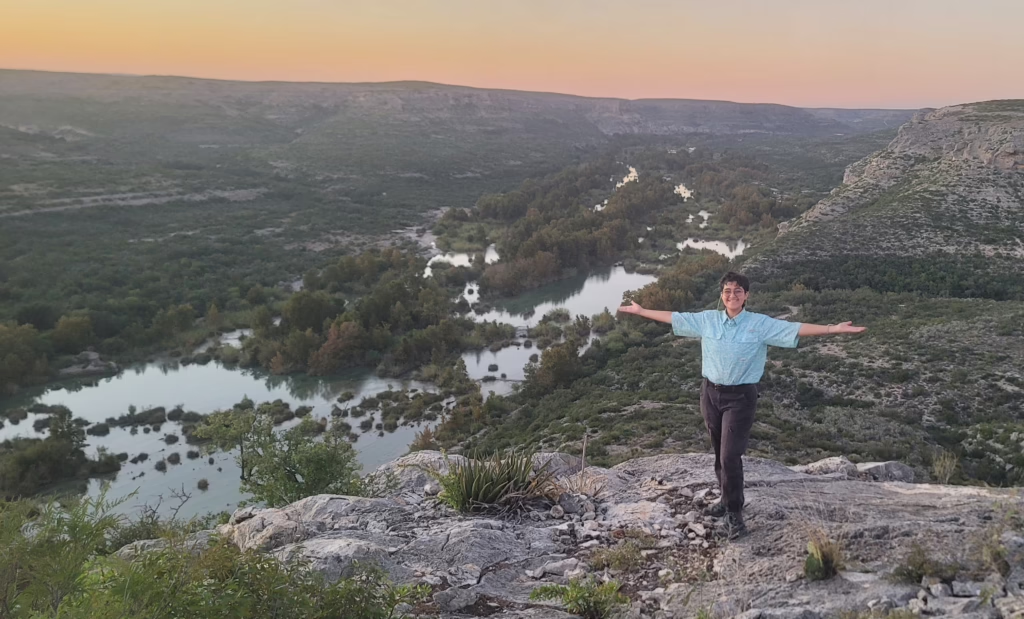
Dante is is an ecologist in training and emerging artist. He is passionate about lifelong learning and serving the environment however he can. After facing relentless struggles with his mental health and feeling adrift after graduating high school, he rediscovered and reconnected with nature and parts of himself he thought were extinct. Besides being an aspiring ecologist and scientist he, first and foremost, aims to be a nexus for peace and to inspire others to rejoice in wilderness and realize that they are indistinguishable and inseparable from it.

Our monthly chapter meetings are held on every 3rd Thursday, January – November. Our meetings are free and open to the public thanks to our members and sponsors.

The presentation will start at 7:00 pm, but come at 6:45 pm for a meet and greet with snacks.

Houston Arboretum and Nature Center

610 Entrance (preferred)
120 W Loop N Fwy
Houston, TX 77024

Woodway Entrance
4501 Woodway Drive
Houston, TX 77024

Meetings will also be live-streamed and recorded for later viewing.

Return to Houston Chapter Page

Date
Jul 16 2026
Expired!
Time
7:00 pm - 9:00 pm
Cost
$
More Info
Read More
Organizer
Houston Calendar

About the Region

2026 Fall Symposium Logo

This low-elevations region of Texas extends inland from the barrier islands, about 60 or so miles, and stretches from Brownsville to Louisiana. In total, it covers about 9.5 million acres, with a high point of 150 feet in elevation. More than 1000 species of plants can be found in this region. On the southern end, species more common in Mexico (such as Sabal mexicana) and Central America occur.

The barrier islands provide us with dune systems, and clay flats to the inland side, which have species found in these areas alone. Many plants here, such as Ipomoea pes-caprae (beach morning glory), can be found throughout tropical regions of the globe. I’ve encountered the same species on the beaches of Guam.

Once inland, vast marshes and wet prairies occur. Occasionally, oak (Quercus fusiformis) groves can be found. Common grasses include species of Bothriochloa, Paspalum, and Sporobolus; eastern gamagrass (Tripsacum dactyloides); and switchgrass (Panicum species). Many rivers and creeks cut through the Gulf Prairies, and along these riparian areas various species of trees, Sabal minor, and other plants adapted to clay soils can be found. Due to overgrazing, farming, and fire suppression, woody species such as mesquite (Prosopis glandulosa) and huisache (Acacia farnesiana), and invasive species such as chinaberry (Melia azedarach), Brazilian pepper (Schinus terebinthifolius), and Chinese tallow (Sapium sebiferum) have increased and displaced our native flora.

Source: Wildflowers of Texas by Michael Eason