
Plants with Purpose

San Antonio Chapter Meeting October 2025

Arrive at 6:30pm to share or find native plants at the Plants x Donation table.

This will be a “hybrid” meeting, attend in-person or online.

  • In person: The Gathering Center at the Urban Ecology Center at Phil Hardberger Park, 8400 NW Military Hwy
  • Online: Please register in advance to attend via Zoom.

Presentation by Monika Maeckle
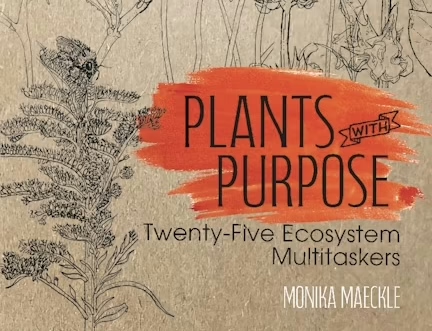
Plants with Purpose

Can you eat it? Make tea from it? Does it serve wildlife? Does it taste good or provide a health benefit? Is it low maintenance? Does it have a fun story? Does it provide a unique landscape service? Oh, and is it attractive?

These are the questions Monika Maeckle asked of each plant upon assembling my new book Plants with Purpose: Twenty-five Ecosystem Multitaskers. To qualify, the plant had to answer YES to at least three besides attractiveness.

Beauty alone is no longer reason enough to choose a plant that will occupy valuable real estate in your landscape. We owe functional plants–plants that do more than look good–to the ecosystem.

Join us for a presentation/discussion about choosing plants that go beyond beauty and actually give back to the ecosystem. Books available for purchase and author autograph.

If you are attending in person, there is no need to register. However, if you are attending via Zoom, please register here before the meeting begins as late registration and entry will not be allowed. After registering, you will receive a confirmation email containing information about joining the meeting.

Note: The Zoom recording will be available within days after the meeting on our  YouTube channel.

Date
Oct 28 2025
Expired!
Time
7:00 pm - 8:00 pm
Cost
$
More Info
Read More
Organizer
San Antonio Calendar

About the Region

2026 Fall Symposium Logo

This low-elevations region of Texas extends inland from the barrier islands, about 60 or so miles, and stretches from Brownsville to Louisiana. In total, it covers about 9.5 million acres, with a high point of 150 feet in elevation. More than 1000 species of plants can be found in this region. On the southern end, species more common in Mexico (such as Sabal mexicana) and Central America occur.

The barrier islands provide us with dune systems, and clay flats to the inland side, which have species found in these areas alone. Many plants here, such as Ipomoea pes-caprae (beach morning glory), can be found throughout tropical regions of the globe. I’ve encountered the same species on the beaches of Guam.

Once inland, vast marshes and wet prairies occur. Occasionally, oak (Quercus fusiformis) groves can be found. Common grasses include species of Bothriochloa, Paspalum, and Sporobolus; eastern gamagrass (Tripsacum dactyloides); and switchgrass (Panicum species). Many rivers and creeks cut through the Gulf Prairies, and along these riparian areas various species of trees, Sabal minor, and other plants adapted to clay soils can be found. Due to overgrazing, farming, and fire suppression, woody species such as mesquite (Prosopis glandulosa) and huisache (Acacia farnesiana), and invasive species such as chinaberry (Melia azedarach), Brazilian pepper (Schinus terebinthifolius), and Chinese tallow (Sapium sebiferum) have increased and displaced our native flora.

Source: Wildflowers of Texas by Michael Eason