
Eastern Gamagrass

Tripsacum dactyloides

Other common name(s):

Fakahatchee Grass

Family:

Poaceae (Grass Family)

Plant Ecoregion Distribution Map

This map uses data from the US EPA. EPA  servers have been offline frequently so maps may not display. We are working on a solution.

Central Great Plains, Chihuahuan Deserts, Cross Timbers, East Central Texas Plains, Edwards Plateau, Gulf Coast Prairies and Marshes, High Plains, Southern Texas Plains, Southwestern Tablelands, Texas Blackland Prairies, Western Gulf Coastal Plain
Red Prairie
Chihuahuan Desert Grasslands, Chihuahuan Montane Woodlands, Low Mountains and Bajadas
Eastern Cross Timbers, Grand Prairie, Limestone Cut Plain
Bastrop Lost Pines, Floodplains and Low Terraces2, Northern Post Oak Savanna, Northern Prairie Outliers, San Antonio Prairie, Southern Post Oak Savanna
Balcones Canyonlands, Edwards Plateau Woodland
Floodplains and Low Terraces4, Mid-Coast Barrier Islands and Coastal Marshes, Northern Humid Gulf Coastal Prairies, Southern Subhumid Gulf Coastal Prairies, Texas-Louisiana Coastal Marshes
Rolling Sand Plains
Northern Nueces Alluvial Plains, Semiarid Edwards Bajada
Canadian/Cimarron Breaks, Semiarid Canadian Breaks
Floodplains and Low Terraces1, Northern Blackland Prairie, Southern Blackland Prairie
Flatwoods, Floodplains and Low Terraces3, Southern Tertiary Uplands, Tertiary Uplands

Plant Characteristics

Growth Form

Grass & Sedge

Height

1
to
3
ft.

Spread

1
to
2
ft.

Leaf Retention

Evergreen

Lifespan

Perennial

Habitat and Care Requirements

Soil Type(s)

Calcareous, Clay, Loam, Moist, Poor Drainage, Saline, Sand

Light Requirement

Part Shade

Water Requirement

High

Native Habitat

Grassland, Riparian, Wetland

Bloom and Attraction

Bloom Color

Brown

Bloom Season

Spring, Summer

Seasonal Interest

Larval Host, Nectar, Seeds

Wildlife Benefit

Birds, Butterflies, Deer

Maintenance

Long-lived; doesn’t like to be moved. Needs plenty of room. Adds size and texture to a shaded perennial border. Also may be grown in woodland gardens, meadows, prairies, naturalized areas and along the edges of ponds or streams. Leave dead stems standing through fall and winter for insect habitat. Cut back dead stems in February before spring growth. Native habitat: borders of salt marshes, stream banks, moist, upland, tallgrass prairies.

Description

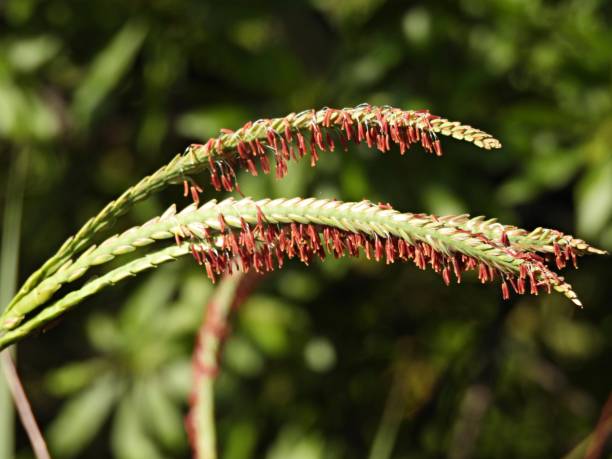
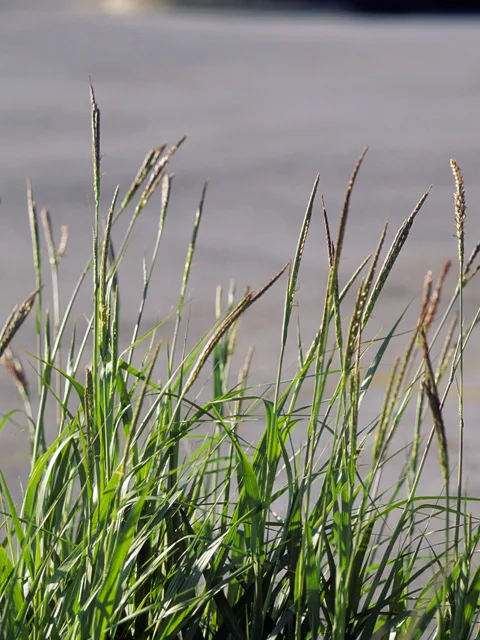
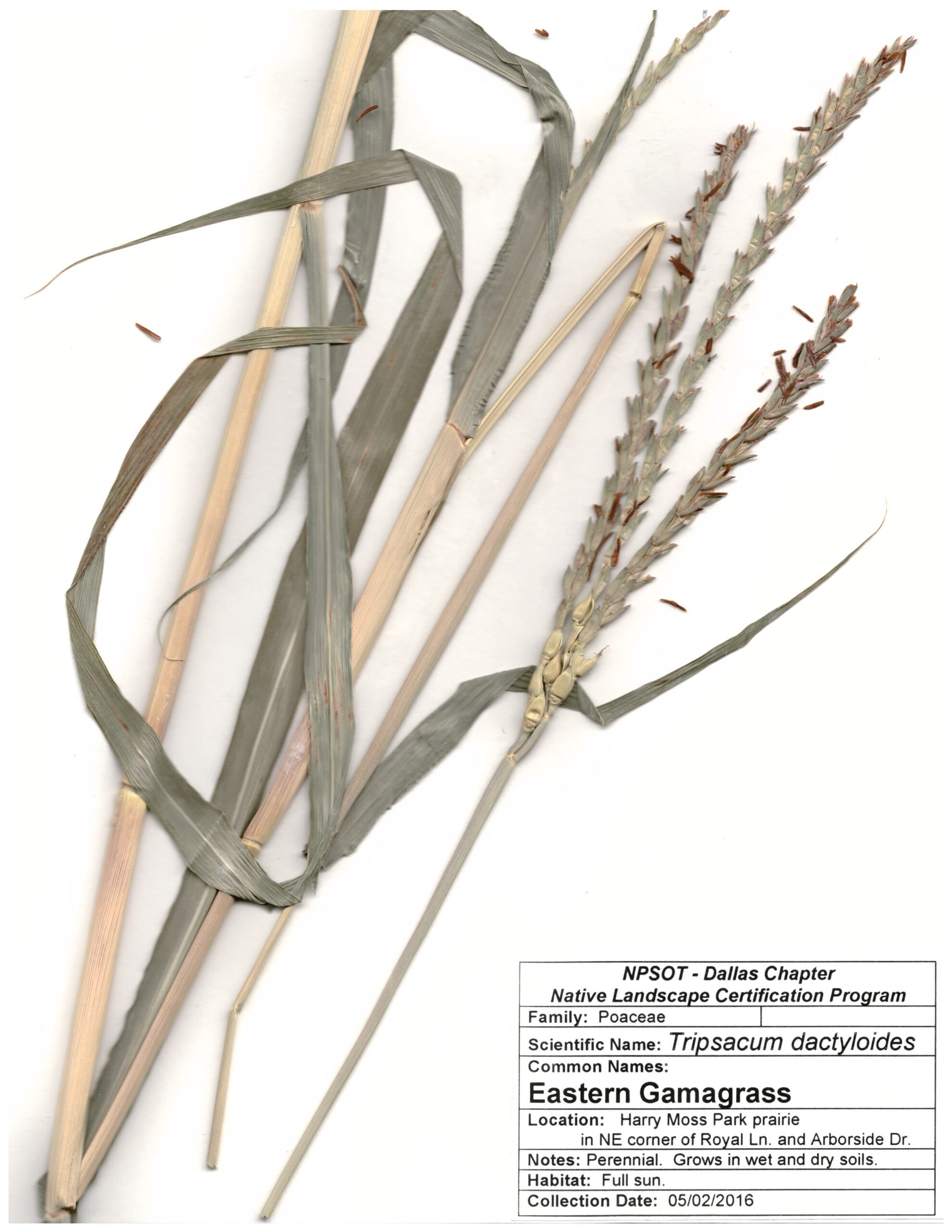
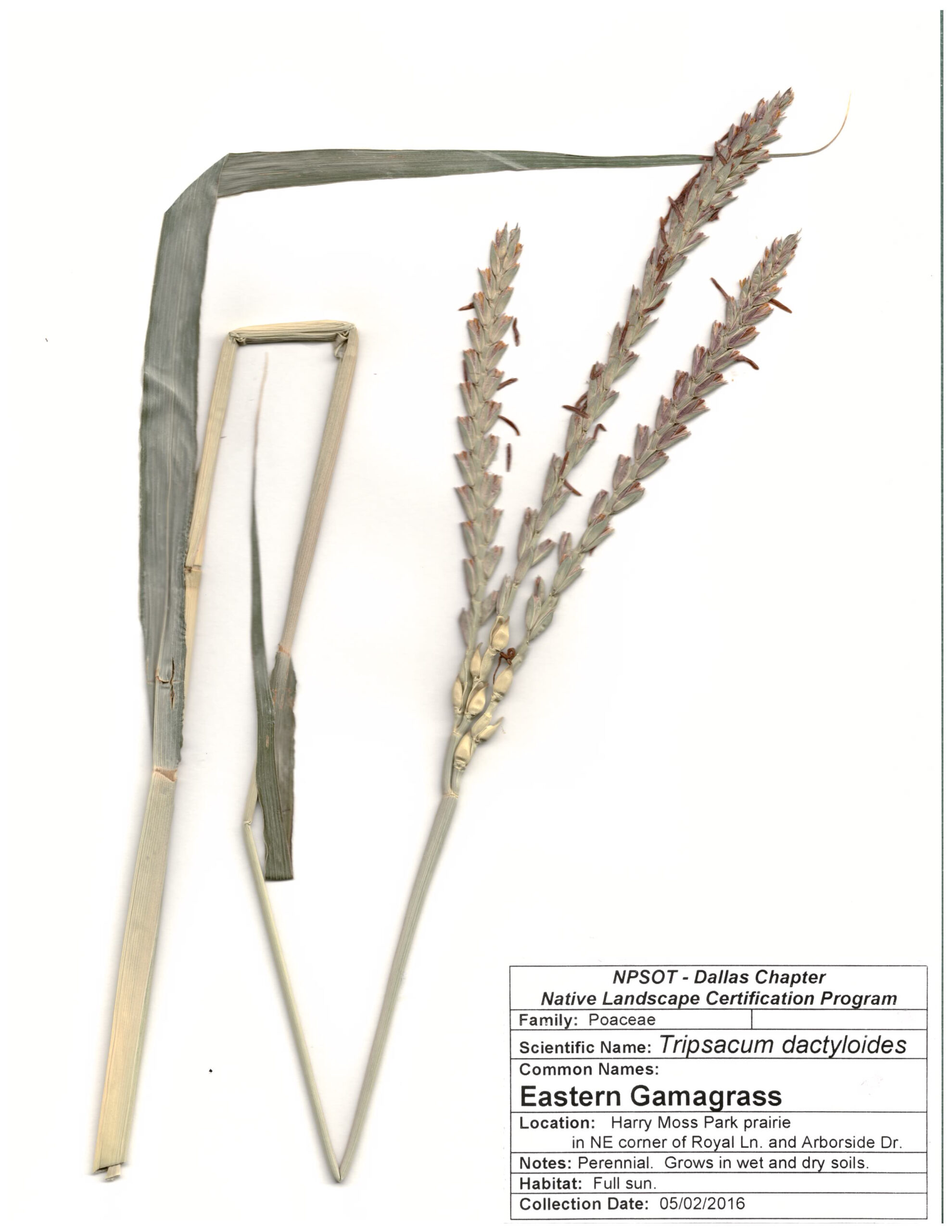
Blooms April-June. A tall, warm-season grass that grows in very dense clumps. Sharp leaf blades. Flowers and seed grow on finger-like spikes that arch above the foliage. Larval host: Bunchgrass Skipper.
Previous Scientific Name(s): Coix dactyloides, Tripsacum dactyloides var. occidentale
Material Treatment Method Collection References
Seed Stratification For best results, sow seeds in late fall to early winter. This allows the seeds to undergo natural stratification, a period of cold-moist conditions that breaks their dormancy and promotes germination come spring. Sowing the Seeds: Scatter seeds on the surface of prepared soil, ensuring good seed-to-soil contact. Since gamagrass seeds are light-sensitive, avoid burying them too deeply. Patience, Young Padawan: Germination can take anywhere from a few weeks to a couple of months. During this time, keep the soil consistently moist but not waterlogged. Once pollination has occurred the flowers will fall from the spikelets. Place a mesh bag (like the kind you buy garlic in), over the seed head. As the yellow corn-like seeds dry up, they will fall into the bag and can be planted immediately. 1) https://www.fnps.org/assets/pdf/pubs/tripsacum_dactyloides_easterngamagrass_3_0.pdf 2) https://propagate.one/how-to-propagate-tripsacum-dactyloides/
Clump Division Transplant the divisions into their new homes, ensuring the crown of the plant (where the roots meet the shoots) is level with the soil surface. Water well but water deeply and less frequently to encourage deep root development. In late spring or early summer, choose established plants that are at least 3-4 years old. Using a sharp spade or shovel, carefully dig around the perimeter of the clump you wish to divide. Once loosened, gently separate the clump into smaller sections, ensuring each division has a good amount of roots and shoots. 1) https://propagate.one/how-to-propagate-tripsacum-dactyloides/ 2) https://earthone.io/plant/tripsacum%20dactyloides

About the Region

2026 Fall Symposium Logo

This low-elevations region of Texas extends inland from the barrier islands, about 60 or so miles, and stretches from Brownsville to Louisiana. In total, it covers about 9.5 million acres, with a high point of 150 feet in elevation. More than 1000 species of plants can be found in this region. On the southern end, species more common in Mexico (such as Sabal mexicana) and Central America occur.

The barrier islands provide us with dune systems, and clay flats to the inland side, which have species found in these areas alone. Many plants here, such as Ipomoea pes-caprae (beach morning glory), can be found throughout tropical regions of the globe. I’ve encountered the same species on the beaches of Guam.

Once inland, vast marshes and wet prairies occur. Occasionally, oak (Quercus fusiformis) groves can be found. Common grasses include species of Bothriochloa, Paspalum, and Sporobolus; eastern gamagrass (Tripsacum dactyloides); and switchgrass (Panicum species). Many rivers and creeks cut through the Gulf Prairies, and along these riparian areas various species of trees, Sabal minor, and other plants adapted to clay soils can be found. Due to overgrazing, farming, and fire suppression, woody species such as mesquite (Prosopis glandulosa) and huisache (Acacia farnesiana), and invasive species such as chinaberry (Melia azedarach), Brazilian pepper (Schinus terebinthifolius), and Chinese tallow (Sapium sebiferum) have increased and displaced our native flora.

Source: Wildflowers of Texas by Michael Eason