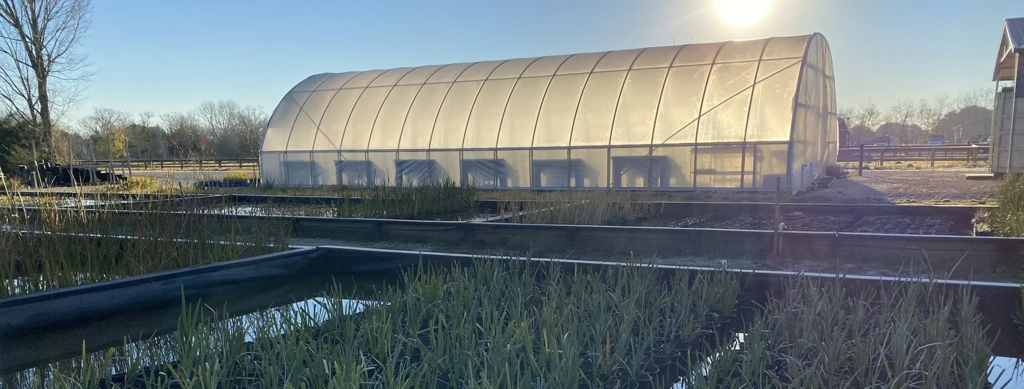

Field Trip: Green Star Wetland Plant Farm

Meeting Location: Green Star Wetland Plant Farm, 4646 County Road 181, Alvin, TX 77511

Things To Bring: Closed toe shoes and bug spray recommended. Please bring adequate hydration and other items you may require to be comfortable. I anticipate we will be in full sun the entire time, so dress appropriately.

Field Trip Overview: Mary Carol Edwards, Green Star Wetland Plant Farm owner, has graciously offered for us to come visit the farm. It will allow us to become more intimate with large scale plant growth from deciding which species to select for cultivation, propagation, and grow out. It will allow participants access to thinking about how wetland plants are used throughout the Houston area for maintaining natural communities, providing water filtration and chemical sequestration, and types of projects currently being implemented around the region. From a plant identification perspective, the farm typically has around 90 species in cultivation so we will have time to talk through plant morphology with an emphasis on adaptations plants utilize to grow in prolonged saturated or inundated environments. Additionally, we will have the opportunity to view ongoing prairie restoration on six acres adjacent to the nursery and view several old live oak mottes.

Plants will be available for sale afterwards, so keep an eye out for something that catches your fancy.

Additional Site Information: https://greenstarwetlands.com/

Additional Coordination Details: Please contact Bob Romero for any further coordination details at
bobromero@gmail.com or by phone at 713.248.6030.

Date
Apr 12 2025
Expired!
Time
9:00 am - 11:00 am
Cost
$
More Info
Read More
Category

About the Region

2026 Fall Symposium Logo

This low-elevations region of Texas extends inland from the barrier islands, about 60 or so miles, and stretches from Brownsville to Louisiana. In total, it covers about 9.5 million acres, with a high point of 150 feet in elevation. More than 1000 species of plants can be found in this region. On the southern end, species more common in Mexico (such as Sabal mexicana) and Central America occur.

The barrier islands provide us with dune systems, and clay flats to the inland side, which have species found in these areas alone. Many plants here, such as Ipomoea pes-caprae (beach morning glory), can be found throughout tropical regions of the globe. I’ve encountered the same species on the beaches of Guam.

Once inland, vast marshes and wet prairies occur. Occasionally, oak (Quercus fusiformis) groves can be found. Common grasses include species of Bothriochloa, Paspalum, and Sporobolus; eastern gamagrass (Tripsacum dactyloides); and switchgrass (Panicum species). Many rivers and creeks cut through the Gulf Prairies, and along these riparian areas various species of trees, Sabal minor, and other plants adapted to clay soils can be found. Due to overgrazing, farming, and fire suppression, woody species such as mesquite (Prosopis glandulosa) and huisache (Acacia farnesiana), and invasive species such as chinaberry (Melia azedarach), Brazilian pepper (Schinus terebinthifolius), and Chinese tallow (Sapium sebiferum) have increased and displaced our native flora.

Source: Wildflowers of Texas by Michael Eason