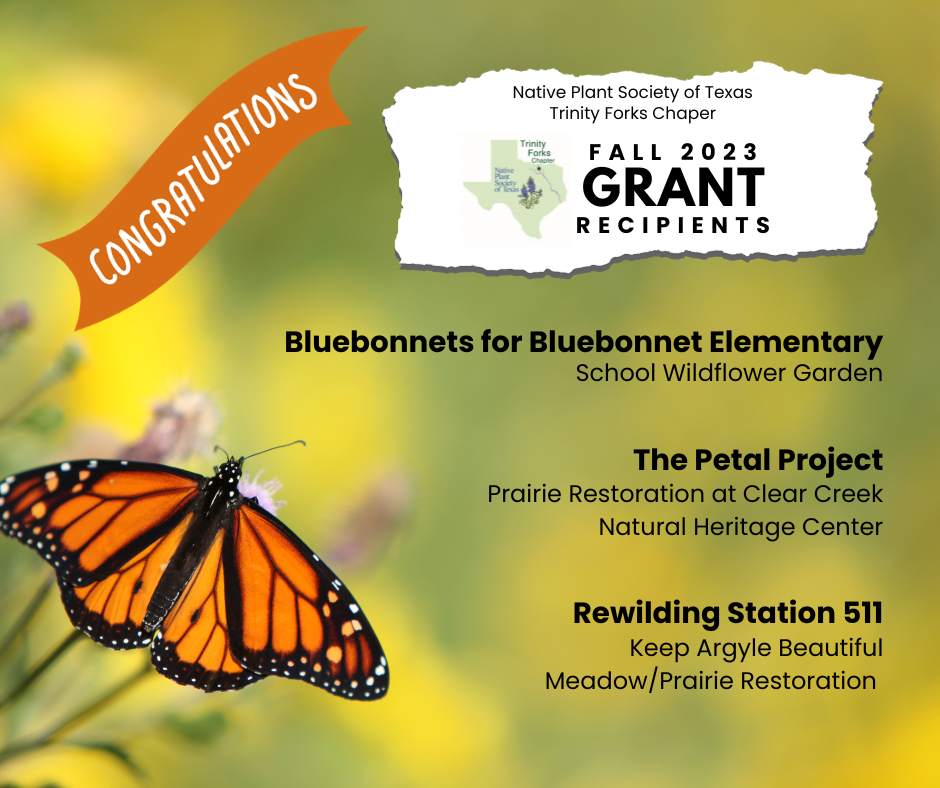

Business Meeting & Program – Adding Native Plants to Our Communities – Trinity Forks 2023 Grant Recipient Project Reports

6:30pm – Social time
7:00pm – Zoom opens and meeting begins

  • The PETAL Prairie Restoration at Clear Creek Natural Heritage Center, presented by Rachel Weaver, Founder and Director of The PETAL Project, demonstrates her partnership with the City of Denton, TX and the Elm Fork Master Naturalists, to add native plants of ecological importance into an area of restored prairie in order to provide creative and educational opportunities that cultivate purposeful community environmental literacy.
  • The Keep Argyle Beautiful – Rewilding Fire Station 511 project, presented by Christian Cockrell and Kathy Salisbury, presents the transformation of an unused barren, weedy area at Argyle Fire Station 511 into a native prairie plant garden.
  • The Bluebonnets for Bluebonnet Elementary project, presented by LISD’s Stormy Allen,TEM Instructor, and Kamille Mayes, Teacher, allows all 700 culturally diverse Kindergarten through 5th grade students to plant, water, weed, grow, maintain and observe bluebonnet plants in their school garden and provides basic science and gardening skills and education.
  • The fourth grant recipient, the Town of Flower Mound’s Monarch Waystation will be the primary program for our July meeting.

Open to the public.

We hope you can join our meeting in person at TWU’s  Ann Stuart Science Complex.  Campus parking is open after 6:00pm.

If you can’t join us in person, we invite you to our Zoom meeting.

ZOOM PARTICIPANTS ONLY: Please Register in advance for this meeting:
https://us02web.zoom.us/meeting/register/tZYodeCtrzoiE9LnBQR0XcOYymsF2Li5-B4G

After registering, you will receive a confirmation email containing information about joining the meeting.

Date
Sep 26 2024
Expired!
Time
6:30 pm - 8:30 pm
Cost
$Free.
Organizer
Trinity Forks Calendar

About the Region

2026 Fall Symposium Logo

This low-elevations region of Texas extends inland from the barrier islands, about 60 or so miles, and stretches from Brownsville to Louisiana. In total, it covers about 9.5 million acres, with a high point of 150 feet in elevation. More than 1000 species of plants can be found in this region. On the southern end, species more common in Mexico (such as Sabal mexicana) and Central America occur.

The barrier islands provide us with dune systems, and clay flats to the inland side, which have species found in these areas alone. Many plants here, such as Ipomoea pes-caprae (beach morning glory), can be found throughout tropical regions of the globe. I’ve encountered the same species on the beaches of Guam.

Once inland, vast marshes and wet prairies occur. Occasionally, oak (Quercus fusiformis) groves can be found. Common grasses include species of Bothriochloa, Paspalum, and Sporobolus; eastern gamagrass (Tripsacum dactyloides); and switchgrass (Panicum species). Many rivers and creeks cut through the Gulf Prairies, and along these riparian areas various species of trees, Sabal minor, and other plants adapted to clay soils can be found. Due to overgrazing, farming, and fire suppression, woody species such as mesquite (Prosopis glandulosa) and huisache (Acacia farnesiana), and invasive species such as chinaberry (Melia azedarach), Brazilian pepper (Schinus terebinthifolius), and Chinese tallow (Sapium sebiferum) have increased and displaced our native flora.

Source: Wildflowers of Texas by Michael Eason