
Upright Burhead

Echinodorus berteroi

Other common name(s):

Family:

Alismataceae (Water Plantain Family)

Plant Ecoregion Distribution Map

This map uses data from the US EPA. EPA  servers have been offline frequently so maps may not display. We are working on a solution.

East Central Texas Plains, Edwards Plateau, Gulf Coast Prairies and Marshes, Southern Texas Plains, Texas Blackland Prairies
Floodplains and Low Terraces2
Balcones Canyonlands
Coastal Sand Plain, Floodplains and Low Terraces4, Laguna Madre Barrier Island and Coastal Marshes, Lower Rio Grande Alluvial Floodplain, Lower Rio Grande Valley, Mid-Coast Barrier Islands and Coastal Marshes, Northern Humid Gulf Coastal Prairies, Southern Subhumid Gulf Coastal Prairies
Northern Nueces Alluvial Plains, Rio Grande Floodplain and Terraces, Semiarid Edwards Bajada, Texas-Tamaulipan Thornscrub
Floodplains and Low Terraces1, Northern Blackland Prairie, Southern Blackland Prairie

Plant Characteristics

Growth Form

Herbaceous, Wetland

Height

1
to
3
ft.

Spread

1
to
3
ft.

Leaf Retention

Deciduous

Lifespan

Annual

Habitat and Care Requirements

Soil Type(s)

Mud, Sand, Wet

Light Requirement

Sun, Part Shade

Water Requirement

Medium, High

Native Habitat

Riparian, Wetland

Bloom and Attraction

Bloom Color

White, Yellow

Bloom Season

Summer, Fall

Seasonal Interest

Seeds

Wildlife Benefit

Aquatic Wildlife, Birds

Maintenance

A shoreline and shallow-water plant. Members of the Water-Plantain Family grow in water, in swamps, on muddy banks, or occasionally in wet sand. Good to control soil erosion on shorelines. Set up a pond or a water collection tank near a downspout to supplement water. Native habitat: clay soils of wet ditches, streams, shallow ponds, edges of swamps.

Description

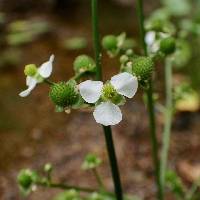
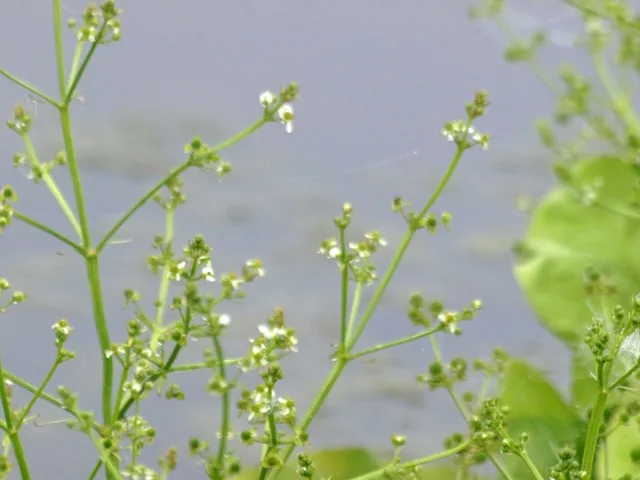
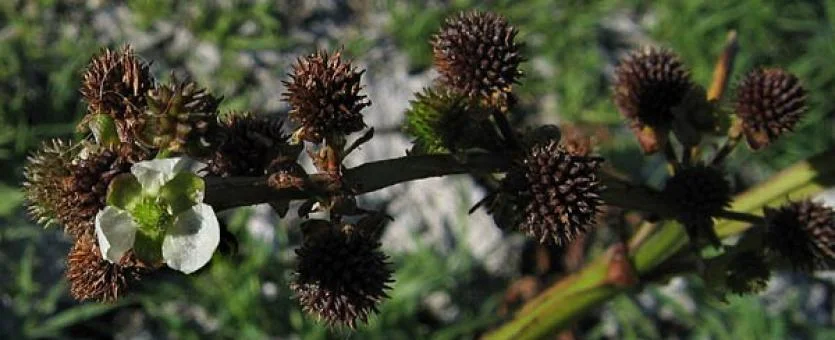
Blooms July-November. Can be short-lived perennial or annual depending on growing conditions. Leaves are variable: large, elliptic to egg-shaped or lance-shaped with a squared or heart-shaped base, somewhat translucent; in submersed forms, leaves are very thin and crisped. The flowering stem rises from the clumped leaves, bearing one to nine whorls of three to eight small, white flowers. Male and female parts may be on separate flowers. The fruit is spherical and spiny.
Previous Scientific Name(s): Echinodorus berteroi var. lanceolatus, Echinodorus rostratus, Echinodorus rostratus var. lanceolatus
Material Treatment Method Collection References
Seed No Treatment The dry nutlets containing the seeds can be sown in any kind of container (aquarium, vase, ...) with water and a substrate, e.g. a mixture of sand and loam. They will float at first, but then they sink to the ground by and by. The seeds inside the nutlets germinate after varying periods of time. The seedlings then are best cultivated submersed in order to get larger, more decorative plants. Young plants cultivated emersed stay smaller and form flower stalks early on. 1) https://www.flowgrow.de/db/aquaticplants/echinodorus-berteroi 2) https://fishy.wiki/en/plants/alismataceae/echinodorus-berteroi.phtml 3) https://pts.lifeasible.com/echinodorus-berteroicellophane-sword-item-1144.html
Offshoots Division Often daughter rosettes may form, which can be separated from the mother plant when they have grown strong enough. 1) https://www.flowgrow.de/db/aquaticplants/echinodorus-berteroi 2) https://fishy.wiki/en/plants/alismataceae/echinodorus-berteroi.phtml
Stem Cutting Upright burhead can be propagated through cuttings from healthy, non-flowering shoots. A clean cut below a node enhances root development. Using rooting hormone and a well-draining soil mix is recommended. Maintain consistent moisture, warmth, and provide indirect light to support successful rooting. https://www.picturethisai.com/wiki/Echinodorus_berteroi.html

About the Region

2026 Fall Symposium Logo

This low-elevations region of Texas extends inland from the barrier islands, about 60 or so miles, and stretches from Brownsville to Louisiana. In total, it covers about 9.5 million acres, with a high point of 150 feet in elevation. More than 1000 species of plants can be found in this region. On the southern end, species more common in Mexico (such as Sabal mexicana) and Central America occur.

The barrier islands provide us with dune systems, and clay flats to the inland side, which have species found in these areas alone. Many plants here, such as Ipomoea pes-caprae (beach morning glory), can be found throughout tropical regions of the globe. I’ve encountered the same species on the beaches of Guam.

Once inland, vast marshes and wet prairies occur. Occasionally, oak (Quercus fusiformis) groves can be found. Common grasses include species of Bothriochloa, Paspalum, and Sporobolus; eastern gamagrass (Tripsacum dactyloides); and switchgrass (Panicum species). Many rivers and creeks cut through the Gulf Prairies, and along these riparian areas various species of trees, Sabal minor, and other plants adapted to clay soils can be found. Due to overgrazing, farming, and fire suppression, woody species such as mesquite (Prosopis glandulosa) and huisache (Acacia farnesiana), and invasive species such as chinaberry (Melia azedarach), Brazilian pepper (Schinus terebinthifolius), and Chinese tallow (Sapium sebiferum) have increased and displaced our native flora.

Source: Wildflowers of Texas by Michael Eason