

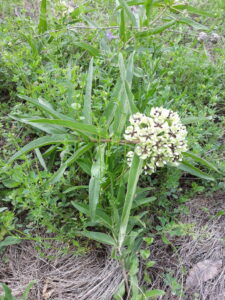
Lately, no matter which direction I head I have seen antelope horns milkweed dotting the roadsides of central Texas.
The leaves of milkweeds are the primary food source for the Monarch caterpillar and the flowers provide a nectar source for the adult butterfly that has a high glucose content.
Antelope horns is not finicky about water. It has a large tap root that develops quickly which allows it to flower even during years like this one when rainfall has been pretty scarce. It prefers to grow in well drained soil in full sun.
The easiest method for planting is to sow the seeds outdoors in September to November. This gives the seeds the exposure to the moisture and cold temperatures that it prefers, and once the temperature is warm enough in the spring, the seeds will germinate.
Beginning in June, aggressively trim back one plant at a time, to provide fresh foliage for butterfly larvae all summer long. Another method includes a careful cold stratification in the refrigerator before spring planting.
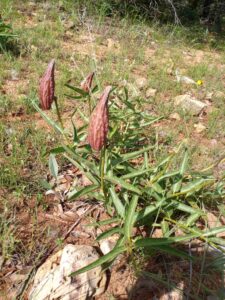
This milkweed gets its name from the seed pods that look similar to the horns of an antelope. Its scientific name Asclepias asperula is derived from Askelpios the Greek word for the god of medicine and asperula the Greek word for rough. In Greek mythology the Greek god Askelpios brought Orion back to life. The Greeks believed that Askelpios could use his powers to bring any of the dead back to life. The constellation Askelpios is also called the serpent holder.
As the scientific name seems to suggest antelope horns is credited with many medicinal properties. Cardiac glycosides which are present in the sap of the milkweed are allied to digitalins used in treating some heart disease. Native Americans made a tea from milkweeds as a tonic to strengthen the heart and the Navahos also used it as a treatment for the bite from a rabid animal.
The same milky sap that the Native Americans used for medicinal purposes can also be toxic like so many modern medicines today. Not surprisingly, antelope-horn is normally deer resistant and livestock also tend to leave it alone because of the bad taste. Monarch caterpillars capitalize on this toxic trait because once the milkweed is ingested the caterpillars also taste bad.
One other interesting bit of milkweed trivia is that during WWII the silky down attached to the seeds was used for both regular life jackets and aviation life jackets. Milkweed silk is 5 to 6 times more buoyant than cork.
