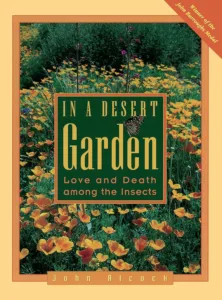
In a Desert Garden: Love and Death Among the Insects

John Alcock

Publisher:

University of Arizona Press

Publication Date:

November 1, 2015

Category:

Wildlife

This book is about the author’s personal laboratory for ecological studies, which he created by replacing the Bermuda grass in his suburban Arizona lawn with gravel, cacti, and fairy dusters. He seeded his property with flowers to entice certain insects and even added a few cowpies to attract termites. His observations of life in his own front yard provided him with the fieldnotes for this unusual book .

The book draws readers into the strange and fascinating world of plants and animals native to Arizona’s Sonoran Desert. As Alcock studies the plants in his yard, he shares thoughts on planting, weeding, and pruning that any gardener will appreciate. And when commenting on the mating rituals of spiders and beetles or marveling at the camouflage of grasshoppers and caterpillars, he uses humor and insight to detail the lives of the insects that live in his patch of desert. Celebrating the virtues of even aphids and mosquitoes, Alcock draws the reader into the intricacies of desert life to reveal the complex interactions found in this unique ecosystem .

About the Region

2026 Fall Symposium Logo

This low-elevations region of Texas extends inland from the barrier islands, about 60 or so miles, and stretches from Brownsville to Louisiana. In total, it covers about 9.5 million acres, with a high point of 150 feet in elevation. More than 1000 species of plants can be found in this region. On the southern end, species more common in Mexico (such as Sabal mexicana) and Central America occur.

The barrier islands provide us with dune systems, and clay flats to the inland side, which have species found in these areas alone. Many plants here, such as Ipomoea pes-caprae (beach morning glory), can be found throughout tropical regions of the globe. I’ve encountered the same species on the beaches of Guam.

Once inland, vast marshes and wet prairies occur. Occasionally, oak (Quercus fusiformis) groves can be found. Common grasses include species of Bothriochloa, Paspalum, and Sporobolus; eastern gamagrass (Tripsacum dactyloides); and switchgrass (Panicum species). Many rivers and creeks cut through the Gulf Prairies, and along these riparian areas various species of trees, Sabal minor, and other plants adapted to clay soils can be found. Due to overgrazing, farming, and fire suppression, woody species such as mesquite (Prosopis glandulosa) and huisache (Acacia farnesiana), and invasive species such as chinaberry (Melia azedarach), Brazilian pepper (Schinus terebinthifolius), and Chinese tallow (Sapium sebiferum) have increased and displaced our native flora.

Source: Wildflowers of Texas by Michael Eason