
Austin Chapter Meeting – Native Grasses and Grasslands of Texas – November 19

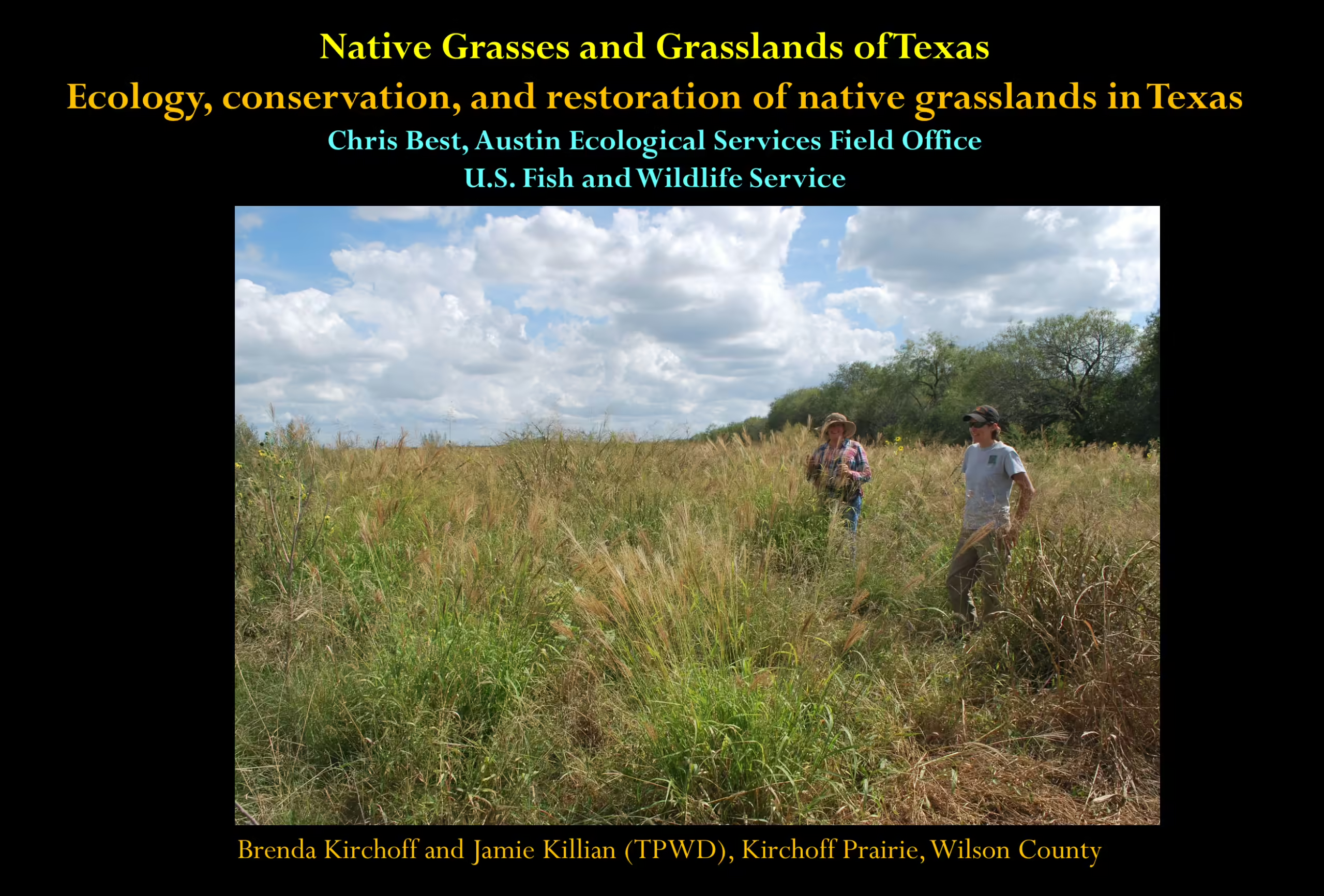
Our guest speaker this month is Chris Best (State Botanist, U.S. Fish and Wildlife Service, Austin, Texas) presenting, “Native Grasses and Grasslands of Texas:  Ecology, conservation, and restoration of native grasslands in Texas.”   

This will be a hybrid meeting, with both in-person and virtual options.

The in-person location is Lakewood Clubhouse (off 360) 7317 Lakewood Drive, Austin, TX 78750

Chris Best earned degrees in Plant Biochemistry and Botany and presented a master’s thesis on the role of arbuscular mycorrhizae in strip mine spoil restoration. From 1985–1989 he was an agroforestry extensionist with the Peace Corps and a consultant for CARE International in Guatemala. He has worked for U.S. Fish and Wildlife Service as a Plant Ecologist at Lower Rio Grande Valley NWR (1990–2006) and since 2006 as the agency’s State Botanist in Texas. His primary responsibilities include assessments of plant species for protection under the federal Endangered Species Act and recovery planning of listed plants in Texas. His current research interests include estimating the population sizes of rare plants, the role of rhizosphere symbionts in the establishment of rare cactuses in harsh environments, and the effect of smoke substances on the germination of bracted twistflower seeds.

Register for the Zoom here https://npsot-org.zoom.us/meeting/register/tZYvc-mrpjIvEtJN0IIypG4VGfUj8LjfS-Q1

After registering, you will receive a confirmation email containing information about joining the meeting.

Date
Nov 19 2024
Expired!
Time
7:00 pm - 8:00 pm
Cost
$
Location
Lakewood Clubhouse
7317 Lakewood Dr.
Organizer
Austin Calendar

About the Region

2026 Fall Symposium Logo

This low-elevations region of Texas extends inland from the barrier islands, about 60 or so miles, and stretches from Brownsville to Louisiana. In total, it covers about 9.5 million acres, with a high point of 150 feet in elevation. More than 1000 species of plants can be found in this region. On the southern end, species more common in Mexico (such as Sabal mexicana) and Central America occur.

The barrier islands provide us with dune systems, and clay flats to the inland side, which have species found in these areas alone. Many plants here, such as Ipomoea pes-caprae (beach morning glory), can be found throughout tropical regions of the globe. I’ve encountered the same species on the beaches of Guam.

Once inland, vast marshes and wet prairies occur. Occasionally, oak (Quercus fusiformis) groves can be found. Common grasses include species of Bothriochloa, Paspalum, and Sporobolus; eastern gamagrass (Tripsacum dactyloides); and switchgrass (Panicum species). Many rivers and creeks cut through the Gulf Prairies, and along these riparian areas various species of trees, Sabal minor, and other plants adapted to clay soils can be found. Due to overgrazing, farming, and fire suppression, woody species such as mesquite (Prosopis glandulosa) and huisache (Acacia farnesiana), and invasive species such as chinaberry (Melia azedarach), Brazilian pepper (Schinus terebinthifolius), and Chinese tallow (Sapium sebiferum) have increased and displaced our native flora.

Source: Wildflowers of Texas by Michael Eason