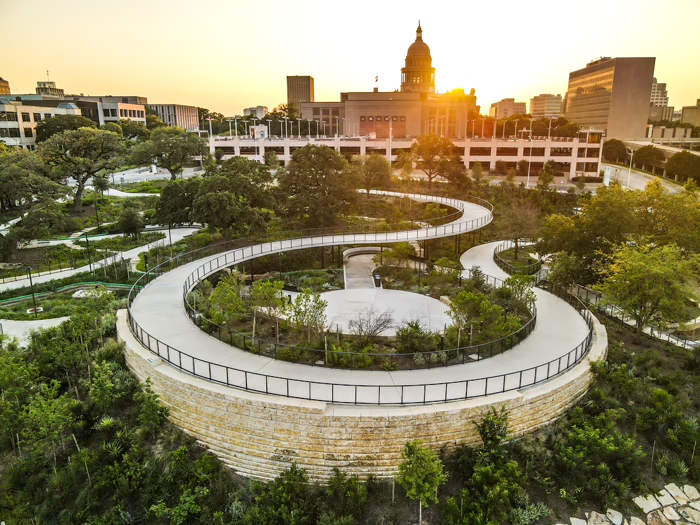

Waterloo Park Field Trip

Hey y’all!

Join us on a field trip to Waterloo Park in the heart of the city.

This field trip will be in two parts. The first hour is just the tour and that is ADA compliant. So anyone that wants to join can! The second hour is going to focus on doing some invasive managing (we will be pulling invasives) around the park.

If you would like to just take the tour all you have to do is show up, fill out the NPSOT waiver, and enjoy the tour.

If you would like to also do the working part of the tour you will have to fill out the NPSOT waiver, the Waterloo waiver, and come dress appropriately to get to work.

What to wear/bring: Closed toed shoes, long pants(prefered), water bottle, hat, sunscreen, gloves, hand pruners, kneeling pads(if desired), and to dress appropriately for the weather. 

Parking: Capitol Visitors Parking Garage located at the corner of Trinity St and 12th St has free parking for the first 2 hours, paid after that. There is paid street parking available on 12th st between Red River and Trinity and on 13th & 14th between San Jacinto and Trinity St. 

If you are not able to attend this date, Waterloo is also having some cut back (pruning) volunteer days coming up as well: Feb 9,11,13,17,19,23,25 12:30-3:00pm. If you are interested in one of those instead. Please use this link to sign up. This is just through Waterloo Park and not affiliated with NPSOT.

Please sign up to let us know that you will be coming out with us: Sign Up

Waterloo Waiver(only for those that want to do the invasive pulling NOT for tour only folks): Liability Waiver

Date
Feb 12 2026
Expired!
Time
10:00 am - 12:00 pm
Cost
$
Category

About the Region

2026 Fall Symposium Logo

This low-elevations region of Texas extends inland from the barrier islands, about 60 or so miles, and stretches from Brownsville to Louisiana. In total, it covers about 9.5 million acres, with a high point of 150 feet in elevation. More than 1000 species of plants can be found in this region. On the southern end, species more common in Mexico (such as Sabal mexicana) and Central America occur.

The barrier islands provide us with dune systems, and clay flats to the inland side, which have species found in these areas alone. Many plants here, such as Ipomoea pes-caprae (beach morning glory), can be found throughout tropical regions of the globe. I’ve encountered the same species on the beaches of Guam.

Once inland, vast marshes and wet prairies occur. Occasionally, oak (Quercus fusiformis) groves can be found. Common grasses include species of Bothriochloa, Paspalum, and Sporobolus; eastern gamagrass (Tripsacum dactyloides); and switchgrass (Panicum species). Many rivers and creeks cut through the Gulf Prairies, and along these riparian areas various species of trees, Sabal minor, and other plants adapted to clay soils can be found. Due to overgrazing, farming, and fire suppression, woody species such as mesquite (Prosopis glandulosa) and huisache (Acacia farnesiana), and invasive species such as chinaberry (Melia azedarach), Brazilian pepper (Schinus terebinthifolius), and Chinese tallow (Sapium sebiferum) have increased and displaced our native flora.

Source: Wildflowers of Texas by Michael Eason