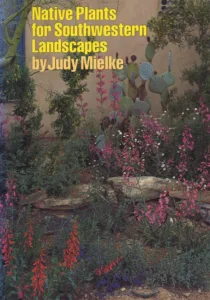
Native Plants for Southwestern Landscapes

Judy Mielke

Publisher:

University of Texas Press

Publication Date:

February 1, 1994

Category:

Landscaping, Regional

For gardeners who want to conserve water, the color, fragrance, shade, and lush vegetation of a traditional garden may seem like a mirage in the desert. But such gardens can flourish when native plants grow in them. In this book, Judy Mielke, an expert on Southwestern gardening, offers the most comprehensive guide available to landscaping with native plants. Writing simply enough for beginning gardeners, while also providing ample information for landscape professionals, she presents over three hundred trees, shrubs, vines, grasses, groundcovers, wildflowers, cacti, and other native plants suited to arid landscapes.

The heart of the book lies in the complete descriptions and beautiful color photographs of plants native to the Mojave, Sonoran, and Chihuahuan desert regions of the southwestern United States and northern Mexico. Mielke characterizes each plant and gives detailed information on its natural habitat, its water, soil, light, temperature, and pruning requirements, and its possible uses in landscape design.

About the Region

2026 Fall Symposium Logo

This low-elevations region of Texas extends inland from the barrier islands, about 60 or so miles, and stretches from Brownsville to Louisiana. In total, it covers about 9.5 million acres, with a high point of 150 feet in elevation. More than 1000 species of plants can be found in this region. On the southern end, species more common in Mexico (such as Sabal mexicana) and Central America occur.

The barrier islands provide us with dune systems, and clay flats to the inland side, which have species found in these areas alone. Many plants here, such as Ipomoea pes-caprae (beach morning glory), can be found throughout tropical regions of the globe. I’ve encountered the same species on the beaches of Guam.

Once inland, vast marshes and wet prairies occur. Occasionally, oak (Quercus fusiformis) groves can be found. Common grasses include species of Bothriochloa, Paspalum, and Sporobolus; eastern gamagrass (Tripsacum dactyloides); and switchgrass (Panicum species). Many rivers and creeks cut through the Gulf Prairies, and along these riparian areas various species of trees, Sabal minor, and other plants adapted to clay soils can be found. Due to overgrazing, farming, and fire suppression, woody species such as mesquite (Prosopis glandulosa) and huisache (Acacia farnesiana), and invasive species such as chinaberry (Melia azedarach), Brazilian pepper (Schinus terebinthifolius), and Chinese tallow (Sapium sebiferum) have increased and displaced our native flora.

Source: Wildflowers of Texas by Michael Eason