

**ARCHIVED POST **
Part of growing up is learning that words can be hurtful and that we have to be careful with the words we toss around. This article will look at Texas native plants that are often labeled as noxious or invasive but in reality are far from those degrading monikers.
Plants with prickles and spines are often targets of brush management efforts. We have long ago given up on calling it brush eradication, even given up calling it brush control, now we are just trying to manage these plants a bit. Plants such as Honey Mesquite (Prosopis glandulosa) and Prickly Pear (Opuntia spp.) are true natives to Texas though both are often thought of as imports to Texas by way of the longhorns being driven northward up the various cattle trails. Though neither is on the official Texas noxious plant list, much in the way of sweat, money, diesel and chemicals are spent each year in an attempt at controlling their spread.

Lady Bird Johnson Wildflower Center
Another native that has become aggressive in its rate of spreading westward is Eastern Red Cedar (Juniperus virginiana.) Though originally found in Texas east of I-35 this woody has spread westward into the western Blackland Prairie, the Cross Timbers and eastern Edwards Plateau. Also native in Oklahoma, it has marched west across that entire state and has encroached upon many open grasslands. The main cause for this aggressive behavior is over-grazing of the land and the prevention of fire. Either wildfires or prescribed range burning can quickly and easily control Eastern Red Cedar. If the fire browns out all of the green needles then the tree will die. The lack of fire across the landscape in recent years has allowed this tree to march westward into new territory. Even organic control methods work for this non-sprouting species, using an ax, loping shears or chain saw to cut the trees off at ground level.

Lady Bird Johnson Wildflower Center
Many people either live in a house or work in an office building that has Yaupon (Ilex vomitoria) as part of the landscaping. As a beautiful landscaping shrub this plant can survive in virtually every county in Texas because of the extra care and watering it receives. This native multistemmed, thicket-forming shrub can grow into a 25-foot tree in the rich, moist soils of East Texas. It is east of I-35 from the sandy soils of the Post Oak Savannah to the varied soils of the Piney Woods where Yaupon has decided to express itself upon its native lands. Yaupon can and has become an aggressive under-story shrub dominating the area for moisture, nutrients and sunlight while shading out other shrubs, grasses and forbs. Yaupon is readily grazed upon by livestock and browsed by deer leading to a compact growth form with many stiff branches which discourages further use by animals. This trait allows the plant to survive on overstocked land at the cost of plants that are less tolerant of overuse.
Lady Bird Johnson Wildflower Center
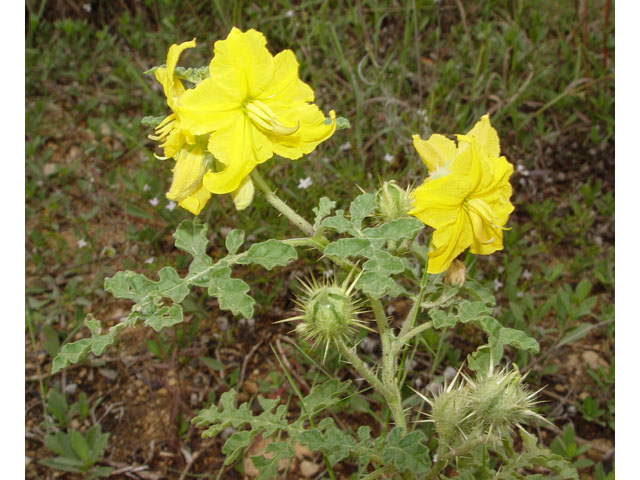
Forbs or broad-leaved weeds are not immune from being associated with noxious weeds. Buffalo Bur (Solanum rostratum) is one that comes to mind especially when it germinates and dominates a piece of recently plowed land. It is poisonous to livestock but they rarely if ever eat it because of the numerous prickles. It is an excellent seed producer for game and song birds and pollinators visit the many flowers that can bloom most of the summer and even now in early fall. It is a native, annual forb and would be commonly found across Texas as shown on this distribution map. Note the map shows only counties where known specimens have been collected and placed in a herbarium. Many years when it is too dry to get food plots for wildlife to germinate and grow, Buffalo Bur will appear and save the day for the birds. Since it is an annual, an early shredding will reduce it prevalence for that year. The timing of beneficial rains usually determines what type and quantity of forbs will appear each year. During 2014 in North Texas, rains didn’t come until late April and May so the forbs were no-shows, but the later rains benefited the grasses which pleased the livestock raisers.

Photo by Ricky Linex
Many Ragweed species are preferred seeds for game and song birds but there is one native, perennial, rhizomatous species that sneaks into cropland, old fields and even native rangeland pastures. Field Ragweed (Ambrosia confertiflora) grows across much of Texas and is often confused with the more beneficial Western Ragweed (A. psilostachya.) The downside to Field Ragweed is that the seeds have tiny hooked barbs much like Velcro and these seeds have never been documented to have been found in the crop contents of quail. So you should verify if you have Western Ragweed (hopefully) or Field Ragweed in your pastures. Sometimes you will find both species mixed in a location and other times it will be Field Ragweed dominating the area.
Lady Bird Johnson Wildflower Center
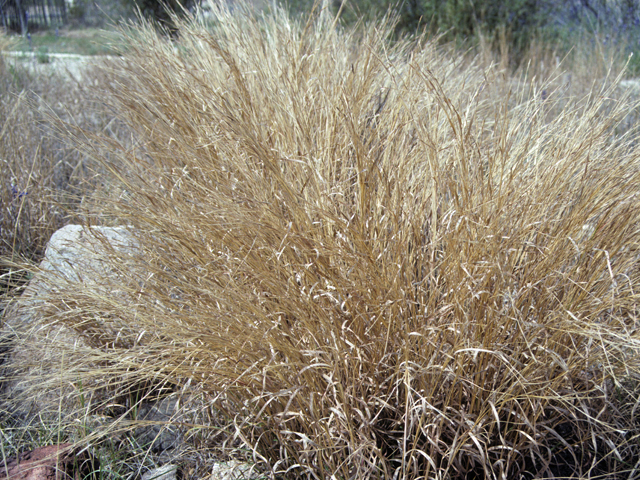
While we often bemoan the invasive nature of old world bluestems there is a native grass found in South Texas and in the Big Bend region that has become as aggressive as these introduced bluestems. This is occurring on land that has been managed strictly for wildlife and where grazing by livestock has been removed over the past 10-15 years. This grass is Tanglehead (Heteropogon contortus), a truly native Texan being a warm season perennial bunchgrass that was once one of many grasses in these southern and western pastures when livestock were commonly grazed. But now that grazing has been removed in favor of managing for various wildlife species, Tanglehead has become extremely fast growing and outcompetes other grasses and forbs. Tanglehead can form monocultures with only scattered brush species seen amidst the many acres of this grass. While it forms excellent nesting and fawning cover for game birds and deer, it becomes too thick for small birds to navigate through and few food plants can grow in its shade.
Reintroducing prescribed burning and livestock grazing to these areas will help to increase the plant diversity of the sites. The problem remains that there are many thousands of acres dominated by Tanglehead, so getting the animal impact upon large areas is difficult. It becomes a logistics problem of concentrating enough animals onto areas for enough time to reduce the grass cover and then moving to the next pasture while hoping that the tanglehead has not grown too mature to graze.
Learning to read the land is an important trait to those who make working with the land part of their lives. We need to learn to recognize these changes on the land, whether by introduced plants or by what I have described as aggressive natives. But let’s call these native plants by their real names and not belittle them with the misnomer noxious or invasive.
**ARCHIVED POST**
**ARCHIVED POST LINKS & PICTURES MAY NOT WORK**
**ARCHIVED POST AUTHOR: rickylinex
