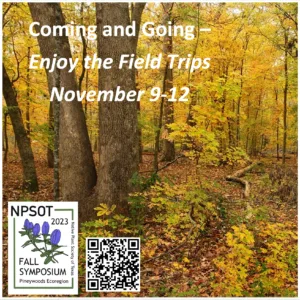
Fall Symposium Comings and Goings

Photo by Matt Buckingham

We are looking forward to seeing you at the fall symposium in Nacogdoches on November 9 – 12! Catch up with your native plant pals at the Meet and Greet at Fredonia Brewery on Thursday evening. 

Field trips

Field trips are a favorite of the fall symposium! Check out the self-guided field trips on your way to and from the symposium. We have curated stops for you every direction. 

Friday morning Matt Buckingham will provide an overview of east Texas plant communities, to prepare you for a fascinating field trip that day. A fun reception is planned at the Fredonia Hotel once you return. Saturday is jam-packed with plenary and concurrent sessions, followed by a feast at the Awards Banquet. You do not want to miss this event!

Friday field trips are led by local experts – register soon to get your first choice. 

  • Angelina National Forest Upland Island Wilderness Area
  • Watson Rare Native Plant Preserve
  • Pineywoods Native Plant Center, Stephen F. Austin State University
  • Scrappin’ Valley
  • Sabine National Forest, Fox Hunters Hill
  • USDA-NRCS East Texas Plant Materials Center and Winston 8 Tree Farm
  • Davy Crockett Neches Bluff Overlook
  • Big Thicket National Preserve, Pitcher Plant Trail
  • Caddo Mounds State Historic Site 

About the Region

2026 Fall Symposium Logo

This low-elevations region of Texas extends inland from the barrier islands, about 60 or so miles, and stretches from Brownsville to Louisiana. In total, it covers about 9.5 million acres, with a high point of 150 feet in elevation. More than 1000 species of plants can be found in this region. On the southern end, species more common in Mexico (such as Sabal mexicana) and Central America occur.

The barrier islands provide us with dune systems, and clay flats to the inland side, which have species found in these areas alone. Many plants here, such as Ipomoea pes-caprae (beach morning glory), can be found throughout tropical regions of the globe. I’ve encountered the same species on the beaches of Guam.

Once inland, vast marshes and wet prairies occur. Occasionally, oak (Quercus fusiformis) groves can be found. Common grasses include species of Bothriochloa, Paspalum, and Sporobolus; eastern gamagrass (Tripsacum dactyloides); and switchgrass (Panicum species). Many rivers and creeks cut through the Gulf Prairies, and along these riparian areas various species of trees, Sabal minor, and other plants adapted to clay soils can be found. Due to overgrazing, farming, and fire suppression, woody species such as mesquite (Prosopis glandulosa) and huisache (Acacia farnesiana), and invasive species such as chinaberry (Melia azedarach), Brazilian pepper (Schinus terebinthifolius), and Chinese tallow (Sapium sebiferum) have increased and displaced our native flora.

Source: Wildflowers of Texas by Michael Eason
