If you’ve been gardening for any amount of time, you have probably discovered practical gardening practices that work for you here in Central Texas. We’d love for you to share them with us! In coming newsletters, we’ll select and share one or two submissions. Please help us make this new monthly feature a success by sending your submissions to sanantonio@npsot.org. Be sure to include your name, fully describe the gardening tip, and possibly include an illustrative photo.
Poor Person's Rescue Drip Waterer
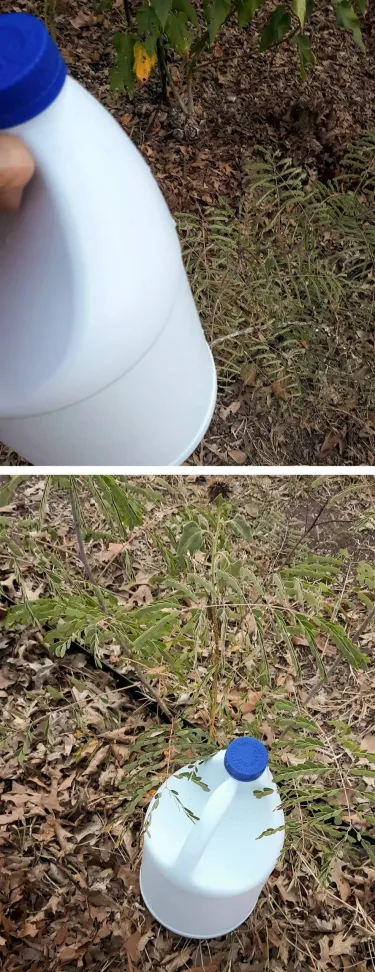
If you have a new plant (or any plant that otherwise needs a little extra, consistent watering), you can easily provide supplemental water by using an empty plastic jug.
Sturdier jugs such as vinegar jugs last longer, but the thinner milk jugs work fine as a short-term fix. Use a large needle, an icepick or other sharp tool to make a small hole near the bottom edge of the jug. Fill with water, replace the lid, and set next to the plant, positioning the jug so that the hole is closest to the plant.
After the jug is positioned, be sure to loosen the lid so that air can enter; otherwise a vacuum will be created, which will stop the drip before the jug is empty.
You may need to experiment with the appropriate hole size to get the “perfect” drip, but even if the jug empties within a couple of hours, the slow watering is beneficial and will generally get deeper without run off than a short deluge with the hose.
(Submitted by Todd Phillips)
Gardening Challenge:
Reader Answer! Jay Collins says, “Regarding the newsletter question about suppressing root sprouts from possumhaws, I have not had that problem and I have several.
The only time I see new sprouts coming from the roots has been when the health of the tree is compromised (it is old, it becoming too shaded, etc.) and the upper branches are dying.”