
Native Plants in Schools Committee Chair

Brooke Adam
Chapter
San Antonio
Biography
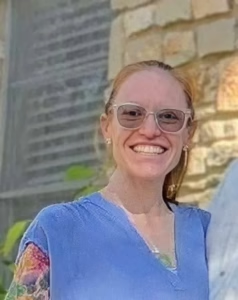
Brooke Adam is a native Texan who grew up in Boerne and has planted roots in San Antonio. She is a steward of native plants and habitats in Texas and considers native seed collection her favorite hobby. A certified Texas Master Naturalist with the Alamo Area Chapter, a Local Phenology Leader with the USA National Phenology Network, and certified through NPSOT’s Native Landscape Program, she helps restore and preserve Texas ecosystems through hands-on conservation, citizen science projects, and community engagement. Brooke focuses on removing invasive species and restoring native habitats through seed collection, propagation, distribution, and habitat restoration. She is an Army veteran and has a professional background in procurement, vendor, and contract management. When she isn’t homeschooling her children, working, or traveling, she volunteers extensively with environmental and conservation organizations across Texas. She is also the co-founder of Deafinitely Green!, a nonprofit connecting Deaf and Hard of Hearing volunteers with environmental initiatives by removing communication barriers.
Brooke Adam

Native Plants in Schools Committee Chair

Chapter
San Antonio
Biography
Brooke Adam is a native Texan who grew up in Boerne and has planted roots in San Antonio. She is a steward of native plants and habitats in Texas and considers native seed collection her favorite hobby. A certified Texas Master Naturalist with the Alamo Area Chapter, a Local Phenology Leader with the USA National Phenology Network, and certified through NPSOT’s Native Landscape Program, she helps restore and preserve Texas ecosystems through hands-on conservation, citizen science projects, and community engagement. Brooke focuses on removing invasive species and restoring native habitats through seed collection, propagation, distribution, and habitat restoration. She is an Army veteran and has a professional background in procurement, vendor, and contract management. When she isn’t homeschooling her children, working, or traveling, she volunteers extensively with environmental and conservation organizations across Texas. She is also the co-founder of Deafinitely Green!, a nonprofit connecting Deaf and Hard of Hearing volunteers with environmental initiatives by removing communication barriers.

About the Region

2026 Fall Symposium Logo

This low-elevations region of Texas extends inland from the barrier islands, about 60 or so miles, and stretches from Brownsville to Louisiana. In total, it covers about 9.5 million acres, with a high point of 150 feet in elevation. More than 1000 species of plants can be found in this region. On the southern end, species more common in Mexico (such as Sabal mexicana) and Central America occur.

The barrier islands provide us with dune systems, and clay flats to the inland side, which have species found in these areas alone. Many plants here, such as Ipomoea pes-caprae (beach morning glory), can be found throughout tropical regions of the globe. I’ve encountered the same species on the beaches of Guam.

Once inland, vast marshes and wet prairies occur. Occasionally, oak (Quercus fusiformis) groves can be found. Common grasses include species of Bothriochloa, Paspalum, and Sporobolus; eastern gamagrass (Tripsacum dactyloides); and switchgrass (Panicum species). Many rivers and creeks cut through the Gulf Prairies, and along these riparian areas various species of trees, Sabal minor, and other plants adapted to clay soils can be found. Due to overgrazing, farming, and fire suppression, woody species such as mesquite (Prosopis glandulosa) and huisache (Acacia farnesiana), and invasive species such as chinaberry (Melia azedarach), Brazilian pepper (Schinus terebinthifolius), and Chinese tallow (Sapium sebiferum) have increased and displaced our native flora.

Source: Wildflowers of Texas by Michael Eason