

Monarch butterflies are on our mind these days and this has never been as true in the Texas Panhandle during my lifetime as now. The mantra of “plant milkweeds for monarchs” resonates with most of us – and I would add “let your milkweeds be natives!” – yet the tapestry of this quest is greater than this magical species that conquers great odds in ts migrations.
What I have also observed (please correct me if I am wrong) is that all milkweed species are not equal in their service to monarch butterflies
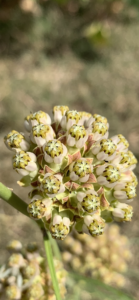
For example there is a reason that Asclepias tuberosa has been known by the vernacular “Butterflyweed” and in contrast A. pumila or A. engelmanniana have not. Where would a growing caterpillar with a ravenous appetite hide on plants of these latter two species? On the other hand, nectar of the flowers from all three of these species may be equally important to adult butterflies. I include a diversity of milkweed species in my postage stamp lawn. The rest of the details I leave to the plants and to the animals that rely on them.
My hope is that we won’t forget that the importance of milkweeds extends far beyond monarch butterflies. There is an excellent field guide funded by the National Science Foundation titled Milkweed, Monarchs and More: a field guide to the invertebrate community in the milkweed patch written by Ba Rea, Karen Oberhauser and Michael A. Quinn and published in 2003. If you don’t have it, you want it!
The Primrose Milkweed (A. oenotheroides) is more common elsewhere in the state where it flowers throughout the year, but the Panhandle boasts its own stand in Palo Duro Canyon State Park. This milkweed is a prime example that milkweeds serve more than just monarchs. The Queen (Danus gilippus), one of the beautiful but less famous “milkweed butterflies,” also benefits from our milkweed work.
There are other milkweeds from the Texas Panhandle that you may find interesting. The Plains Milkweed (A. pumila) is quite small and easily overlooked among the short-grass prairie unless it’s in flower (June-September) or in fruit. It occurs on sandy and caliche soils and is most often found in groups, which helps to make its presence noticed.
Showy Milkweed (A. speciosa) is stunningly eye-grabbing when in bloom May-September, and even more so when you stumble onto a cluster. This may be a species you have already introduced into your own gardens.
Monarchs are the poster child for milkweeds. However a diversity of native plants and their communities sustain these magical creatures that have captured our imagination. The passion for growing natives – championed decades ago by Carroll Abbott and his “Grow good!” philosophy – is in the midst of a resurgence. Who would have thought that a 6-legged beauty would inspire such action? Carroll Abbott, for one, would be pleased.
