By Chelsea Schleifer, Dallas Chapter
The first time I put a plant in the ground in Texas, my husband and I had just purchased our first home. The flowerbeds mustached against the front of our home were pathetically empty with only a few struggling Liriope plants, two Crepe Myrtles with terrible scale, and several overgrown Burford Holly bushes. That’s when I made my first mistake: instead of doing my own research, I cheerfully drove to the nearest plant nursery and asked them to give me a bulletproof plant for shade. They assured me a St. Joseph’s Coat plant would be the perfect fit.
The first one died within a couple weeks. I had never heard of clay soil before. I knew nothing about adding compost or drainage amendments or cutting into the sides of the hole with my shovel to give the roots room to grow. A helpful neighbor loaned me a tiller to break up the dirt. I dug the remaining three up, tilled the soil, and planted again. This time they survived! Success!
…until the following spring. I had assumed they were deciduous when they died over winter. The nursery assured me they were bulletproof. By the end of April, everything else was showing signs of life except my Joseph’s Coats. Turns out they DO make for beautiful, Texas-tough plants…but not in winter. I decided to go learn something about plants to avoid wasting more money and time killing them.
I am practical sometimes to a fault, and everything about natives appealed to me: hardy, tough plants that survive on less water than their non-native counterparts? AND they can be beautiful? Where do I join the club?
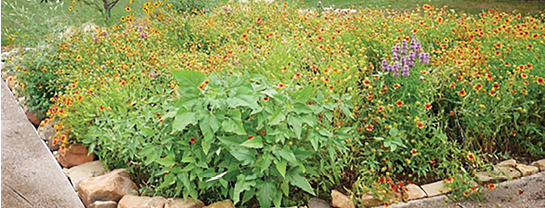
I aggressively converted ecological dead spaces on my property (looking at you, turf grass) into planting beds. Like an obsessive collector, I’ve gradually added over 100 different species of plants to my property, and most of them are native.
I was also thrilled to be the first person to earn the Roots for Wings Certified Pollinator Garden certification for the city of Lewisville–a true honor AND a justification to my neighbors for all my efforts!
Chelsea Schleifer can be reached at graceandgritgardens@pm.me.
Did you like this article? It’s from our Fall 2023 Texas Native Plants magazine. Read more here