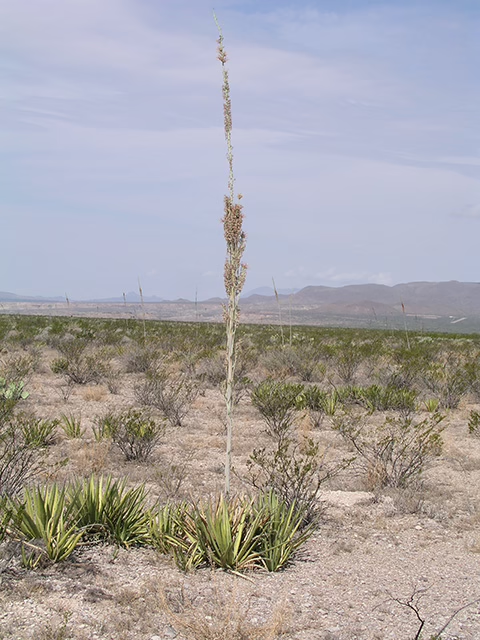


Lechuguilla

Agave lechuguilla

Other common name(s):

Tula Ixtle, Maguey Lechuguilla, Shindagger

Family:

Asparagaceae (Asparagus Family)

Plant Ecoregion Distribution Map

This map uses data from the US EPA. EPA  servers have been offline frequently so maps may not display. We are working on a solution.

Chihuahuan Deserts
Chihuahuan Basins and Playas, Chihuahuan Desert Grasslands, Chihuahuan Montane Woodlands, Low Mountains and Bajadas, Stockton Plateau

Plant Characteristics

Growth Form

Cactus & Succulent

Height

1
to
2
ft.

Spread

to
ft.

Leaf Retention

Evergreen

Lifespan

Perennial

Habitat and Care Requirements

Soil Type(s)

Gravelly, Rocky, Limestone, Calcareous, Dry

Light Requirement

Sun

Water Requirement

Low

Native Habitat

Grassland

Bloom and Attraction

Bloom Color

White, Pink, Yellow

Bloom Season

Spring, Summer

Seasonal Interest

Forage, Nectar, Pollen, Larval Host

Wildlife Benefit

Beetles, Browsers, Butterflies, Hummingbirds, Moths, Bees

Maintenance

Long-lived and drought tolerant. Dense patches of lechuguilla are common due to clonal growth. Plant out of the way of foot traffic due to sharp pointed leaves. Native habitat: desert plains, mountains. This agave is often cultivated in rock gardens. Flowers open in late afternoon and last almost 96 hours. It thrives in more arid environments. When planting, leave ample room for the development of pups/offsets. The species is also a good choice for colder or more dry climates because they are fairly hardy and require very little water.

Description

Blooms May-July. Plants erect rosettes, frequently suckering. Lechuguilla is shallowly rooted. Narrow, fleshy leaves are tipped with a strong spine. Leaf margins are lined with downward pointing spines. Requires 12-15 years to store up enough food for the production of the large flower stalk, which grows up to 15 feet tall. The stalk is unbranched and flexible, so that it often bends when it is heavy with buds or flowers, retaining a permanent, graceful arc. The upper part of the stalk is covered with a solid mass of purplish or yellowish flowers. After producing flowers and seeds, the stalk dies. Flowers are capable of self fertilization, and cross pollination by insects. The fruit is an oblong capsule. Seeds appear smooth and black when fertile and white and dull when infertile. Larval host: Coahuila Giant Skipper (Agathymus remingtoni)/
Previous Scientific Name(s): Agave lophantha var. poselgeri

About the Region

Fall Symposium 2025 Logo - Teach for the Future

Salado, the location of our Fall 2025 Symposium, lies at the intersection of two ecoregions: the Edwards Plateau (Limestone Cut Plain) and Blackland Prairie (Northern Blackland Prairie).

The Edwards Plateau area is also called the Hill Country; however, this general term covers a much larger area extending farther north. Spring-fed creeks are found throughout the region; deep limestone canyons, rivers, and lakes (reservoirs) are common. Ashe juniper is perhaps the most common woody species found throughout the region. Additional woody species include various species of oak, with live oak (Quercus fusiformis) being the most common. Sycamores (Platanus occidentalis) and bald cypress (Taxodium distichum) border waterways. This area is well known for its spring wildflower displays, though they may be viewed in spring, late summer, and fall, as well. According to Texas Parks and Wildlife, average annual rainfall in the Edwards Plateau ranges from 15 to 34 inches.

The Blackland Prairie extends from the Red River south to San Antonio, bordered on the west by the Edwards Plateau and the Cross Timbers, and on the east by the Post Oak Savannah. Annual rainfall averages 30 to 40 inches, with higher averages to the east. This region is dominated by prairie species. The most common grass species include little bluestem (Schizachyrium scoparium) and Indian grass (Sorghastrum nutans) in the uplands and switchgrass (Panicum virgatum) in the riparian areas and drainages. Common herbaceous flowering plants include salvias, penstemons, and silphiums. This area has suffered greatly from overgrazing and agricultural use. Few intact areas remain, though many of the plants can be found along county roadsides throughout the region.

Our fall Symposium host chapter, the Tonkawa Chapter, includes both of these ecoregions.

Source: Wildflowers of Texas by Michael Eason