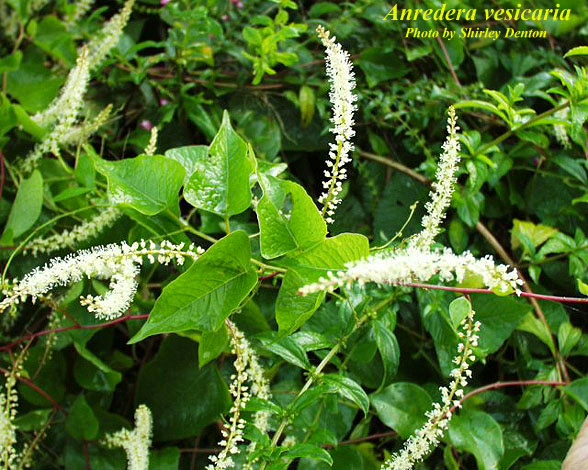


Texas Madeiravine

Anredera vesicaria

Other common name(s):

Sacasile

Family:

Basellaceae (Basella Family)

Plant Ecoregion Distribution Map

This map uses data from the US EPA. EPA  servers have been offline frequently so maps may not display. We are working on a solution.

Gulf Coast Prairies and Marshes, Southern Texas Plains
Lower Rio Grande Alluvial Floodplain, Lower Rio Grande Valley
Rio Grande Floodplain and Terraces, Texas-Tamaulipan Thornscrub

Plant Characteristics

Growth Form

Herbaceous, Vine

Height

3
to
25
ft.

Spread

.5
to
.5
ft.

Leaf Retention

Deciduous

Lifespan

Annual

Habitat and Care Requirements

Soil Type(s)

Clay, Loam, Well Drained

Light Requirement

Sun, Part Shade, Shade

Water Requirement

Low

Native Habitat

Disturbed Areas, Grassland

Bloom and Attraction

Bloom Color

Green, White

Bloom Season

Summer, Fall

Seasonal Interest

Nectar, Pollen

Wildlife Benefit

Bees, Butterflies

Maintenance

Low maintenance. Should be watered sparingly, allowing the soil to dry out between waterings. With its sprawling growth habit, this plant makes an excellent ground cover. It helps prevent soil erosion, making it a practical choice for sloped areas. Likes to spread so give lots of room or thin as needed. Native habitat: disturbed areas, fencerows, roadsides and thickets.

Description

Blooms August-November. Forms twining stems with oval to elliptic leaves with undulating margins. Produces long dangling clusters of tiny flowers. The fruit is a purple/black, slightly triangular capsule.
Previous Scientific Name(s): Anredera leptostachys, Anredera scandens, Basella vesicaria, Boussingaultia leptostachys

About the Region

2026 Fall Symposium Logo

This low-elevations region of Texas extends inland from the barrier islands, about 60 or so miles, and stretches from Brownsville to Louisiana. In total, it covers about 9.5 million acres, with a high point of 150 feet in elevation. More than 1000 species of plants can be found in this region. On the southern end, species more common in Mexico (such as Sabal mexicana) and Central America occur.

The barrier islands provide us with dune systems, and clay flats to the inland side, which have species found in these areas alone. Many plants here, such as Ipomoea pes-caprae (beach morning glory), can be found throughout tropical regions of the globe. I’ve encountered the same species on the beaches of Guam.

Once inland, vast marshes and wet prairies occur. Occasionally, oak (Quercus fusiformis) groves can be found. Common grasses include species of Bothriochloa, Paspalum, and Sporobolus; eastern gamagrass (Tripsacum dactyloides); and switchgrass (Panicum species). Many rivers and creeks cut through the Gulf Prairies, and along these riparian areas various species of trees, Sabal minor, and other plants adapted to clay soils can be found. Due to overgrazing, farming, and fire suppression, woody species such as mesquite (Prosopis glandulosa) and huisache (Acacia farnesiana), and invasive species such as chinaberry (Melia azedarach), Brazilian pepper (Schinus terebinthifolius), and Chinese tallow (Sapium sebiferum) have increased and displaced our native flora.

Source: Wildflowers of Texas by Michael Eason