
Scarlet Bouvardia

Bouvardia ternifolia

Other common name(s):

Firecracker Bush, Trompetilla, Clavillo

Family:

Rubiaceae (Madder Family)

Plant Ecoregion Distribution Map

This map uses data from the US EPA. EPA  servers have been offline frequently so maps may not display. We are working on a solution.

Chihuahuan Deserts
Chihuahuan Desert Grasslands, Chihuahuan Montane Woodlands, Low Mountains and Bajadas

Plant Characteristics

Growth Form

Shrub

Height

3
to
5
ft.

Spread

2
to
3
ft.

Leaf Retention

Deciduous

Lifespan

Perennial

Habitat and Care Requirements

Soil Type(s)

Dry, Granitic, Gravelly, Loam, Rocky, Sand, Well Drained

Light Requirement

Part Shade

Water Requirement

Low

Native Habitat

Shrubland, Woodland

Bloom and Attraction

Bloom Color

Red

Bloom Season

Spring, Summer, Fall

Seasonal Interest

Flowers, Forage, Nectar

Wildlife Benefit

Browsers, Hummingbirds

Maintenance

Most often used as a flower in mass or singly. It makes a beautiful border. Trim if a dense appearance is desired. Not very winter hardy. Can be grown in a container and taken indoors in cold weather. Good drainage is very important. Native habitat: Native habitat: rocky slopes and canyon bottoms, from 2,500-8,000 ft, pine-oak and juniper-oak woodlands, oak chaparral, granite sand.

Description

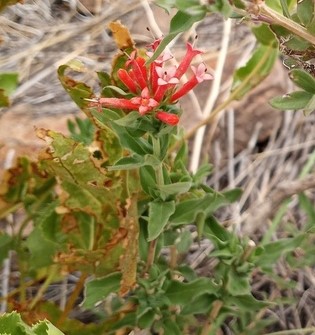
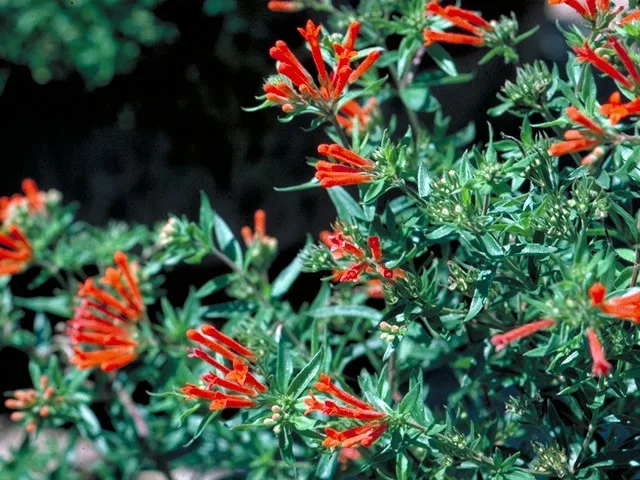
Blooms May-November. Firecracker-bush has shiny, oval, dark-green leaves. Bugle-shaped red flowers occur in loose clusters at ends of branches. The Spanish name, Trompetilla, which means “little trumpet,” refers to the corolla’s shape. The fruit is a capsule.
Previous Scientific Name(s): Bouvardia glaberrima

References

1) Griffith, Bryce, Omernick & Rodgers (2007). Ecoregions of Texas. 2) http://bonap.net/TDC/Image/Map?taxonType=Species&taxonId=21986&locationType=County&mapType=Normal 3) https://www.wildflower.org/plants/result.php?id_plant=BOTE2. 4) https://portal.torcherbaria.org/portal/taxa/index.php?taxon=Bouvardia+ternifolia&formsubmit=Search+Terms. 5) Wasowski, Sally and Wasowski, Andy, Native Texas Plants, Landscaping Region by Region, 1988, 1991, pg 234. 6) Miller, George O., Landscaping with Native Plants of Texas 2nd Ed., 2013, pg 48., 7) https://www.itis.gov/servlet/SingleRpt/SingleRpt?search_topic=TSN&search_value=34953#null
Material Treatment Method Collection References
Semi-harwood Cutting Remove lower leaves and immerse the cut end in rooting hormone. Plant cuttings in a well-draining medium, keep moist but not waterlogged, and maintain high humidity to encourage root development. Patience is needed as rooting can take several weeks. The optimal time to propagate bouvardia tenuifolia via cuttings is during late spring to early summer. This period ensures warm temperatures and ample sunlight, essential for root development. Using semi-ripe cuttings during this time maximizes success, as the plant’s growth phase supports robust root formation. Always opt for well-draining soil and maintain consistent moisture levels. Select healthy, semi-hardwood stems and ensure cuttings are 4-6 inches in length. 1) https://www.picturethisai.com/care/propagate/Bouvardia_tenuifolia.html#:~:text=Bouvardia%20tenuifolia%20thrives%20with%20cutting,rooting%20can%20take%20several%20weeks. 2) https://earthone.io/plant/bouvardia%20ternifolia?srsltid=AfmBOoosQDJTkScRlA2xbVD615i2iM0gEBrji2dc81LSCmQfC5LDdT3P
Root Division Unearth the Bounty: Carefully dig up the entire plant. Divide and Conquer: Gently separate the root ball into smaller sections, ensuring each division has healthy roots and shoots. Replant and Thrive: Replant the divisions in wellprepared soil, spacing them according to the mature size of the plant. This method is best done in early spring or fall when the plant is dormant. https://propagate.one/how-to-propagate-bouvardia-ternifolia/?print=pdf

About the Region

2026 Fall Symposium Logo

This low-elevations region of Texas extends inland from the barrier islands, about 60 or so miles, and stretches from Brownsville to Louisiana. In total, it covers about 9.5 million acres, with a high point of 150 feet in elevation. More than 1000 species of plants can be found in this region. On the southern end, species more common in Mexico (such as Sabal mexicana) and Central America occur.

The barrier islands provide us with dune systems, and clay flats to the inland side, which have species found in these areas alone. Many plants here, such as Ipomoea pes-caprae (beach morning glory), can be found throughout tropical regions of the globe. I’ve encountered the same species on the beaches of Guam.

Once inland, vast marshes and wet prairies occur. Occasionally, oak (Quercus fusiformis) groves can be found. Common grasses include species of Bothriochloa, Paspalum, and Sporobolus; eastern gamagrass (Tripsacum dactyloides); and switchgrass (Panicum species). Many rivers and creeks cut through the Gulf Prairies, and along these riparian areas various species of trees, Sabal minor, and other plants adapted to clay soils can be found. Due to overgrazing, farming, and fire suppression, woody species such as mesquite (Prosopis glandulosa) and huisache (Acacia farnesiana), and invasive species such as chinaberry (Melia azedarach), Brazilian pepper (Schinus terebinthifolius), and Chinese tallow (Sapium sebiferum) have increased and displaced our native flora.

Source: Wildflowers of Texas by Michael Eason