
Pecan

Carya illinoinensis

Other common name(s):

Family:

Juglandaceae (Walnut Family)

Plant Ecoregion Distribution Map

This map uses data from the US EPA. EPA  servers have been offline frequently so maps may not display. We are working on a solution.

Central Great Plains, Chihuahuan Deserts, Cross Timbers, East Central Texas Plains, Edwards Plateau, Gulf Coast Prairies and Marshes, Southwestern Tablelands, Texas Blackland Prairies, Western Gulf Coastal Plain
Broken Red Plains, Limestone Plains
Chihuahuan Basins and Playas, Chihuahuan Desert Grasslands, Chihuahuan Montane Woodlands, Low Mountains and Bajadas
Eastern Cross Timbers
Bastrop Lost Pines, Floodplains and Low Terraces2, San Antonio Prairie, Southern Post Oak Savanna
Balcones Canyonlands, Edwards Plateau Woodland, Llano Uplift, Semiarid Edwards Plateau
Floodplains and Low Terraces4, Lower Rio Grande Alluvial Floodplain, Lower Rio Grande Valley, Northern Humid Gulf Coastal Prairies
Semiarid Edwards Bajada
Caprock Canyons Badlands Breaks, Flat Tablelands and Valleys
Floodplains and Low Terraces1, Northern Blackland Prairie, Southern Blackland Prairie
Flatwoods

Plant Characteristics

Growth Form

Tree

Height

60
to
75
ft.

Spread

40
to
75
ft.

Leaf Retention

Deciduous

Lifespan

Perennial

Habitat and Care Requirements

Soil Type(s)

Deep, Moist

Light Requirement

Sun

Water Requirement

High

Native Habitat

Riparian, Woodland

Bloom and Attraction

Bloom Color

Yellow

Bloom Season

Spring

Seasonal Interest

Larval Host, Nectar, Nesting Material, Nuts

Wildlife Benefit

Birds, Butterflies, Small Mammals

Maintenance

Slow growing. Makes an excellent shade tree. Needs deep soil. Hard to transplant due to long tap root. May be pruned for shape or to raise canopy. Susceptible to galls, twig girdlers, aphids, borers, weevils, pecan scab, tent caterpillars, and webworms. Native habitat: wooded bottomlands and stream banks.

Description

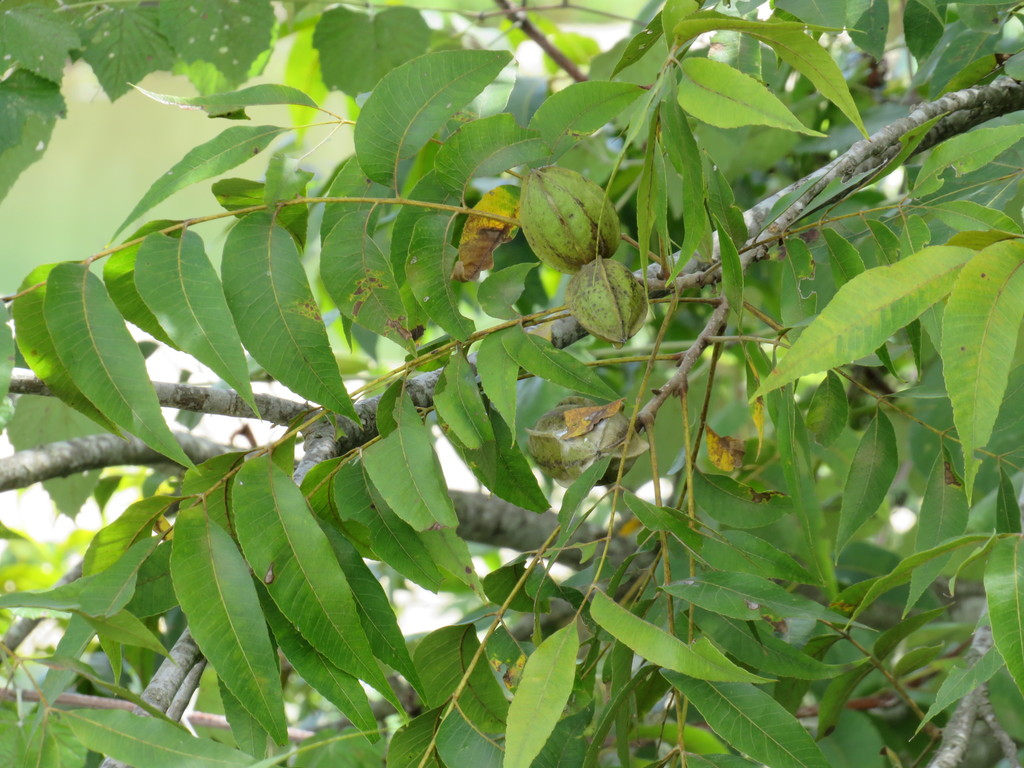
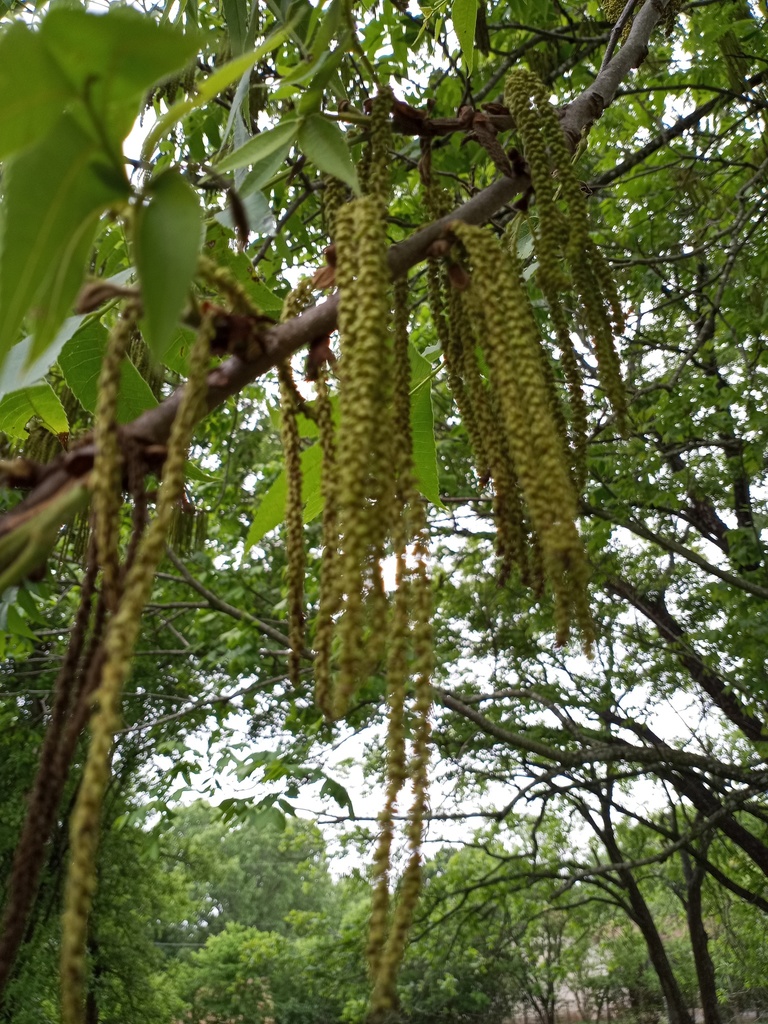
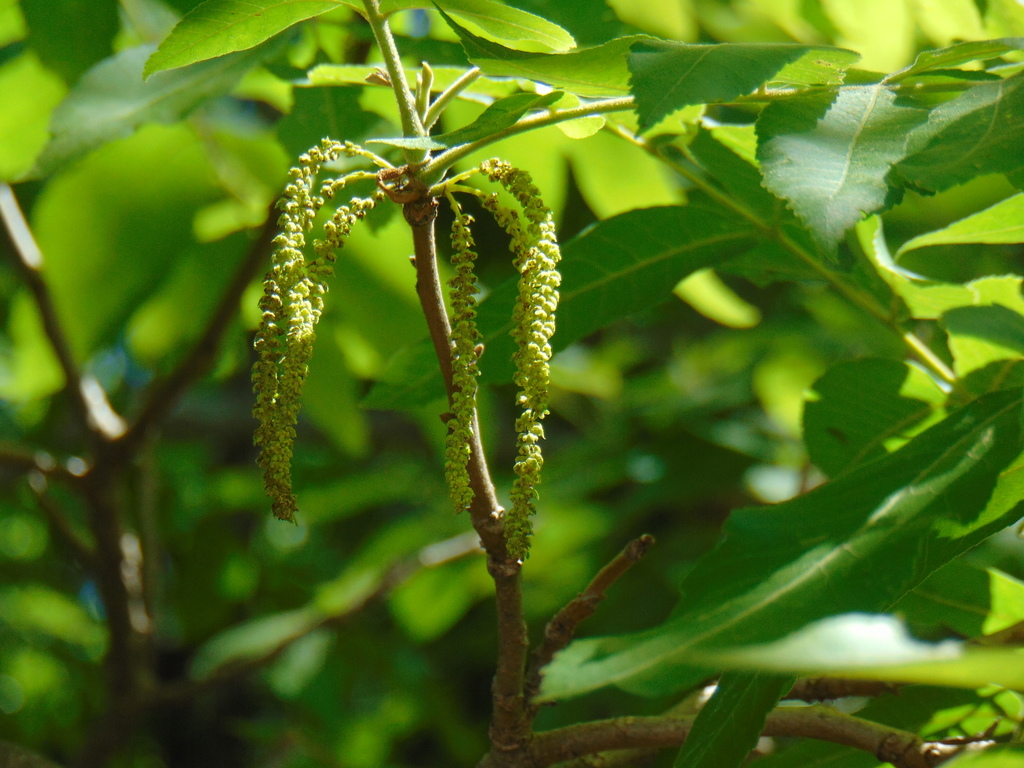
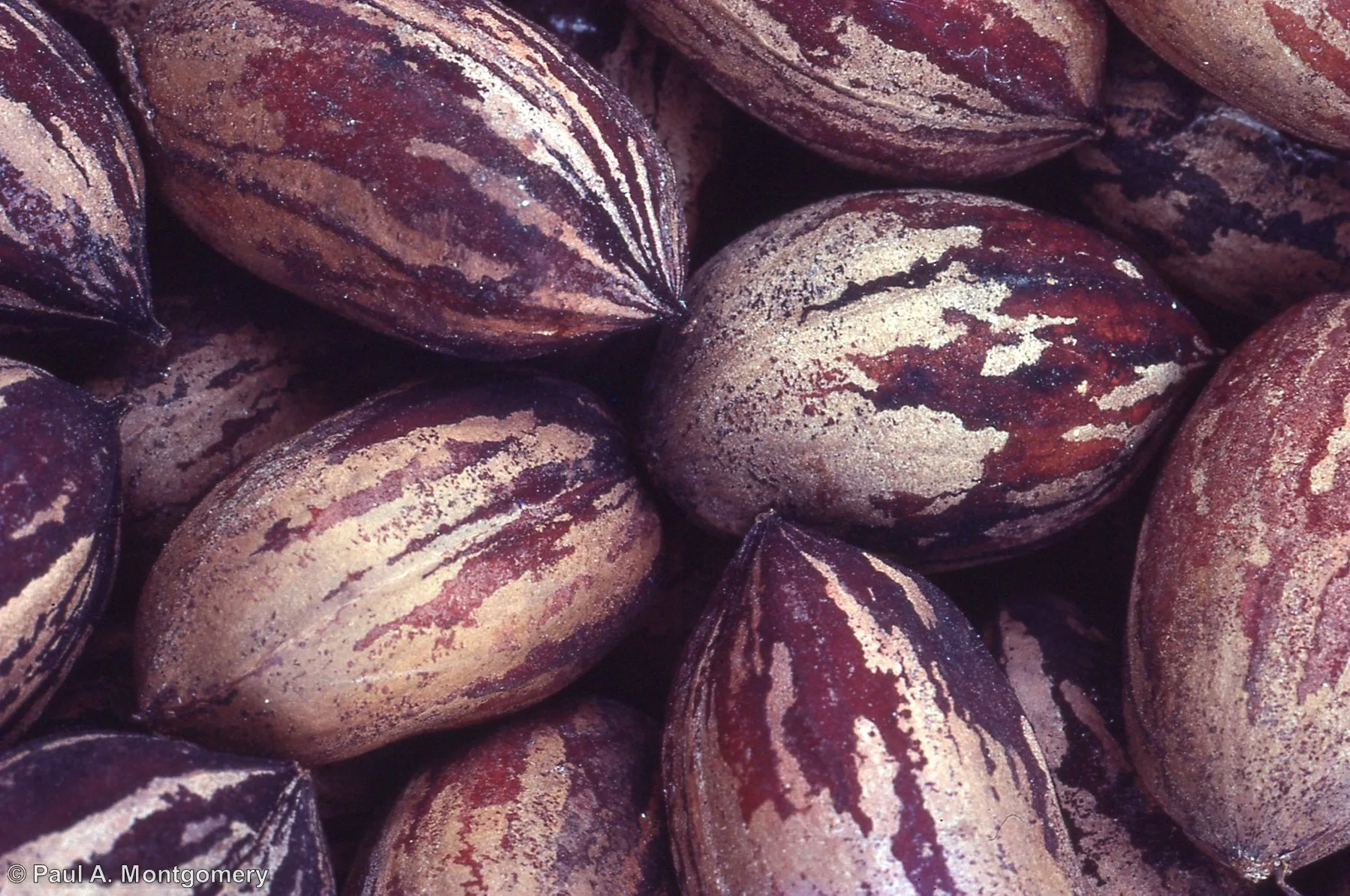
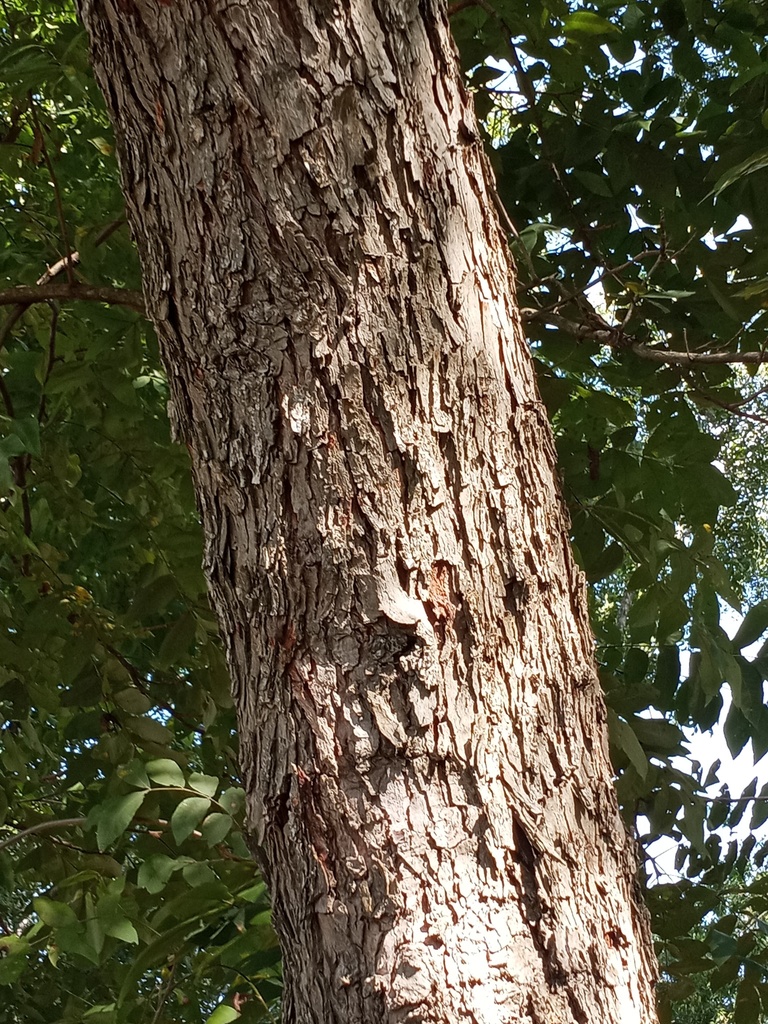
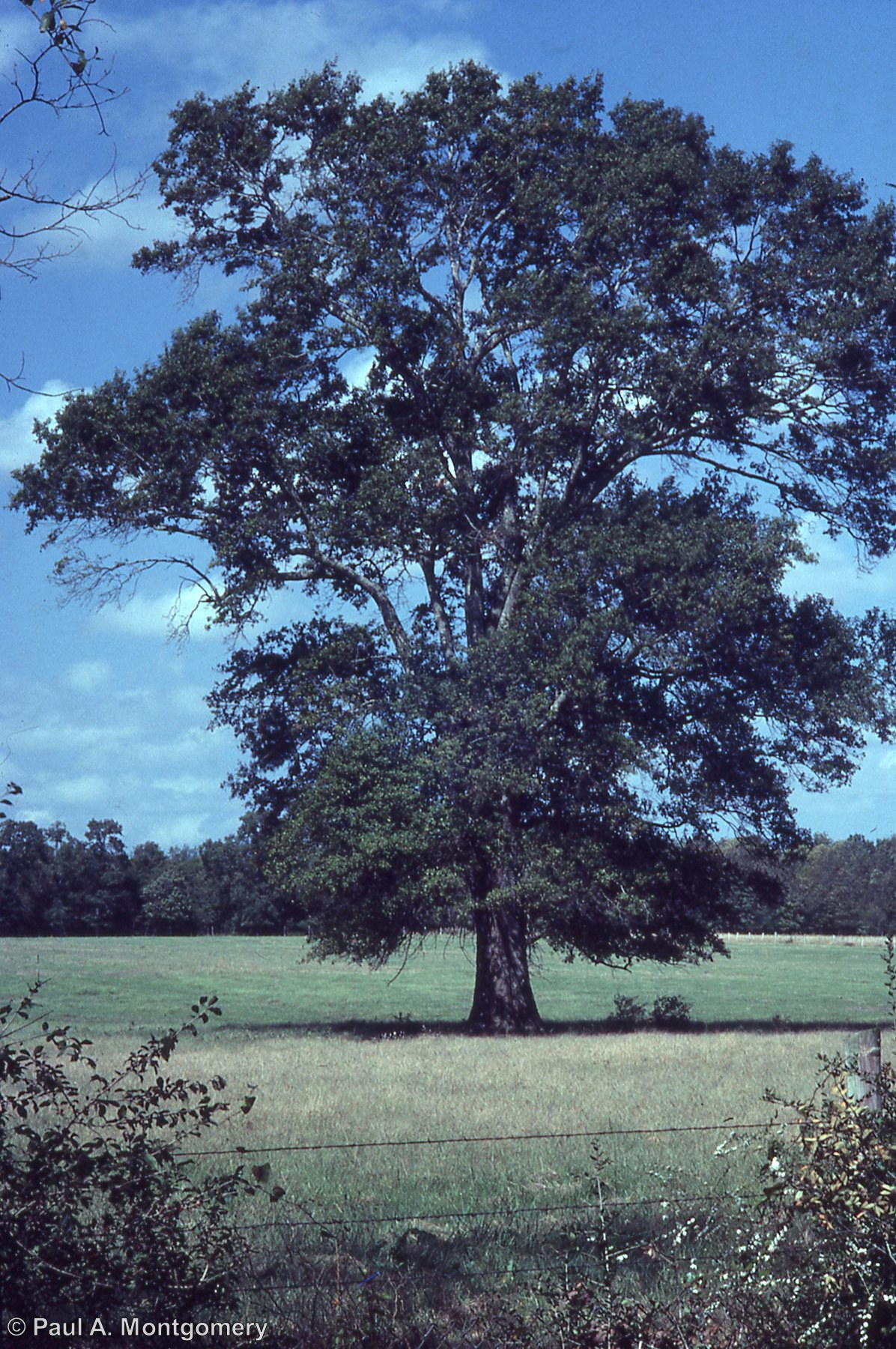
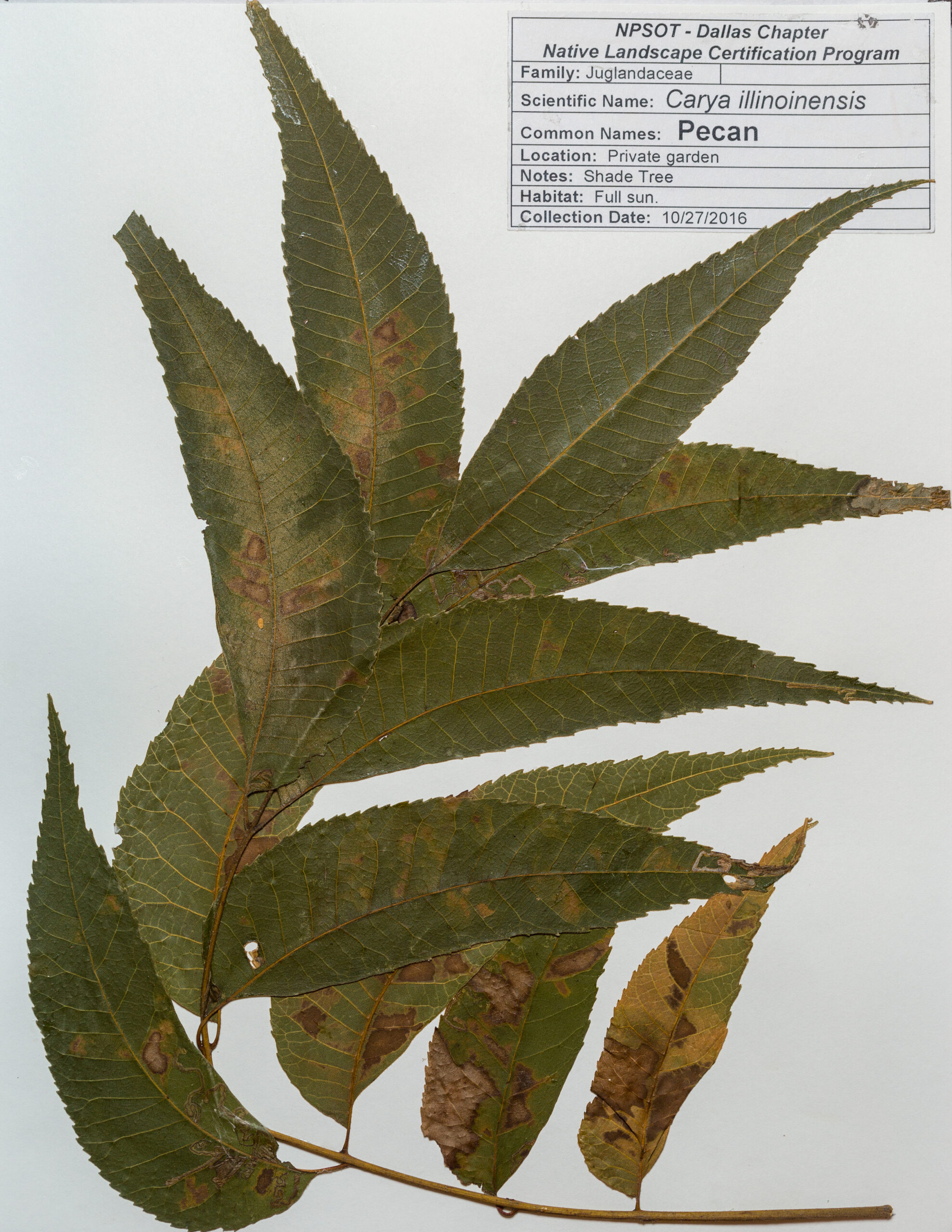
Blooms March-May. A tall impressive tree with Bark light gray or brownish, ridged with appressed scales or exfoliating with small platelike scales. Compound leaves are divided into 11-17 lance-shaped leaflets. Inconspicuous flowers are arranged on long hanging clusters. The fruit is an oblong nut, enclosed in a thin husk, splitting open at maturity. Larval host: Gray Hairstreak. Replaces non-natives: Tree of Heaven (Varnishtree, Stinktree).
Previous Scientific Name(s): Carya oliviformis, Carya pecan, Hicoria pecan

References

Material Treatment Method Collection References
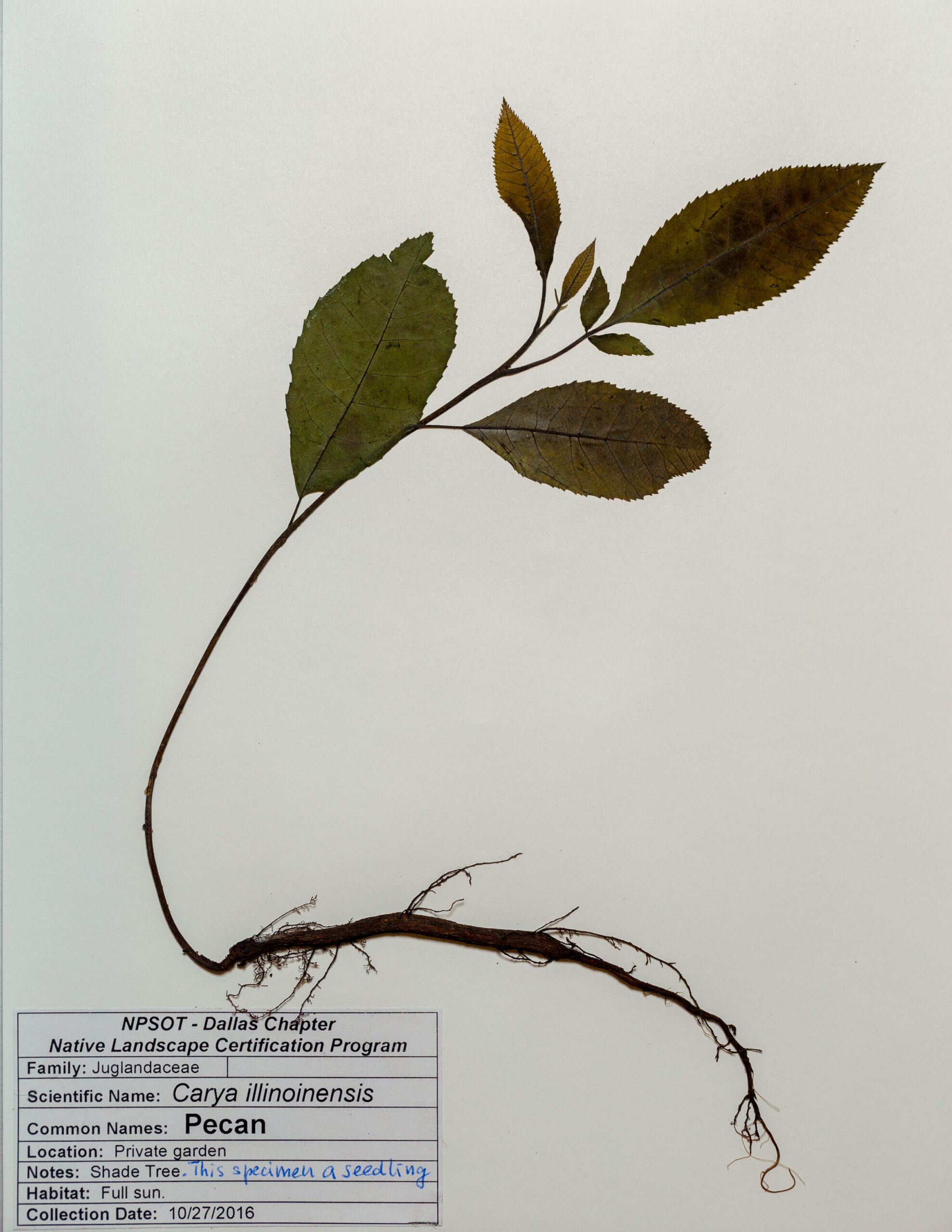
Seed Stratification Seeds are best sown in a cold frame as soon as they are ripe. Pecan seeds show delayed germination and require a period of cold stratification. Seeds should be stratified at 36-41º F for thirty to sixty days and then followed by incubation at room temperature. The seedlings should be transplanted when they are large enough to handle and planted in deep pots to accommodate the taproot. Put the plants in their permanent positions as soon as possible, preferable during the first summer, and give them some protection from the cold for the first winter. Pecan requires a frost-free period of 6 to 9 months for nuts to be produced and mature. The trees require 1 to 2 inches of rain per week during the growing season. 1) https://plants.usda.gov/DocumentLibrary/plantguide/pdf/pg_cail2.pdf 2) https://hort.ifas.ufl.edu/database/lppi/sp070.shtml#:~:text=Time%20of%20year%20to%20graft,and%20stored%20at%2035%20F. 3) https://hort.ifas.ufl.edu/database/lppi/sp070.shtml
Softwood Cutting Dip the severed end of the cutting in 1 percent IBA (indolebutyric acid) rooting talc or rooting hormone. Flick the stem to knock loose the excess talc. Insert the pecan cutting to half its length into the moistened perlite. Shake the pot gently to settle the perlite against the stem. Drizzle water around the cutting to further settle it. Place the pecan cutting outdoors where it will receive light shade and shelter from the wind. Choose a spot with no midday sun or western sun. This kind of sunlight will desiccate the cutting. One of the keys is if you had a misting sprinkler that was on a timer to come on twice during the day. Preferably not allowing the water droplets to stay on the leaves overnight. A light mist over the pecan cutting with a spray bottle twice a day will prevent drying out. Moisten the perlite whenever you mist the cutting, so it never fully dries out. If you close this area in a mini-greenhouse keep in mind that the pecan cutting will be susceptible to a variety of diseases. Roots of your cutting should appear in 6 to 8 weeks by lightly tugging on the stem and feeling for resistance. Fill a 5-inch peat pot with perlite or vermiculite. Pour water into the pot until the perlite is saturated and the sides of the pot feel moist. Transplant the rooted pecan cutting into a 1-gallon container filled with garden soil. A south-facing wall will be the best location to place your new plant to protect your plant from the winter winds. Water your pecan cutting only if the weather is dry for longer than two weeks. Transplant your 1-year-old plant into your garden in the spring. Take cuttings in late spring or early summer when the tree is no longer dormant. Gather a 6-inch-long tip cutting from a healthy side branch. Select one with a pliant, ¼-inch-thick stem and plenty of foliage. Avoid branches with blossoms. Sever the cutting 1/16-inch below a mature leaf using bypass shears or utility knife or grafting knife. Before making the cut, dip the blade in rubbing alcohol, which stops diseases. Make the cut slightly angled to expose a larger portion of the inner flesh. Pull off all the leaves along the lower half of the cutting. 1) https://hort.ifas.ufl.edu/database/lppi/sp070.shtml#:~:text=Time%20of%20year%20to%20graft,and%20stored%20at%2035%20F. 2) https://www.times-gazette.com/story/lifestyle/2019/04/29/a-stroll-through-garden-starting/5316186007/ 3) https://hort.ifas.ufl.edu/database/lppi/sp070.shtml

About the Region

2026 Fall Symposium Logo

This low-elevations region of Texas extends inland from the barrier islands, about 60 or so miles, and stretches from Brownsville to Louisiana. In total, it covers about 9.5 million acres, with a high point of 150 feet in elevation. More than 1000 species of plants can be found in this region. On the southern end, species more common in Mexico (such as Sabal mexicana) and Central America occur.

The barrier islands provide us with dune systems, and clay flats to the inland side, which have species found in these areas alone. Many plants here, such as Ipomoea pes-caprae (beach morning glory), can be found throughout tropical regions of the globe. I’ve encountered the same species on the beaches of Guam.

Once inland, vast marshes and wet prairies occur. Occasionally, oak (Quercus fusiformis) groves can be found. Common grasses include species of Bothriochloa, Paspalum, and Sporobolus; eastern gamagrass (Tripsacum dactyloides); and switchgrass (Panicum species). Many rivers and creeks cut through the Gulf Prairies, and along these riparian areas various species of trees, Sabal minor, and other plants adapted to clay soils can be found. Due to overgrazing, farming, and fire suppression, woody species such as mesquite (Prosopis glandulosa) and huisache (Acacia farnesiana), and invasive species such as chinaberry (Melia azedarach), Brazilian pepper (Schinus terebinthifolius), and Chinese tallow (Sapium sebiferum) have increased and displaced our native flora.

Source: Wildflowers of Texas by Michael Eason