

Golden Dalea

Dalea aurea

Other common name(s):

Golden Prairie Clover

Family:

Fabaceae (Pea Family)

Plant Ecoregion Distribution Map

This map uses data from the US EPA. EPA  servers have been offline frequently so maps may not display. We are working on a solution.

Central Great Plains, Chihuahuan Deserts, Cross Timbers, East Central Texas Plains, Edwards Plateau, High Plains, Southern Texas Plains, Southwestern Tablelands, Texas Blackland Prairies
Broken Red Plains, Limestone Plains
Chihuahuan Basins and Playas, Chihuahuan Desert Grasslands, Chihuahuan Montane Woodlands, Low Mountains and Bajadas, Stockton Plateau
Carbonate Cross Timbers, Eastern Cross Timbers, Grand Prairie, Limestone Cut Plain, Western Cross Timbers
Bastrop Lost Pines, Floodplains and Low Terraces2, Northern Post Oak Savanna, Northern Prairie Outliers, San Antonio Prairie, Southern Post Oak Savanna
Balcones Canyonlands, Edwards Plateau Woodland, Llano Uplift, Semiarid Edwards Plateau
Canadian/Cimarron High Plains, Llano Estacado, Rolling Sand Plains
Northern Nueces Alluvial Plains, Semiarid Edwards Bajada
Canadian/Cimarron Breaks, Caprock Canyons Badlands Breaks, Flat Tablelands and Valleys, Semiarid Canadian Breaks
Floodplains and Low Terraces1, Northern Blackland Prairie, Southern Blackland Prairie

Plant Characteristics

Growth Form

Herbaceous

Height

.5
to
2
ft.

Spread

.5
to
2
ft.

Leaf Retention

Deciduous

Lifespan

Perennial

Habitat and Care Requirements

Soil Type(s)

Calcareous, Dry, Gravelly, Limestone, Silt

Light Requirement

Sun

Water Requirement

Very Low, Low

Native Habitat

Grassland

Bloom and Attraction

Bloom Color

Yellow

Bloom Season

Spring

Seasonal Interest

Larval Host, Nectar, Pollen

Wildlife Benefit

Bees, Butterflies

Maintenance

A long tap root allows this plant to be drought tolerant. Golden Dalea grows well in rock gardens and dry soils. Cut back in summer to encourage new growth for fall. Native habitat: silty or gravelly prairies, often over limestone.

Description

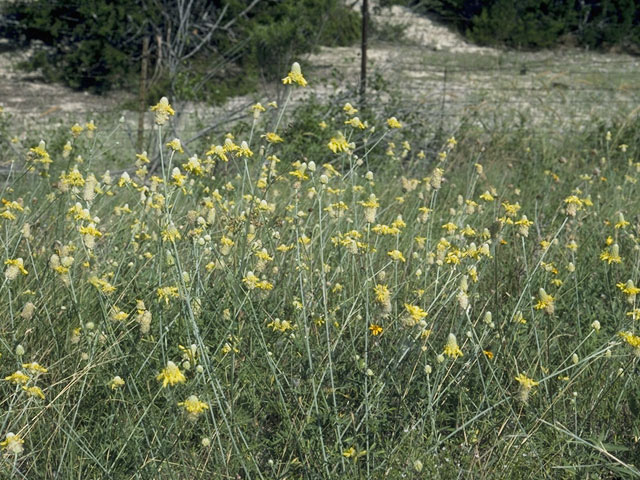
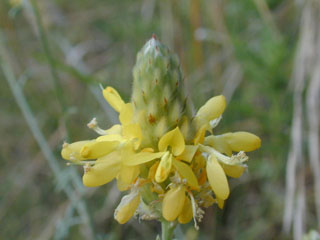
Blooms April-June. Stiff stems topped with cone-shaped, fuzzy yellow flower spikes. Compound leaves with five silky, hairy leaflets. Roundish, wafer-like single seeds. Larval host: Reakirt’s Blue Butterfly.
Previous Scientific Name(s): Parosela aurea
Material Treatment Method Collection References
Seed Scarification Sow in early spring in a greenhouse. The seed has a hard seedcoat and benefits from scarification before sowing in order to speed up and improve germination. This can usually be done by pouring a small amount of nearly boiling water on the seeds (being careful not to cook them!) and then soaking them for 12 - 24 hours in warm water. By this time they should have imbibed moisture and swollen - if they have not, then carefully make a nick in the seedcoat (being careful not to damage the embryo) and soak for a further 12 hours before sowing. When they are large enough to handle, prick the seedlings out into individual pots and plant them out into their permanent positions in the summer. Allow pods to dry on plant; break open to collect seeds 1) https://temperate.theferns.info/plant/Dalea+aurea#:~:text=Propagation,/plant/Dalea+aurea%3E 2) https://davesgarden.com/guides/pf/go/68331
Stem Cutting Dip the cut base of the cutting into a rooting hormone powder to promote root development and reduce the risk of disease. Fill a small pot with a well-draining propagation mix (e.g., a mixture of perlite and peat moss). Make a hole in the medium with a pencil or similar tool, and insert the cutting. Firm the soil gently around the cutting to ensure good contact. Water the cutting thoroughly but avoid waterlogging the soil. Maintain a humid environment by covering the pot with a plastic bag or placing it in a propagation dome. Ensure the bag or dome has ventilation holes to prevent fungal growth. Place the pot in a warm location with indirect light. Monitor the moisture level and humidity, ensuring the soil remains moist but not overly wet. In 4-6 weeks, check for root development by gently tugging the cutting. Once roots have established, transplant the cutting to its final location with well-draining soil. Golden prairie clover thrives in full sun to partial shade and requires moderate watering until it is well-established. Afterward, it is relatively drought-tolerant. Regularly check for pests and diseases, and provide minimal fertilization, as golden prairie clover generally prefers nutrient-poor soils. Select healthy, semi-hardwood cuttings from the parent plant, preferably around 4-6 inches long. Ensure the cutting includes at least a couple of nodes, and remove the leaves from the lower half, leaving a few at the top. https://www.picturethisai.com/care/propagate/Dalea_aurea.html

About the Region

2026 Fall Symposium Logo

This low-elevations region of Texas extends inland from the barrier islands, about 60 or so miles, and stretches from Brownsville to Louisiana. In total, it covers about 9.5 million acres, with a high point of 150 feet in elevation. More than 1000 species of plants can be found in this region. On the southern end, species more common in Mexico (such as Sabal mexicana) and Central America occur.

The barrier islands provide us with dune systems, and clay flats to the inland side, which have species found in these areas alone. Many plants here, such as Ipomoea pes-caprae (beach morning glory), can be found throughout tropical regions of the globe. I’ve encountered the same species on the beaches of Guam.

Once inland, vast marshes and wet prairies occur. Occasionally, oak (Quercus fusiformis) groves can be found. Common grasses include species of Bothriochloa, Paspalum, and Sporobolus; eastern gamagrass (Tripsacum dactyloides); and switchgrass (Panicum species). Many rivers and creeks cut through the Gulf Prairies, and along these riparian areas various species of trees, Sabal minor, and other plants adapted to clay soils can be found. Due to overgrazing, farming, and fire suppression, woody species such as mesquite (Prosopis glandulosa) and huisache (Acacia farnesiana), and invasive species such as chinaberry (Melia azedarach), Brazilian pepper (Schinus terebinthifolius), and Chinese tallow (Sapium sebiferum) have increased and displaced our native flora.

Source: Wildflowers of Texas by Michael Eason