
Sand Lovegrass

Eragrostis trichodes

Other common name(s):

Sand Love Grass

Family:

Poaceae (Grass Family)

Plant Ecoregion Distribution Map

This map uses data from the US EPA. EPA  servers have been offline frequently so maps may not display. We are working on a solution.

Central Great Plains, Cross Timbers, East Central Texas Plains, Edwards Plateau, Gulf Coast Prairies and Marshes, High Plains, Southwestern Tablelands, Texas Blackland Prairies, Western Gulf Coastal Plain
Broken Red Plains, Limestone Plains, Red Prairie
Carbonate Cross Timbers, Eastern Cross Timbers, Grand Prairie, Limestone Cut Plain, Western Cross Timbers
Bastrop Lost Pines, Floodplains and Low Terraces2, Northern Post Oak Savanna, Northern Prairie Outliers, San Antonio Prairie, Southern Post Oak Savanna
Balcones Canyonlands, Edwards Plateau Woodland, Llano Uplift
Lower Rio Grande Alluvial Floodplain, Lower Rio Grande Valley, Southern Subhumid Gulf Coastal Prairies
Canadian/Cimarron High Plains, Llano Estacado, Rolling Sand Plains
Canadian/Cimarron Breaks, Caprock Canyons Badlands Breaks, Flat Tablelands and Valleys, Semiarid Canadian Breaks
Floodplains and Low Terraces1, Northern Blackland Prairie, Southern Blackland Prairie
Floodplains and Low Terraces3, Pleistocene Fluvial Terraces, Red River Bottomlands, Southern Tertiary Uplands, Tertiary Uplands

Plant Characteristics

Growth Form

Grass & Sedge

Height

1
to
5
ft.

Spread

2
to
3
ft.

Leaf Retention

Deciduous

Lifespan

Perennial

Habitat and Care Requirements

Soil Type(s)

Deep, Sand

Light Requirement

Sun

Water Requirement

Medium

Native Habitat

Grassland, Woodland

Bloom and Attraction

Bloom Color

Yellow

Bloom Season

Spring

Seasonal Interest

Fall Color, Forage, Larval Host, Nesting Material

Wildlife Benefit

Bees, Birds, Browsers, Small Mammals

Maintenance

Frequently flops over on its neighbors in late season. Leaves turn rusty-tan when dormant. Sand Lovegrass grows best on sandy land in the 18 to 35 inch rain belt, but is sometimes planted on heavier soils. Provides increased ground cover which reduces both wind and water erosion on fragile sandy soil sites. This is a beautiful ornamental grass with airy seed heads. When planted in groups or mass planted in native plant areas or meadows it will naturalize. In the fall, it provides winter interest in beds and borders as well. Not common in plant nurseries but seeds are available commercially. Native habitat: open, sandy woods, sand barrens.

Description

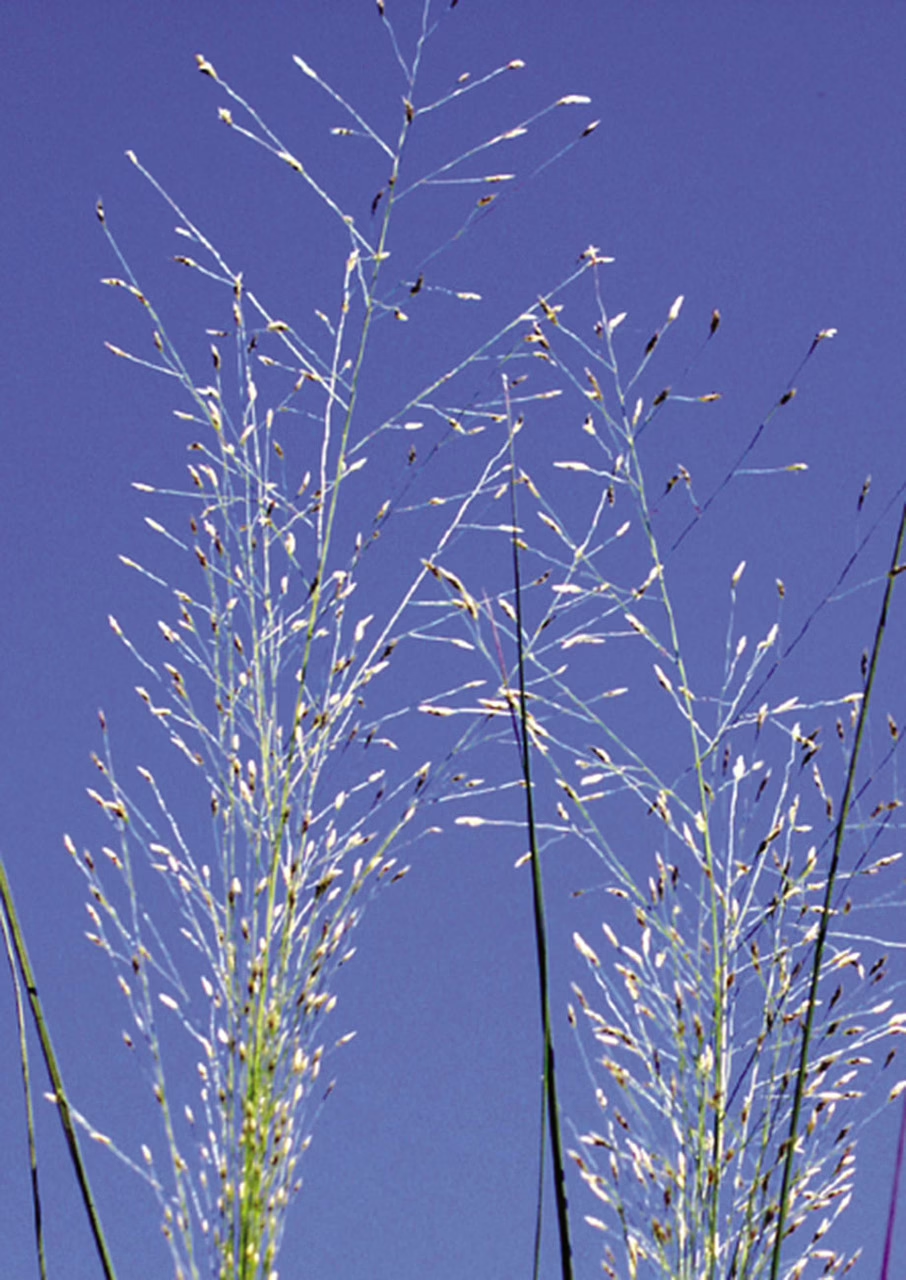
Blooms April-May. A warm season bunch grass with graceful, arching stems. It’s showy purple tinted to coppery orange flowers appear in loose, open panicles in summer. The narrow leaf blade will roll inward under dry conditions to conserve moisture. Larval host: paradoxical grass moth.
Previous Scientific Name(s): Eragrostis pilifera, Eragrostis trichodes var. pilifera, Poa trichodes
Material Treatment Method Collection References
Seed Stratification Seeds are placed in cold moist stratification for 14 days. Germination occurs at 30D/20N C alternating temperature cycle. Dry storage of spring germinating seeds resulted in 62% germination. Heating pretreatment resulted in 100% germination. Pretreatment with potassium nitrate resulted in 63% germination. https://npn.rngr.net/renderNPNProtocolDetails?selectedProtocolIds=poaceae-eragrostis-1770#:~:text=General%20Distribution:,Citation:
Seed No Treatment Sowing outdoors: seedbed preparation should provide a weed free, firm surface on which to plant. Since seed sze is small the planting depth should be 2.5 to 5 mm to allow seedling emergence. Neoteric seed of E. trichodes often shows considerable dormancy. This quality may be considered desirable for range seedings since seedlings continue to emerge over a longer period of time (Ahring et al. 1963). Sowing indoors: Direct sow either in late fall or early spring. Press the Eragrostis Trichodes seed into the surface of the soil, compacting the soil very firmly. . Keep the soil lightly moist until germination. Water seedlings occasionally until they become established. Mature plants tolerate heat and drought well, since they prefer dry and sandy soil. This plant readily spreads and reseeds itself, and can grow very quickly in good conditions. It makes an excellent choice for erosion control, as well as being a beautiful ornamental grass. At the end of the season, the seed heads will begin to ripen and turn color. Strip the seed from the stem, and separate the seed from the plant material. Store the sand love grass seeds in a cool, dry place. 1) https://plants.usda.gov/DocumentLibrary/plantguide/pdf/pg_ertr3.pdf 2) https://www.everwilde.com/store/Eragrostis-trichodes-Seed.html

About the Region

2026 Fall Symposium Logo

This low-elevations region of Texas extends inland from the barrier islands, about 60 or so miles, and stretches from Brownsville to Louisiana. In total, it covers about 9.5 million acres, with a high point of 150 feet in elevation. More than 1000 species of plants can be found in this region. On the southern end, species more common in Mexico (such as Sabal mexicana) and Central America occur.

The barrier islands provide us with dune systems, and clay flats to the inland side, which have species found in these areas alone. Many plants here, such as Ipomoea pes-caprae (beach morning glory), can be found throughout tropical regions of the globe. I’ve encountered the same species on the beaches of Guam.

Once inland, vast marshes and wet prairies occur. Occasionally, oak (Quercus fusiformis) groves can be found. Common grasses include species of Bothriochloa, Paspalum, and Sporobolus; eastern gamagrass (Tripsacum dactyloides); and switchgrass (Panicum species). Many rivers and creeks cut through the Gulf Prairies, and along these riparian areas various species of trees, Sabal minor, and other plants adapted to clay soils can be found. Due to overgrazing, farming, and fire suppression, woody species such as mesquite (Prosopis glandulosa) and huisache (Acacia farnesiana), and invasive species such as chinaberry (Melia azedarach), Brazilian pepper (Schinus terebinthifolius), and Chinese tallow (Sapium sebiferum) have increased and displaced our native flora.

Source: Wildflowers of Texas by Michael Eason