
Joe Pye Weed

Eutrochium fistulosum

Other common name(s):

Trumpetweed, Queen Of The Meadow, Hollow Joe-pye Weed

Family:

Asteraceae (Aster Family)

Plant Ecoregion Distribution Map

This map uses data from the US EPA. EPA  servers have been offline frequently so maps may not display. We are working on a solution.

Western Gulf Coastal Plain
Flatwoods, Southern Tertiary Uplands

Plant Characteristics

Growth Form

Herbaceous

Height

5
to
7
ft.

Spread

2
to
4
ft.

Leaf Retention

Deciduous

Lifespan

Perennial

Habitat and Care Requirements

Soil Type(s)

Clay, Dry, Loam, Moist, Rocky, Sand, Shallow

Light Requirement

Sun

Water Requirement

Medium, High

Native Habitat

Riparian, Wetland, Woodland

Bloom and Attraction

Bloom Color

Pink, Purple

Bloom Season

Summer

Seasonal Interest

Nectar, Pollen, Seeds

Wildlife Benefit

Bees, Birds, Butterflies

Maintenance

Landscape uses include meadows, naturalized areas, ponds, woodland, butterfly garden, pollinator garden, rain garden, mass planting. Its height makes this a dramatic accent in the back of a garden. Native habitat: alluvial woods, meadows, bogs, marshes, stream banks.

Description

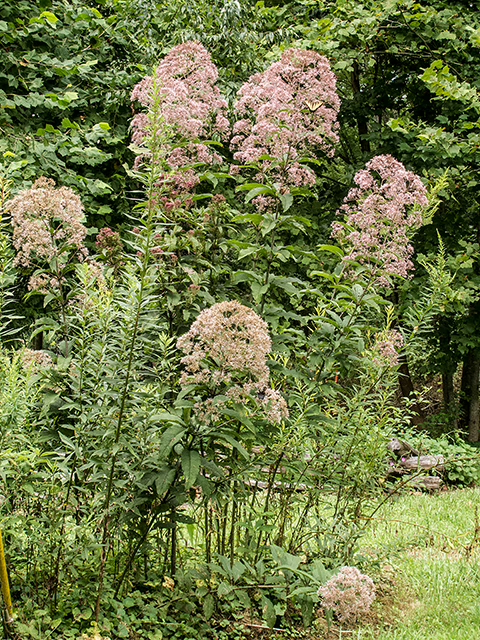
Blooms July-September. An erect, clump-forming plant. characterized by the hollow central cavity of the stem. The stem is also covered with a whitish bloom, and is usually purplish. Dark green leaves are lance-shaped, serrated and whorled on the stem. The flowers have a vanilla scent, and occur in rounded clusters of 5 to 7 florets per head that are up to 12-18 inches across. Larval host: Pearl Crescent (Phyciodes tharos). Fruit: small dry seeds with hair-like bristles are dispersed by the wind.
Previous Scientific Name(s): Eupatoriadelphus fistulosus, Eupatorium fistulosum
Material Treatment Method Collection References
Seed Stratification Mix seeds with damp, but not wet, soil, Place mixture in a sealed plastic bag and store in a refrigerator (33-38 F). Leave for 60 days. Some seeds may sprout in the bag. Plant them immmediately. The nutlets mature to shiny black 4-5 weeks after the flower has faded. Only a small percentage viable; these will be plump and swollen. To collect, either take the entire top of the plant or shake it into a paper bag. Seeds can be allowed to dry out before sowing and do not have to be perfectly cleaned. Store in a sealed refrigerated container. 1) https://www.prairiemoon.com/eutrochium-fistulosum-hollow-joe-pye-weed#panel-planting 2) https://growitbuildit.com/joe-pye-weed-eutrochium-eupatorium/#germinate
Seed No Treatment A less complicated approach is to let nature handle the stratifying through a dormant seeding, sowing seeds on the surface of a weed-free site in late fall or winter. Seeds will be conditioned by weathering to make germination possible in subsequent growing seasons. The nutlets mature to shiny black 4-5 weeks after the flower has faded. Only a small percentage viable; these will be plump and swollen. To collect, either take the entire top of the plant or shake it into a paper bag. Seeds can be allowed to dry out before sowing and do not have to be perfectly cleaned. Store in a sealed refrigerated container. 1) https://www.prairiemoon.com/eutrochium-fistulosum-hollow-joe-pye-weed#panel-planting 2) https://growitbuildit.com/joe-pye-weed-eutrochium-eupatorium/#germinate
Clump Division Use a spade to dig out the plant. Make a perimeter about 2″ beyond the edge of the plant. Place the spade at a 45-60 degree angle from horizontal, and dig toward the center of the plant. Do this all around the circumference. Lift out the root mass. Use a pruning or camping saw to cut up the root mass in 2-4 pieces, depending on the size. Replant the pieces immediately to the same depth in new areas. Or, you can store them for a few hours in a moist towel. If clump widens too much, divide it in fall or early spring. 1) https://www.wildflower.org/plants/result.php?id_plant=eufi14#:~:text=Propagation%20Material:%20Root%20Division%20%2C%20Seeds,in%20a%20sealed%20refrigerated%20container. 2) https://growitbuildit.com/joe-pye-weed-eutrochium-eupatorium/#germinate 3) https://earthone.io/plant/eutrochium%20fistulosum?srsltid=AfmBOoqsMvXIuGyM_JCCHnB0Z8MfKpuYT8sh0ikZGV1qswwQ4EpHHhHD

About the Region

2026 Fall Symposium Logo

This low-elevations region of Texas extends inland from the barrier islands, about 60 or so miles, and stretches from Brownsville to Louisiana. In total, it covers about 9.5 million acres, with a high point of 150 feet in elevation. More than 1000 species of plants can be found in this region. On the southern end, species more common in Mexico (such as Sabal mexicana) and Central America occur.

The barrier islands provide us with dune systems, and clay flats to the inland side, which have species found in these areas alone. Many plants here, such as Ipomoea pes-caprae (beach morning glory), can be found throughout tropical regions of the globe. I’ve encountered the same species on the beaches of Guam.

Once inland, vast marshes and wet prairies occur. Occasionally, oak (Quercus fusiformis) groves can be found. Common grasses include species of Bothriochloa, Paspalum, and Sporobolus; eastern gamagrass (Tripsacum dactyloides); and switchgrass (Panicum species). Many rivers and creeks cut through the Gulf Prairies, and along these riparian areas various species of trees, Sabal minor, and other plants adapted to clay soils can be found. Due to overgrazing, farming, and fire suppression, woody species such as mesquite (Prosopis glandulosa) and huisache (Acacia farnesiana), and invasive species such as chinaberry (Melia azedarach), Brazilian pepper (Schinus terebinthifolius), and Chinese tallow (Sapium sebiferum) have increased and displaced our native flora.

Source: Wildflowers of Texas by Michael Eason