
Willowleaf Sunflower

Helianthus salicifolius

Other common name(s):

Willow-leaved Sunflower

Family:

Asteraceae (Aster Family)

Plant Ecoregion Distribution Map

This map uses data from the US EPA. EPA  servers have been offline frequently so maps may not display. We are working on a solution.

Cross Timbers
Carbonate Cross Timbers, Eastern Cross Timbers, Grand Prairie, Limestone Cut Plain, Western Cross Timbers

Plant Characteristics

Growth Form

Herbaceous

Height

5
to
8
ft.

Spread

1
to
3
ft.

Leaf Retention

Deciduous

Lifespan

Perennial

Habitat and Care Requirements

Soil Type(s)

Dry, Limestone, Rocky

Light Requirement

Sun, Part Shade

Water Requirement

Low, Medium

Native Habitat

Grassland

Bloom and Attraction

Bloom Color

Yellow

Bloom Season

Summer, Fall

Seasonal Interest

Nectar, Pollen, Seeds

Wildlife Benefit

Bees, Birds, Butterflies

Maintenance

Tolerant of wide range of soil conditions. Rare in the wild but sold in some specialty nurseries. If grown in part shade, plants tend to be taller and more open, produce fewer flowers and require support. Attractive foliage and profuse late summer to fall bloom make this an excellent addition to the border background, wild or native plant garden, or naturalized planting. Spreads over time by creeping rhizomes to form dense colonies. Divide every 3-4 years to control spread and maintain vigor. Sunflowers are generally susceptible to rust, leaf fungal spots and powdery mildew. Caterpillars and beetles may chew on th foliage. Watch for aphids. Taller plants may need staking. Deer tend to avoid this plant. Native habitat: limestone prairies.

Description

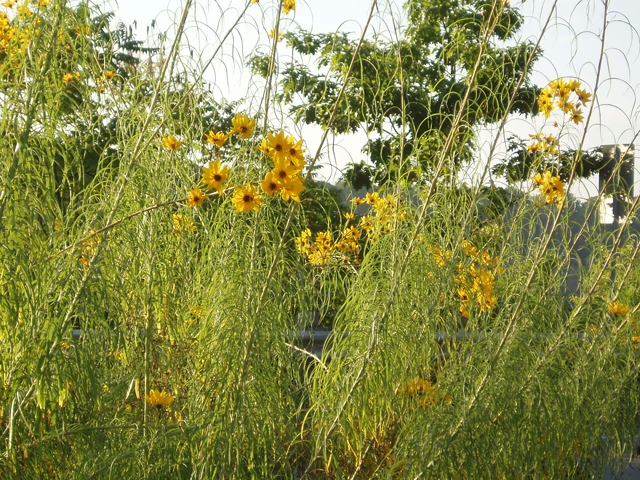
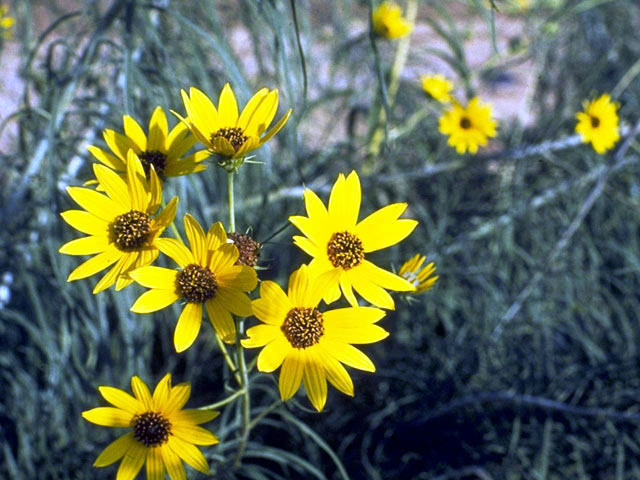
Blooms August-November. The narrow, dark green willow-like leaves, covered with soft hairs, form into a tight mound giving a tidy shrub-like appearance. Clusters of 2 in. wide, medium yellow sunflowers with dark brown centers bloom on whitish green stems.
Previous Scientific Name(s): Helianthus filiformis, Helianthus orgyalis
Material Treatment Method Collection References
Clump Division Gently tease apart the clump into smaller sections, each with a healthy amount of roots and Divide every 3-4 years to control spread and maintain vigor. Carefully dig up a mature plant, ensuring you get as much of the root system as possible. 1) https://www.missouribotanicalgarden.org/PlantFinder/PlantFinderDetails.aspx?kempercode=c970#:~:text=Problems,tend%20to%20avoid%20this%20plant. 2_ https://earthone.io/plant/helianthus%20salicifolius. 3/ https://propagate.one/
Seed No Treatment Propagate with seed in containers in a cold frame in the spring. 1) https://www.gardenia.net/plant/helianthus-salicifolius#:~:text=Propagate%20by%20seed%20in%20containers,increase%20plants%20and%20retain%20vigor. 2) https://earthone.io/plant/helianthus%20salicifolius. 3) https://propagate.one/
Stem Cutting Basal cuttings may be rooted in the spring. Choose a healthy, non-flowering stem and take a 4-6 inch cutting just below a leaf node. Remove the lower leaves and dip the cut end in rooting hormone (optional, but helpful). Plant the cutting in a pot filled with a welldraining seed starting mix. Keep the soil moist and cover the pot with a plastic bag to create a humid environment. After a few weeks, gently tug on the cutting; resistance means roots have developed. 1) https://www.gardenia.net/plant/helianthus-salicifolius#:~:text=Propagate%20by%20seed%20in%20containers,increase%20plants%20and%20retain%20vigor. 2) https://earthone.io/plant/helianthus%20salicifolius, 3) https://propagate.one/

About the Region

2026 Fall Symposium Logo

This low-elevations region of Texas extends inland from the barrier islands, about 60 or so miles, and stretches from Brownsville to Louisiana. In total, it covers about 9.5 million acres, with a high point of 150 feet in elevation. More than 1000 species of plants can be found in this region. On the southern end, species more common in Mexico (such as Sabal mexicana) and Central America occur.

The barrier islands provide us with dune systems, and clay flats to the inland side, which have species found in these areas alone. Many plants here, such as Ipomoea pes-caprae (beach morning glory), can be found throughout tropical regions of the globe. I’ve encountered the same species on the beaches of Guam.

Once inland, vast marshes and wet prairies occur. Occasionally, oak (Quercus fusiformis) groves can be found. Common grasses include species of Bothriochloa, Paspalum, and Sporobolus; eastern gamagrass (Tripsacum dactyloides); and switchgrass (Panicum species). Many rivers and creeks cut through the Gulf Prairies, and along these riparian areas various species of trees, Sabal minor, and other plants adapted to clay soils can be found. Due to overgrazing, farming, and fire suppression, woody species such as mesquite (Prosopis glandulosa) and huisache (Acacia farnesiana), and invasive species such as chinaberry (Melia azedarach), Brazilian pepper (Schinus terebinthifolius), and Chinese tallow (Sapium sebiferum) have increased and displaced our native flora.

Source: Wildflowers of Texas by Michael Eason