

Arizona Cypress

Hesperocyparis arizonica

Other common name(s):

Cedro Blanco

Family:

Cupressaceae (Cypress Family)

Plant Ecoregion Distribution Map

This map uses data from the US EPA. EPA  servers have been offline frequently so maps may not display. We are working on a solution.

Chihuahuan Deserts
Low Mountains and Bajadas

Plant Characteristics

Growth Form

Tree

Height

30
to
40
ft.

Spread

15
to
25
ft.

Leaf Retention

Evergreen

Lifespan

Perennial

Habitat and Care Requirements

Soil Type(s)

Clay, Dry, Loam, Sand, Well Drained

Light Requirement

Sun

Water Requirement

Low

Native Habitat

Shrubland, Woodland

Bloom and Attraction

Bloom Color

Brown

Bloom Season

Spring

Seasonal Interest

Nesting Material, Seeds

Wildlife Benefit

Birds, Small Mammals

Maintenance

Arizona cypress is low maintenance, drought-tolerant, once established. Fast growth rate, and relatively short-lived. Overwatering can cause root rot. Provide enough space for the tree to grow. It is widely used as an ornamental and for windbreaks in its native range. It is also often grown for Christmas trees. It is used for reforestation and soil stabilization in arid areas. Excellent for xeriscaping. It can adapt to other areas of Texas, but may need extra care. Cypress Bark Beetles can bore into the bark and weaken the tree. Cypress Canker can cause lesions on branches. Warning: pollen can cause allergies. Native habitat: hot, dry canyon bottoms and stream banks from 3000 to 7000 ft., pinyon-juniper woodland, chaparral, mountain slopes.

Description

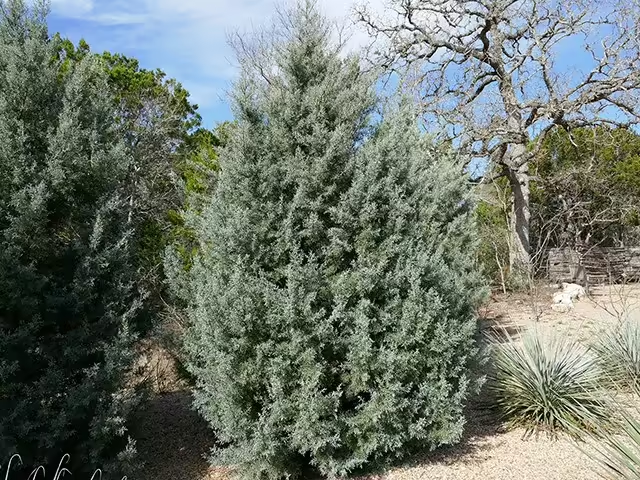
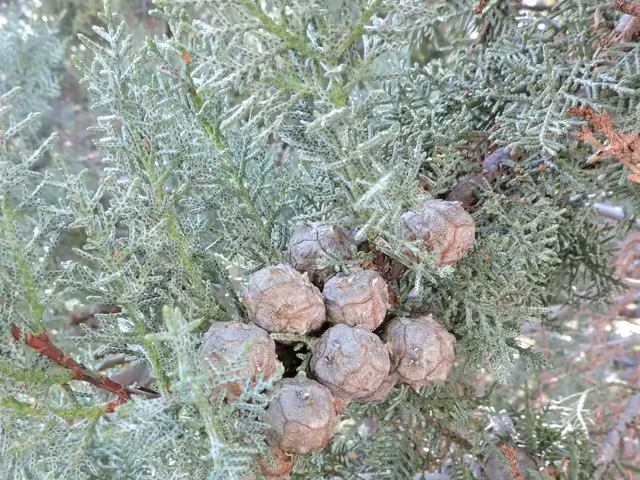
Blooms April-May. A pyramid shaped tree with stout, horizontal branches. The aromatic, pale, gray green foliage is scale-like and flattened against the branchlets. Rough, peeling, outer bark of older trees have tan to plum to red inner bark. Produces separate pollen cones and seed cones. Seed cones are spherical, warty, covered in resin, and can hang on the trees for several years without opening. Pollen cones are cylindric to 4-sided. Provides habitat for birds and small mammals.
Previous Scientific Name(s): Callitropsis arizonica, Cupressus arizonica, Cupressus arizonica ssp. arizonica, Neocupressus arizonica
Material Treatment Method Collection References
Seed Stratification Before planting, stratify the seeds by placing them in a damp paper towel for 30 days at 4°C (39°F). This pre-treatment mimics natural conditions and enhances germination rates. Prepare a well-draining soil mix with a pH of 6.0 to 7.0. Maintain temperatures between 20°C to 25°C (68°F to 77°F) with indirect sunlight for optimal germination. Most cypresses have seratiunous cones that can hang on the trees for several years without opening. Cone should be collected by cutting them from the limbs. They can be opened by boiling for 30-60 seconds. 1) https://www.wildflower.org/plants/result.php?
Semi-harwood Cutting Trim the lower leaves from the bottom half of the cutting to encourage root growth. Make a clean cut at a 45-degree angle to increase the surface area for rooting. Using a rooting hormone, either powder or gel, can significantly boost your success rate. Dip the cut end of the cutting into the hormone before planting to stimulate root development. Utilize a sterile, well-draining potting mix for rooting. Maintain high humidity by covering the cuttings with a plastic bag or humidity dome, and provide indirect light to avoid scorching. The best time to plant seeds is early spring, after the last frost. Plant them about 1/4 inch deep and space them 12-18 inches apart to promote healthy growth. For cuttings, choose healthy, semi-hardwood stems that are 6-8 inches long. Late spring to early summer is the ideal time for taking these cuttings. 1) https://www.wildflower.org/plants/result.php?id_plant=HEAR22

About the Region

2026 Fall Symposium Logo

This low-elevations region of Texas extends inland from the barrier islands, about 60 or so miles, and stretches from Brownsville to Louisiana. In total, it covers about 9.5 million acres, with a high point of 150 feet in elevation. More than 1000 species of plants can be found in this region. On the southern end, species more common in Mexico (such as Sabal mexicana) and Central America occur.

The barrier islands provide us with dune systems, and clay flats to the inland side, which have species found in these areas alone. Many plants here, such as Ipomoea pes-caprae (beach morning glory), can be found throughout tropical regions of the globe. I’ve encountered the same species on the beaches of Guam.

Once inland, vast marshes and wet prairies occur. Occasionally, oak (Quercus fusiformis) groves can be found. Common grasses include species of Bothriochloa, Paspalum, and Sporobolus; eastern gamagrass (Tripsacum dactyloides); and switchgrass (Panicum species). Many rivers and creeks cut through the Gulf Prairies, and along these riparian areas various species of trees, Sabal minor, and other plants adapted to clay soils can be found. Due to overgrazing, farming, and fire suppression, woody species such as mesquite (Prosopis glandulosa) and huisache (Acacia farnesiana), and invasive species such as chinaberry (Melia azedarach), Brazilian pepper (Schinus terebinthifolius), and Chinese tallow (Sapium sebiferum) have increased and displaced our native flora.

Source: Wildflowers of Texas by Michael Eason