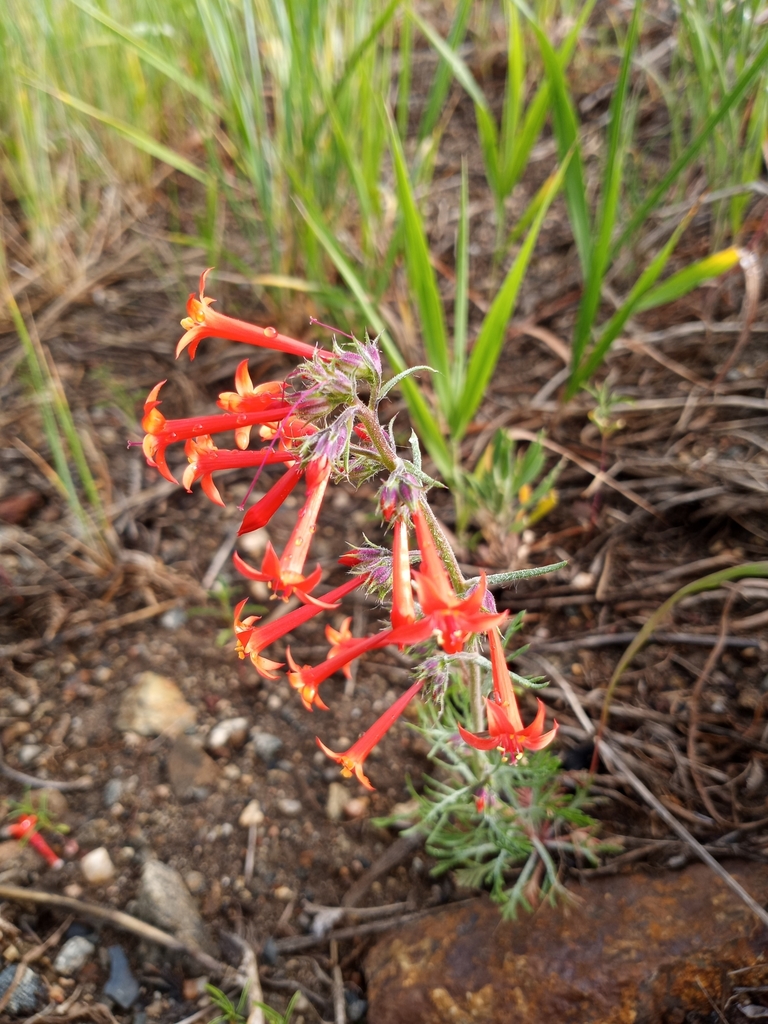
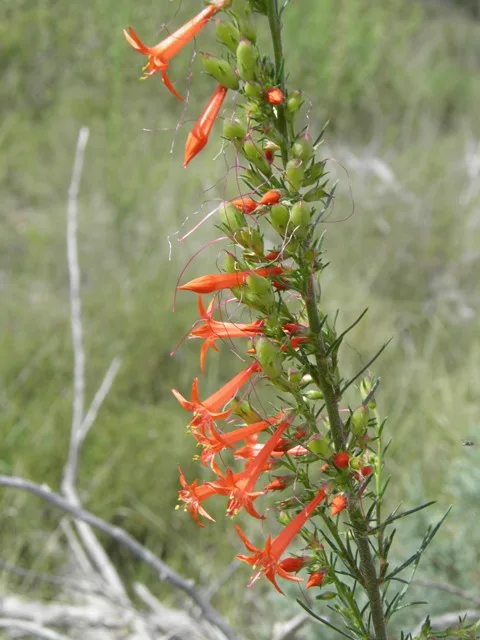


Scarlet Standing Cypress

Ipomopsis aggregata

Other common name(s):

Skyrocket, Scarlet Gilia, Skunkflower

Family:

Polemoniaceae (Phlox Family)

Plant Ecoregion Distribution Map

This map uses data from the US EPA. EPA  servers have been offline frequently so maps may not display. We are working on a solution.

Chihuahuan Deserts
Chihuahuan Basins and Playas, Chihuahuan Desert Grasslands, Chihuahuan Montane Woodlands, Low Mountains and Bajadas, Stockton Plateau

Plant Characteristics

Growth Form

Herbaceous

Height

3
to
6
ft.

Spread

.25
to
.5
ft.

Leaf Retention

Semi Evergreen

Lifespan

Biennial

Habitat and Care Requirements

Soil Type(s)

Dry, Loam, Sand, Well Drained

Light Requirement

Part Shade

Water Requirement

Low

Native Habitat

Desert, Grassland, Woodland

Bloom and Attraction

Bloom Color

Red

Bloom Season

Spring, Summer

Seasonal Interest

Nectar

Wildlife Benefit

Hummingbirds

Maintenance

Showy, attractive accent for landscape. Let the flowers go to seed to keep up the biennial cycle: low rosettes in the first year and 2-4 ft tall plants with flowers the second year. Rosettes can be transplanted to other parts of your garden, in late fall, but dig deep to get the tap roots. Native habitat: coniferous forests, from 5,000-8,500 ft, desert canyons and cliffs, mountain meadows, subalpine rock fields.

Description

Blooms May-October. Grows with a tall, upright form. In upper leaf axils and at tops of sparsely-leaved stems are clusters of bright red or deep pink, trumpet-shaped flowers. Deeply lobed leaves have a faint skunky smell. The fruit is a capsule.
Material Treatment Method Collection References
Seed Stratification For best germination rate, stratify in cold-moist peat moss for 30-45 days prior to sowing.8 germination rate is 90% when stratified. 6 Seeds could be sown right away, but germination rate is poor for some ecotype. Grows in a wide range of medium that drains well. Perlite could be mixed in potting medium to improve drainage. Top surface of growing container with sand to prevent seeds being washed away when watering. Sow November to early December in greenhouse after stratifying seeds that were collected in the same summer. Allow seedlings to access full sun, water every other day on cooler weather, every day on dry, hot weather. Seed emerge in six weeks. Flower heads could be collected into a paper bag post-bloom. Allow flower heads to dry completely before gently crushing to expose seeds. Seeds are light brown colored. Seeds must be collected before capsules burst and release seeds. 1) https://courses.washington.edu/esrm412/protocols/2018/IPAG.pdf 2) https://klamathsiskiyouseeds.com/product/ipomopsis-aggregata-scarlet-gilia/#:~:text=To%20germinate%20scarlet%20gilia%20seeds%2C%20you%20can:,reseed%20if%20it%20has%20the%20right%20conditions. 3) chrome-extension://efaidnbmnnnibpcajpcglclefindmkaj/https://frontrange.wildones.org/wp-content/images/sites/105/2025/06/Ipomopsis-aggregata-full-page-Reduced-File-Size.pdf
Seed No Treatment Gently scatter the seeds of scarlet gilia on top of a well-draining soil mixture in a flat or a pot. These seeds need light to germinate, so do not cover them with soil, just press them lightly into the surface. Water the seeds lightly to keep the soil moist but not soggy. Use a spray bottle to mist the surface without disturbing the seeds. Maintaining a consistent moisture level is crucial for germination. Place the pot in a location where it receives bright, indirect sunlight. Scarlet gilia germinates best under bright light conditions, which mimic its native alpine habitat. Keep the germination environment between 60 to 70 degrees Fahrenheit. Cooler nighttime temperatures can help mimic scarlet gilia's natural setting and enhance germination rates. Once seedlings develop several true leaves and are sturdy enough, transplant them to their final location. Ensure each seedling has enough space to grow without competition for light and nutrients. https://www.picturethisai.com/care/propagate/Ipomopsis_aggregata.html

About the Region

2026 Fall Symposium Logo

This low-elevations region of Texas extends inland from the barrier islands, about 60 or so miles, and stretches from Brownsville to Louisiana. In total, it covers about 9.5 million acres, with a high point of 150 feet in elevation. More than 1000 species of plants can be found in this region. On the southern end, species more common in Mexico (such as Sabal mexicana) and Central America occur.

The barrier islands provide us with dune systems, and clay flats to the inland side, which have species found in these areas alone. Many plants here, such as Ipomoea pes-caprae (beach morning glory), can be found throughout tropical regions of the globe. I’ve encountered the same species on the beaches of Guam.

Once inland, vast marshes and wet prairies occur. Occasionally, oak (Quercus fusiformis) groves can be found. Common grasses include species of Bothriochloa, Paspalum, and Sporobolus; eastern gamagrass (Tripsacum dactyloides); and switchgrass (Panicum species). Many rivers and creeks cut through the Gulf Prairies, and along these riparian areas various species of trees, Sabal minor, and other plants adapted to clay soils can be found. Due to overgrazing, farming, and fire suppression, woody species such as mesquite (Prosopis glandulosa) and huisache (Acacia farnesiana), and invasive species such as chinaberry (Melia azedarach), Brazilian pepper (Schinus terebinthifolius), and Chinese tallow (Sapium sebiferum) have increased and displaced our native flora.

Source: Wildflowers of Texas by Michael Eason