
Tepeguaje

Leucaena pulverulenta

Other common name(s):

Great Leadtree, Mexican Leadtree, Great Leucaena

Family:

Fabaceae (Pea Family)

Plant Ecoregion Distribution Map

This map uses data from the US EPA. EPA  servers have been offline frequently so maps may not display. We are working on a solution.

Gulf Coast Prairies and Marshes, Southern Texas Plains
Coastal Sand Plain, Lower Rio Grande Alluvial Floodplain, Lower Rio Grande Valley
Northern Nueces Alluvial Plains, Semiarid Edwards Bajada

Plant Characteristics

Growth Form

Tree

Height

30
to
55
ft.

Spread

10
to
20
ft.

Leaf Retention

Deciduous

Lifespan

Perennial

Habitat and Care Requirements

Soil Type(s)

Caliche, Clay, Loam, Moist, Sand, Well Drained

Light Requirement

Sun, Part Shade

Water Requirement

Low, Medium

Native Habitat

Riparian

Bloom and Attraction

Bloom Color

White

Bloom Season

Spring, Summer

Seasonal Interest

Fruit, Nectar, Nesting Material

Wildlife Benefit

Birds, Nectar Insects

Maintenance

Fast growth rate, short-lived. Heat tolerant. It is extremely cold-sensitive and is not hardy north of its native Texas range. Makes a good shade tree with showy blooms. This tree will do very well near a resaca or water source but will survive with whatever rain it receives. Native habitat: stream sides and river banks.

Description

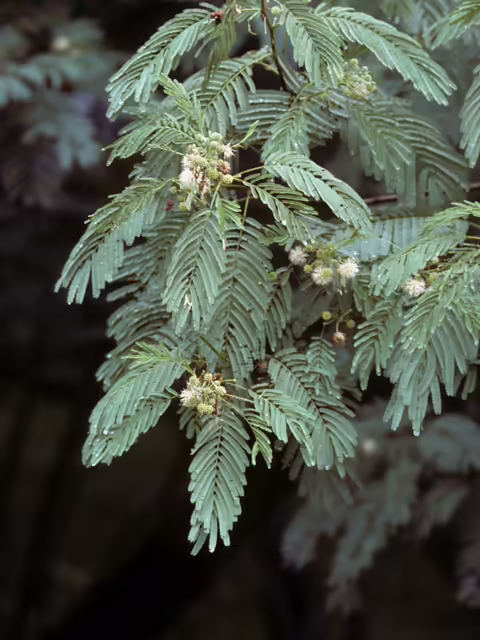
Blooms March-July. A medium sized tree with a light, open canopy and brittle branches. The wood is hard and heavy, giving the plant its common name. The leaves are twice-pinnately compound and range from four to ten inches in length. It blooms in spring and summer with dense balls of white sweet-scented flowers. The fruit is a legume pod with narrow, flattened seeds.
Material Treatment Method Collection References
Seed Scarification It has a hard seedcoat and may benefit from scarification before sowing to speed up germination. This can usually be done by pouring a small amount of nearly boiling water on the seeds (being careful not to cook them!) and then soaking them for 12 - 24 hours in warm water. By this time they should have imbibed moisture and swollen - if they have not, then carefully make a nick in the seedcoat (being careful not to damage the embryo) and soak for a further 12 hours before sowing. Another method is to lightly nick or abrade the seed coat to help water and oxygen penetrate. Sow seeds in a well-draining potting mix, keeping them moist but not soggy. Germination: Seeds generally germinate within 2-4 weeks, depending on the environment and the seed’s age. Gather Seeds: Collect mature seed pods from your existing tree or purchase them from reputable sources. Preparation: Gently remove the seeds from the pods and let them dry completely in a well-ventilated area. 1) https://tropical.theferns.info/viewtropical.php?id=Leucaena+pulverulenta 2) https://propagate.one/how-to-propagate-leucaena-pulverulenta/
Stem Cutting Remove the leaves from the lower half of the cutting and dip the cut end in rooting hormone powder. Plant the cuttings into a pre-moistened rooting mix, ensuring the nodes are buried beneath the soil. Keep the cuttings moist and protected from direct sunlight. They should root within 4-6 weeks. The ideal time to propagate Leucaena pulverulenta is during spring and early summer when temperatures are warm and growth is robust. Select healthy, mature branches from your tree. Cuttings should be 6-8 inches long, with at least two nodes (where leaves emerge).Select healthy, mature branches from your tree. Cuttings should be 6-8 inches long, with at least two nodes (where leaves emerge). https://propagate.one/how-to-propagate-leucaena-pulverulenta/

About the Region

2026 Fall Symposium Logo

This low-elevations region of Texas extends inland from the barrier islands, about 60 or so miles, and stretches from Brownsville to Louisiana. In total, it covers about 9.5 million acres, with a high point of 150 feet in elevation. More than 1000 species of plants can be found in this region. On the southern end, species more common in Mexico (such as Sabal mexicana) and Central America occur.

The barrier islands provide us with dune systems, and clay flats to the inland side, which have species found in these areas alone. Many plants here, such as Ipomoea pes-caprae (beach morning glory), can be found throughout tropical regions of the globe. I’ve encountered the same species on the beaches of Guam.

Once inland, vast marshes and wet prairies occur. Occasionally, oak (Quercus fusiformis) groves can be found. Common grasses include species of Bothriochloa, Paspalum, and Sporobolus; eastern gamagrass (Tripsacum dactyloides); and switchgrass (Panicum species). Many rivers and creeks cut through the Gulf Prairies, and along these riparian areas various species of trees, Sabal minor, and other plants adapted to clay soils can be found. Due to overgrazing, farming, and fire suppression, woody species such as mesquite (Prosopis glandulosa) and huisache (Acacia farnesiana), and invasive species such as chinaberry (Melia azedarach), Brazilian pepper (Schinus terebinthifolius), and Chinese tallow (Sapium sebiferum) have increased and displaced our native flora.

Source: Wildflowers of Texas by Michael Eason