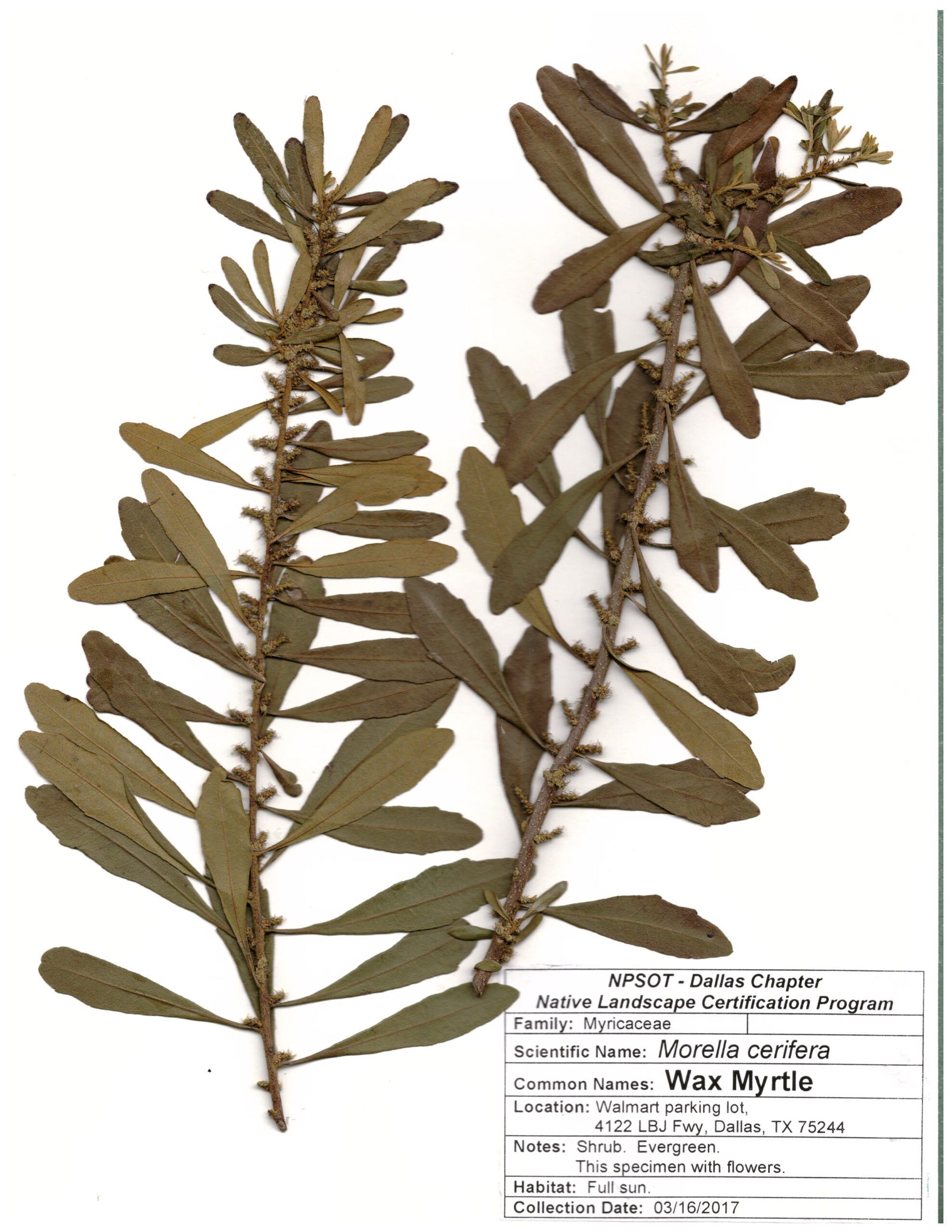
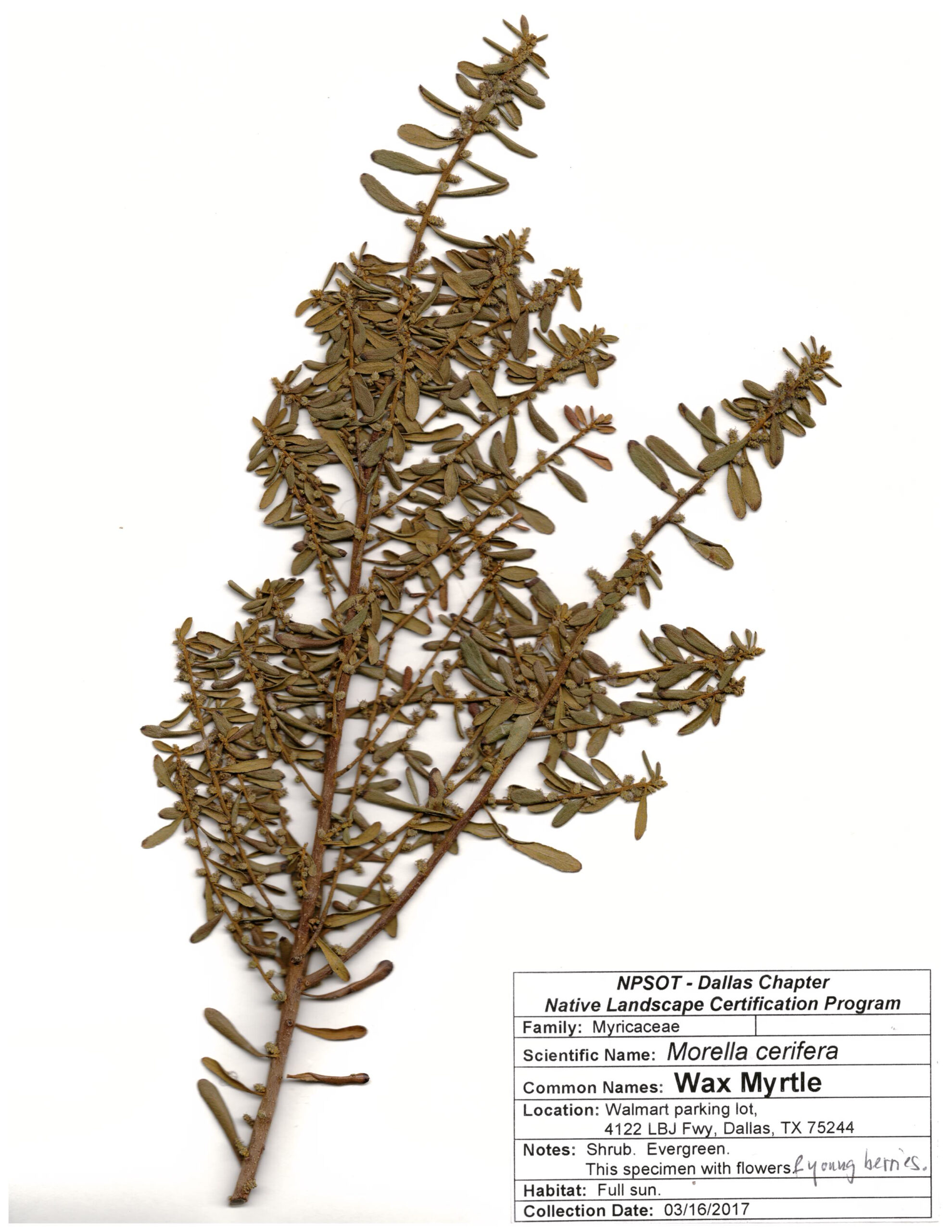


Wax Myrtle

Morella cerifera

Other common name(s):

Southern Wax Myrtle, Southern Bayberry, Eastern Bayberry, Bayberry, Candleberry, Tallow Shrub

Family:

Myricaceae (Bayberry Family)

Plant Ecoregion Distribution Map

This map uses data from the US EPA. EPA  servers have been offline frequently so maps may not display. We are working on a solution.

East Central Texas Plains, Gulf Coast Prairies and Marshes, Western Gulf Coastal Plain
Bastrop Lost Pines, Floodplains and Low Terraces2, Northern Post Oak Savanna, Northern Prairie Outliers, San Antonio Prairie, Southern Post Oak Savanna
Floodplains and Low Terraces4, Laguna Madre Barrier Island and Coastal Marshes, Lower Rio Grande Alluvial Floodplain, Mid-Coast Barrier Islands and Coastal Marshes, Northern Humid Gulf Coastal Prairies, Southern Subhumid Gulf Coastal Prairies, Texas-Louisiana Coastal Marshes
Flatwoods, Floodplains and Low Terraces3, Pleistocene Fluvial Terraces, Red River Bottomlands, Southern Tertiary Uplands, Tertiary Uplands

Plant Characteristics

Growth Form

Shrub

Height

6
to
20
ft.

Spread

4
to
10
ft.

Leaf Retention

Evergreen

Lifespan

Perennial

Habitat and Care Requirements

Soil Type(s)

Clay, Dry, Loam, Moist, Poor Drainage, Saline, Sand

Light Requirement

Sun, Part Shade, Shade

Water Requirement

Low, Medium, High

Native Habitat

Grassland, Riparian, Sand Dunes & Beaches, Shrubland, Wetland, Woodland

Bloom and Attraction

Bloom Color

Green

Bloom Season

Spring

Seasonal Interest

Fruit, Larval Host, Nectar

Wildlife Benefit

Birds, Butterflies

Maintenance

Fast growth. Initially needs constant moisture, but once established in the landscape it will grow in a wide range of soil conditions and habitats, ranging from wet swampy areas to dry xeric uplands. May be pruned into a small multi-trunked tree, or left in shrub form. Provide deep soil. Makes an excellent evergreen screen. Shrubs tend to sucker, sometimes forming sizable colonies in optimum growing conditions. Give plenty of room to grow or pull sprouts to control. Native habitat: moist forest, marshes, fresh to slightly brackish stream banks, swamps, upland hardwood forests, pinelands, upland mixed forest, floodplains, wetland edges, cutthroat seeps, old fields, scrub, fencerows, coastal dunes.

Description

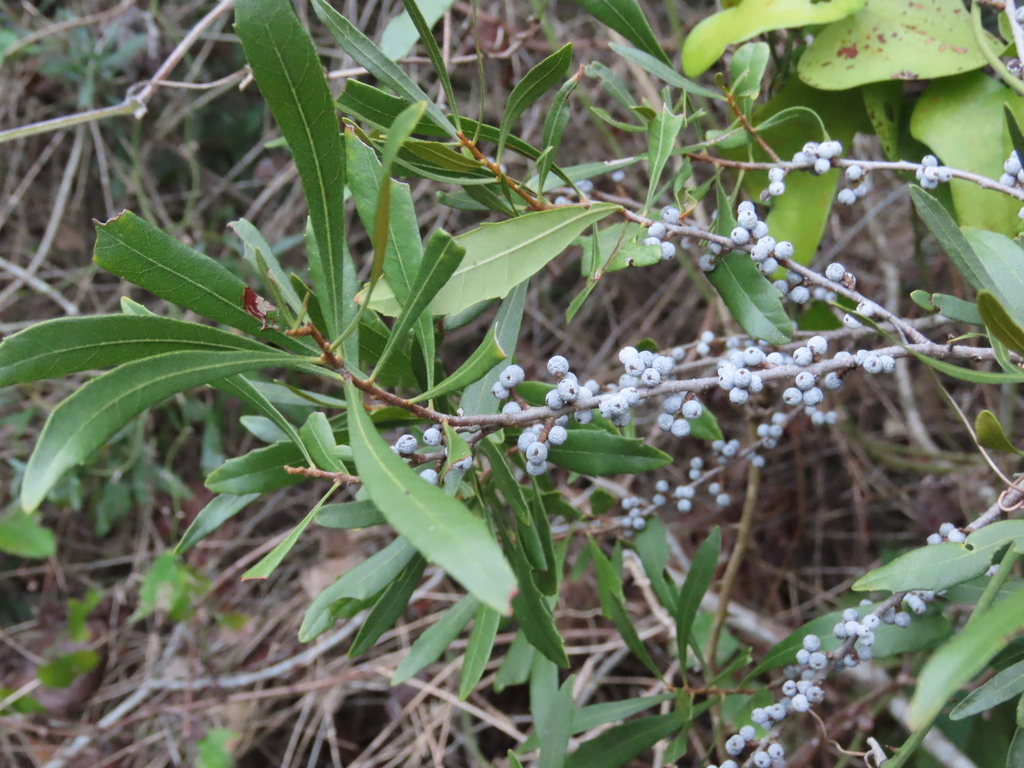
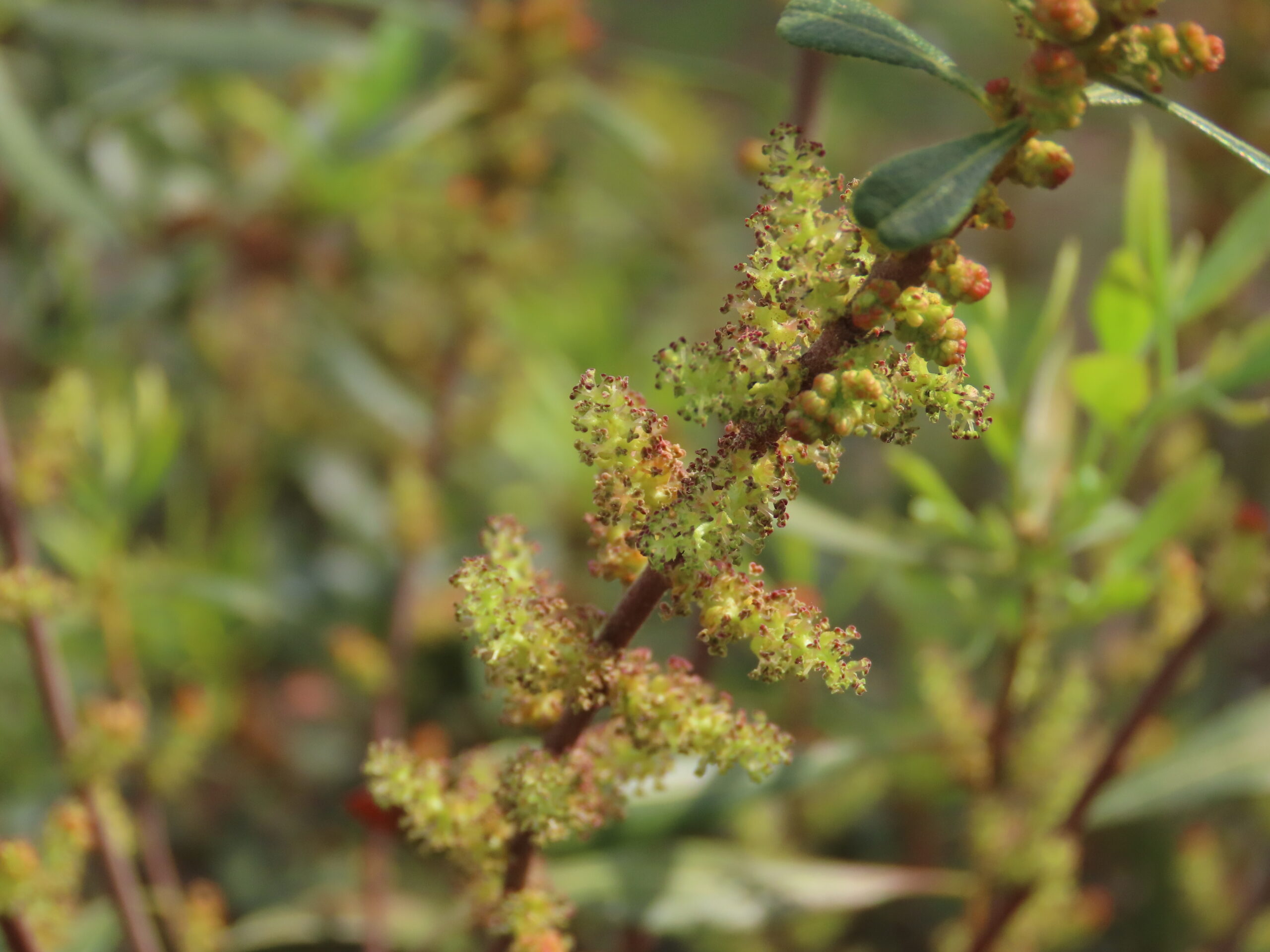
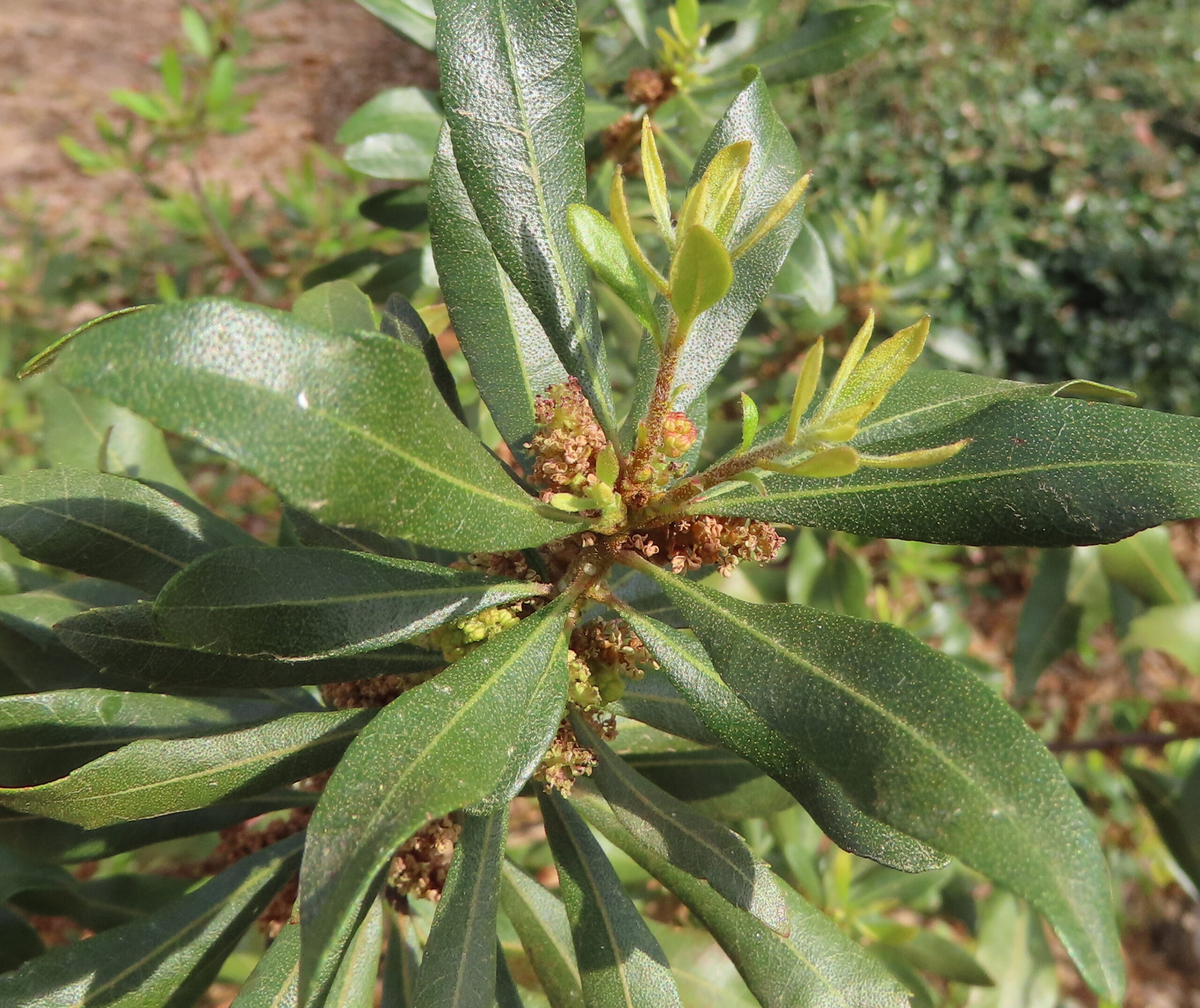
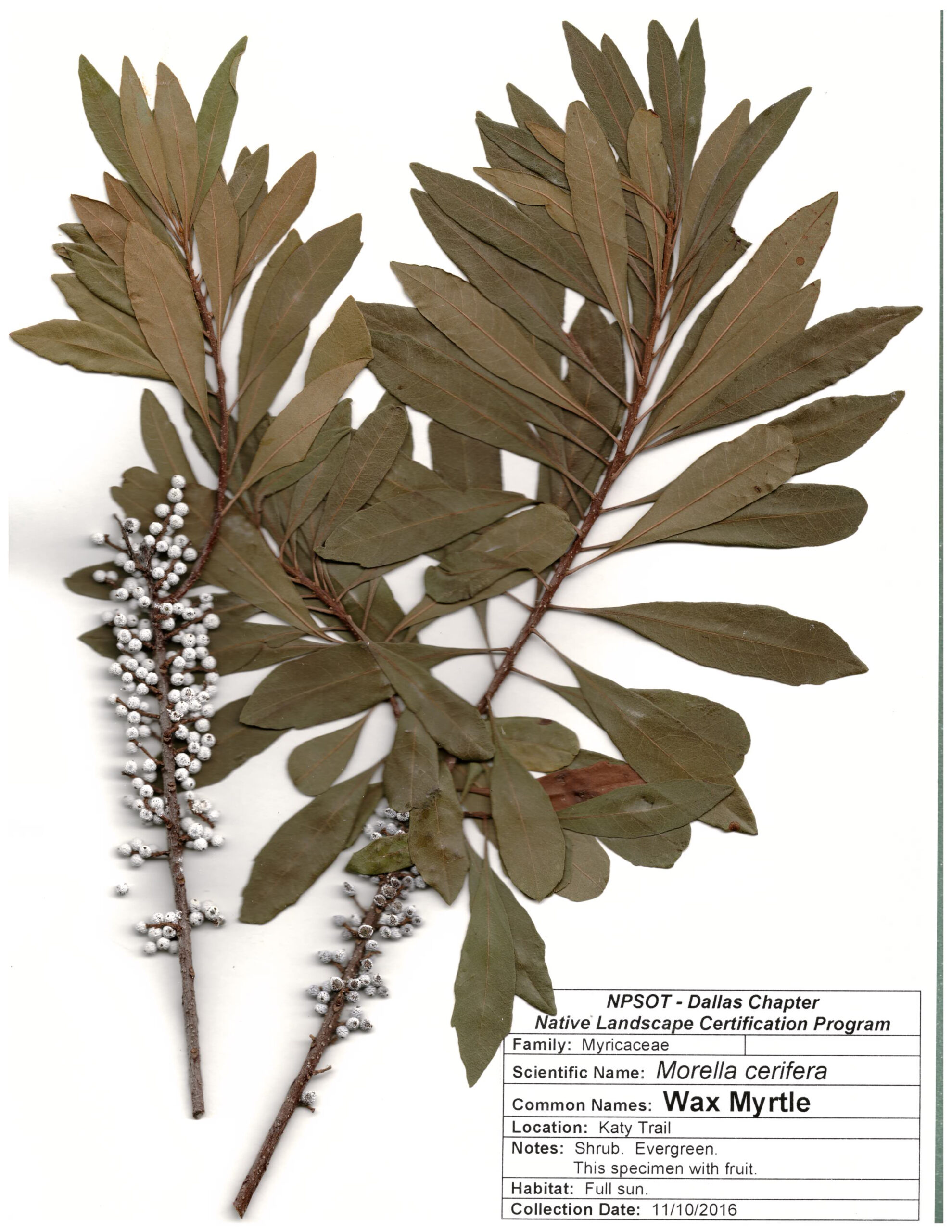
Blooms February-May. A multi-trunked, evergreen shrub, with light gray bark. Light, olive-green leaves are aromatic. Produces small, inconspicuous, fragrant flowers. Male and female flowers are borne in catkins on separate plants. Small, waxy, pale blue berries are produced on female plants. Larval host: Red-Banded Hairstreak.
Previous Scientific Name(s): Myrica cerifera, Cerothamnus ceriferus, Cerothamnus pumilus, Morella cerifera var. pumila, Myrica cerifera var. pumila, Myrica pusilla
Material Treatment Method Collection References
Seed No Treatment Sow in the fall. Remove waxy coating in a solution of 1 t. lye to 1 gal. water. Collect fruit in September or October. Leave waxy coating on during storage. https://www.wildflower.org/plants/result.php?id_plant=MOCE2
Seed Stratification Sow in the spring. Seed germination requires removal of the wax coating from the fruit. Wash the fruit in warm detergent water and rinse with plain cool water. Seed require a cool, moist stratification period of 40 to 90 days at 34-41 degrees. Seeds can be sown in open flats and covered with ¼ in of vermiculite. Stratification is necessary to overcome physiological dormancy; hence seed from more northern populations may have a longer stratification requirement than southern populations. Collect fruit in September or October. Leave waxy coating on during storage, remove it prior to sowing or stratification. Remove in a solution of 1 t. lye to 1 gal. water. 1) https://ask.ifas.ufl.edu/publication/SG176 2) https://www.wildflower.org/plants/result.php?id_plant=MOCE2
Softwood Cutting Trim your cuttings off with sharp scissors or secateurs just below a node. Gently remove the leaves from the bottom nodes. These stripped nodes are where roots will develop. Use the edge of scissors or a knife to lightly scrape some bark from the bottom of the cuttings. Remove only the outermost layer and expose some of the light green cambium underneath. Dip the end of the stem in a rooting hormone. An IBA quick dip of 5000ppm works the best, but powdered rooting hormone can also be used, albeit with slightly less success. Dip the basal (bottom) end of the cuttings about an inch into the solution for around 5 seconds, then immediately stick them. Stick the cuttings, right-side up, in your rooting mix. Make a hole with a pencil and then firm up the soil around the cutting if you like. The cutting should have all the stripped nodes buried. Wax myrtles root best when the cuttings are misted to maintain humidity, but you can mimic the professional nursery environment with a spray bottle and a humidity dome or bag. Place the cuttings in a bright location out of direct sunlight. They will show root growth at approximately 4 weeks. Check the progress of your new wax myrtle’s roots by gently giving the stem a little tug. If there is resistance, your cutting has grown roots. Plant them out in your yard or garden when they have rooted well and are of an appropriate size. Select pieces of stem about 6 inches long. Use stem tip cuttings for wax myrtle. An ideal cutting will have the growing tip and top leaves and several nodes below that. Softwood cuttings should be taken in late spring or early summer when the new growth can still be dented or damaged by a fingernail and hasn’t turned finished turning woody. Softwood cuttings are more prone to drying and wilting, so keep them moist and stick them as soon as possible after harvesting. 1) https://gardening.org/propagate-wax-myrtles/ 2) https://ask.ifas.ufl.edu/publication/SG176

About the Region

2026 Fall Symposium Logo

This low-elevations region of Texas extends inland from the barrier islands, about 60 or so miles, and stretches from Brownsville to Louisiana. In total, it covers about 9.5 million acres, with a high point of 150 feet in elevation. More than 1000 species of plants can be found in this region. On the southern end, species more common in Mexico (such as Sabal mexicana) and Central America occur.

The barrier islands provide us with dune systems, and clay flats to the inland side, which have species found in these areas alone. Many plants here, such as Ipomoea pes-caprae (beach morning glory), can be found throughout tropical regions of the globe. I’ve encountered the same species on the beaches of Guam.

Once inland, vast marshes and wet prairies occur. Occasionally, oak (Quercus fusiformis) groves can be found. Common grasses include species of Bothriochloa, Paspalum, and Sporobolus; eastern gamagrass (Tripsacum dactyloides); and switchgrass (Panicum species). Many rivers and creeks cut through the Gulf Prairies, and along these riparian areas various species of trees, Sabal minor, and other plants adapted to clay soils can be found. Due to overgrazing, farming, and fire suppression, woody species such as mesquite (Prosopis glandulosa) and huisache (Acacia farnesiana), and invasive species such as chinaberry (Melia azedarach), Brazilian pepper (Schinus terebinthifolius), and Chinese tallow (Sapium sebiferum) have increased and displaced our native flora.

Source: Wildflowers of Texas by Michael Eason