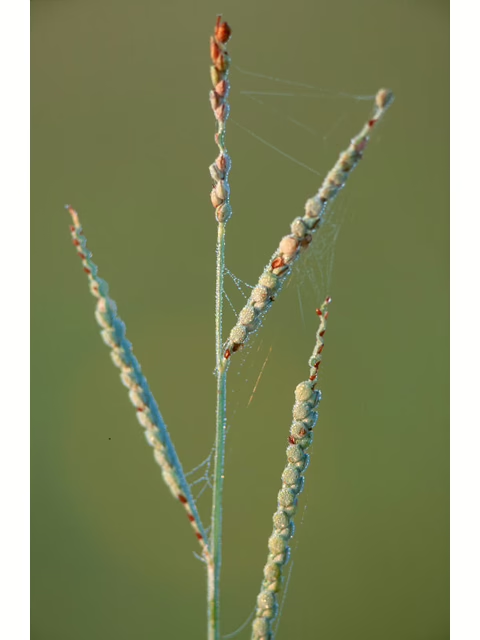
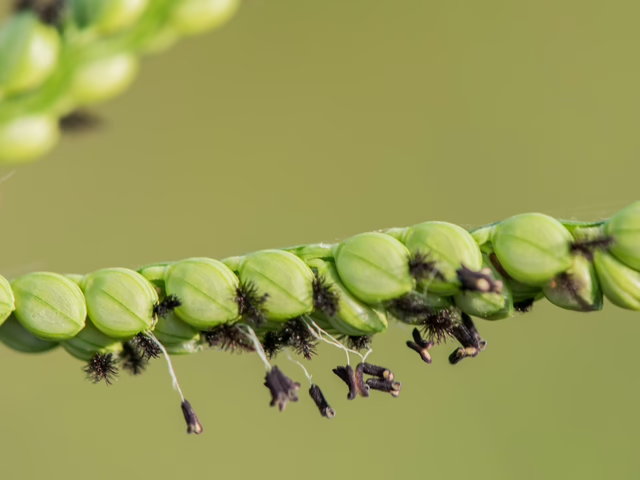
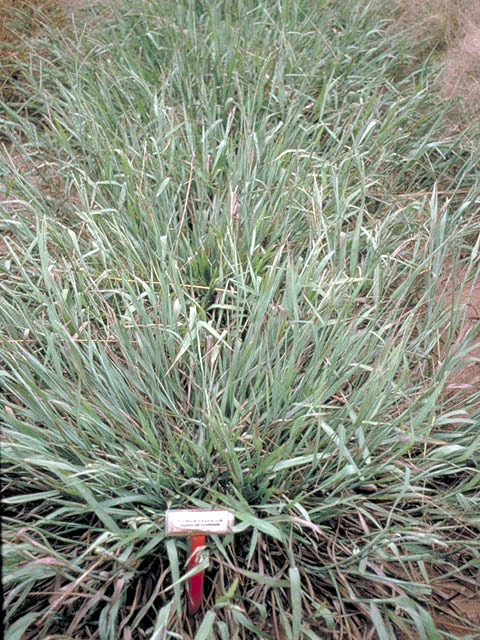


Florida Paspalum

Paspalum floridanum

Other common name(s):

Family:

Poaceae (Grass Family)

Plant Ecoregion Distribution Map

This map uses data from the US EPA. EPA  servers have been offline frequently so maps may not display. We are working on a solution.

Cross Timbers, East Central Texas Plains, Gulf Coast Prairies and Marshes, Texas Blackland Prairies, Western Gulf Coastal Plain
Carbonate Cross Timbers, Eastern Cross Timbers, Grand Prairie
Bastrop Lost Pines, Floodplains and Low Terraces2, Northern Post Oak Savanna, Northern Prairie Outliers, San Antonio Prairie, Southern Post Oak Savanna
Northern Humid Gulf Coastal Prairies
Floodplains and Low Terraces1, Northern Blackland Prairie, Southern Blackland Prairie
Flatwoods, Floodplains and Low Terraces3, Pleistocene Fluvial Terraces, Red River Bottomlands, Southern Tertiary Uplands, Tertiary Uplands

Plant Characteristics

Growth Form

Grass & Sedge

Height

5
to
7
ft.

Spread

1
to
2
ft.

Leaf Retention

Deciduous

Lifespan

Perennial

Habitat and Care Requirements

Soil Type(s)

Clay, Loam, Moist, Sand

Light Requirement

Part Shade

Water Requirement

Medium

Native Habitat

Grassland, Savanna, Woodland

Bloom and Attraction

Bloom Color

Brown, Green, White

Bloom Season

Summer, Fall

Seasonal Interest

Nesting Material, Seeds

Wildlife Benefit

Birds, Small Mammals

Maintenance

Plays a role in soil erosion control, making it a valuable plant for conservation. Not common in plant nurseries but seeds are available commercially. Native habitat: prairies, meadows, pastures, savannas, open woodlands.

Description

Blooms August-November. A stout, erect, warm season grass. Plants are bunch-like but slowly spread from short, thick rhizomes forming a sod over time.
Previous Scientific Name(s): Paspalum glabrum, Paspalum laevigatum, Paspalum macrospermum, Paspalum laeve var. floridanum
Material Treatment Method Collection References
Seed No Treatment Freshly harvested seed has a high degree of dormancy which is reduced as the seed ages. Ambient (room) temperature storage reduces dormancy better than cold stratification treatment, with the best germination attained after 9 months of ambient storage. Cold storage reduces seed dormancy less quickly, requiring a minimum of 3 years of cold storage to reduce seed dormancy. For optimal germination, Florida Paspalum seeds thrive in temperatures ranging from 70°F to 85°F. This warm environment encourages quick sprouting, setting the stage for healthy growth. Florida paspalum establishes quite easily from seed compared to many other warm-season grasses. Seedlings are vigorous and compete well with concurrently germinating weeds, establishing well in the first growing season with adequate moisture and fertility. Florida paspalum can be seeded in a pure stand or in a mix of other species with a seeding depth of 1/4” on fine textured soils and up to 3/4” on coarse textured soils. The smooth seed can be planted with most seed drills or broadcast seeded into a prepared firm seedbed. It is recommended to firm the seedbed after seeding with a roller or culti-packer. General seeding recommendations are 6 to 8 pounds PLS per acre for most applications. Seeds are large and light with approximately 91,000 seeds/lb. With adequate moisture, most seeds will germinate within 7 days. 1) https://plants.usda.gov/DocumentLibrary/plantguide/pdf/pg_pafl4.pdf

About the Region

2026 Fall Symposium Logo

This low-elevations region of Texas extends inland from the barrier islands, about 60 or so miles, and stretches from Brownsville to Louisiana. In total, it covers about 9.5 million acres, with a high point of 150 feet in elevation. More than 1000 species of plants can be found in this region. On the southern end, species more common in Mexico (such as Sabal mexicana) and Central America occur.

The barrier islands provide us with dune systems, and clay flats to the inland side, which have species found in these areas alone. Many plants here, such as Ipomoea pes-caprae (beach morning glory), can be found throughout tropical regions of the globe. I’ve encountered the same species on the beaches of Guam.

Once inland, vast marshes and wet prairies occur. Occasionally, oak (Quercus fusiformis) groves can be found. Common grasses include species of Bothriochloa, Paspalum, and Sporobolus; eastern gamagrass (Tripsacum dactyloides); and switchgrass (Panicum species). Many rivers and creeks cut through the Gulf Prairies, and along these riparian areas various species of trees, Sabal minor, and other plants adapted to clay soils can be found. Due to overgrazing, farming, and fire suppression, woody species such as mesquite (Prosopis glandulosa) and huisache (Acacia farnesiana), and invasive species such as chinaberry (Melia azedarach), Brazilian pepper (Schinus terebinthifolius), and Chinese tallow (Sapium sebiferum) have increased and displaced our native flora.

Source: Wildflowers of Texas by Michael Eason