
Smooth White Penstemon

Penstemon digitalis

Other common name(s):

Talus slope penstemon, Mississippi Penstemon, Mississippi Beardtongue, Smooth White Beardtongue, Talus Slope Beardtongue, Foxglove Penstemon, Foxglove Beardtongue

Family:

Plantaginaceae (Plantain Family)

Plant Ecoregion Distribution Map

This map uses data from the US EPA. EPA  servers have been offline frequently so maps may not display. We are working on a solution.

East Central Texas Plains, Texas Blackland Prairies, Western Gulf Coastal Plain
Northern Post Oak Savanna, Northern Prairie Outliers
Northern Blackland Prairie
Flatwoods, Floodplains and Low Terraces3, Pleistocene Fluvial Terraces, Red River Bottomlands, Southern Tertiary Uplands, Tertiary Uplands

Plant Characteristics

Growth Form

Herbaceous

Height

2
to
5
ft.

Spread

.5
to
1
ft.

Leaf Retention

Semi Evergreen

Lifespan

Perennial

Habitat and Care Requirements

Soil Type(s)

Clay, Dry, Loam, Moist, Rich, Well Drained

Light Requirement

Sun, Part Shade

Water Requirement

Low, Medium, High

Native Habitat

Grassland, Woodland

Bloom and Attraction

Bloom Color

White

Bloom Season

Spring, Summer

Seasonal Interest

Nectar, Pollen

Wildlife Benefit

Bees, Hummingbirds

Maintenance

Somewhat short-lived, so keep a supply of seed on hand to renew your population. Will form large colonies. Not common in plant nurseries but seeds are available commercially. Native habitat: low, moist areas, prairies, open woodlands.

Description

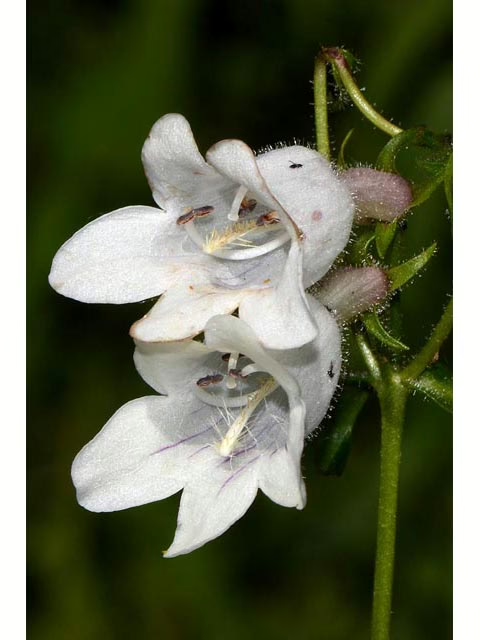
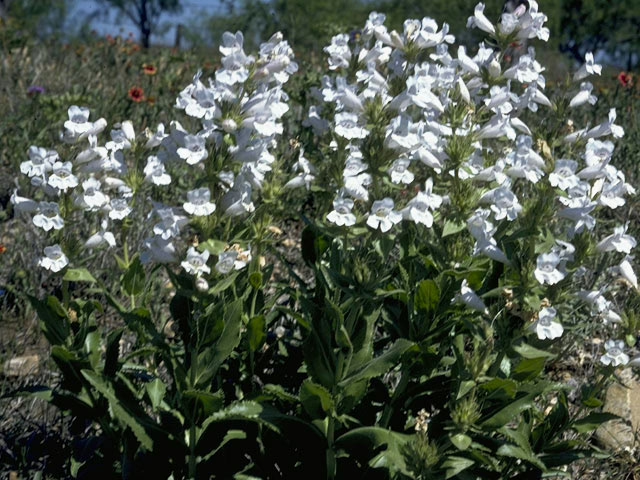
Blooms May-July. Erect stems are topped with clusters of white, tubular, unevenly five-lobed flowers which rise in pairs from the upper leaf axils. Flowers have purple lines in the throat for bees. Leaves are oblong to lance-shaped. The fruit is a tan capsule.
Previous Scientific Name(s): Penstemon alluviorum, Penstemon laevigatus ssp. alluviorum. Penstemon laevigatus ssp. digitalis. Penstemon laevigatus var. angulatus
Material Treatment Method Collection References
Clump Division Dividing is done by digging up the plant and gently separating the crowns and roots into sections, each with a few shoots and roots attached. Prune back the foliage of each new division. Fall or early spring. 1) https://www.wildflower.org/plants/result.php?id_plant=PEDI 2) https://plantiary.com/plant/penstemon-digitalis_864.html
Seed Stratification Seeds require exposure to sunlight to germinate and a cold/moist stratification period of approximately 4 weeks. Not exposing Penstemon seed to a cold/moist period will significantly reduce the germination rate. Either cold-stratify the seeds in the refrigerator for 30 days, or winter-sow the seeds in order to break the seeds dormancy. Sprinkle seed on top of the soil in a pot, press the seed into the soil with your thumb to ensure good contact with the soil without burying the seed. If direct sowing on bare, disturbed areas, just scatter seed where you would like the plants to grow. Then, walk over the seed to press them into the soil. Keep the soil and seed moist. Seeds will generally germinate within a few weeks in spring and will bloom the second year. Collect ripe seeds in the fall 1) https://www.wildflower.org/plants/result.php?id_plant=PEDI 2) https://growitbuildit.com/foxglove-beardtongue-guide-penstemon-digitalis/
Stem Cutting Remove the bottom leaves of the cutting and dip the cut end into rooting hormone before planting in moist soil. Keep the soil moist and the cutting in a bright but not too hot location until roots begin to form. Stem cuttings can be taken the summer or fall from healthy stems that are not flowering, and should be about 4-6 inches long. https://plantiary.com/plant/penstemon-digitalis_864.html

About the Region

2026 Fall Symposium Logo

This low-elevations region of Texas extends inland from the barrier islands, about 60 or so miles, and stretches from Brownsville to Louisiana. In total, it covers about 9.5 million acres, with a high point of 150 feet in elevation. More than 1000 species of plants can be found in this region. On the southern end, species more common in Mexico (such as Sabal mexicana) and Central America occur.

The barrier islands provide us with dune systems, and clay flats to the inland side, which have species found in these areas alone. Many plants here, such as Ipomoea pes-caprae (beach morning glory), can be found throughout tropical regions of the globe. I’ve encountered the same species on the beaches of Guam.

Once inland, vast marshes and wet prairies occur. Occasionally, oak (Quercus fusiformis) groves can be found. Common grasses include species of Bothriochloa, Paspalum, and Sporobolus; eastern gamagrass (Tripsacum dactyloides); and switchgrass (Panicum species). Many rivers and creeks cut through the Gulf Prairies, and along these riparian areas various species of trees, Sabal minor, and other plants adapted to clay soils can be found. Due to overgrazing, farming, and fire suppression, woody species such as mesquite (Prosopis glandulosa) and huisache (Acacia farnesiana), and invasive species such as chinaberry (Melia azedarach), Brazilian pepper (Schinus terebinthifolius), and Chinese tallow (Sapium sebiferum) have increased and displaced our native flora.

Source: Wildflowers of Texas by Michael Eason