
Laurel Oak

Quercus laurifolia

Other common name(s):

Swamp Laurel Oak, Darlington Oak, Diamond-leaf Oak, Laurel-leaf Oak, Water Oak, Obtusa Oak

Family:

Fagaceae (Beech Family)

Plant Ecoregion Distribution Map

This map uses data from the US EPA. EPA  servers have been offline frequently so maps may not display. We are working on a solution.

Gulf Coast Prairies and Marshes, Western Gulf Coastal Plain
Coastal Sand Plain, Floodplains and Low Terraces4, Laguna Madre Barrier Island and Coastal Marshes, Lower Rio Grande Alluvial Floodplain, Lower Rio Grande Valley, Mid-Coast Barrier Islands and Coastal Marshes, Northern Humid Gulf Coastal Prairies, Southern Subhumid Gulf Coastal Prairies, Texas-Louisiana Coastal Marshes
Flatwoods

Plant Characteristics

Growth Form

Tree

Height

40
to
80
ft.

Spread

30
to
40
ft.

Leaf Retention

Semi Evergreen

Lifespan

Perennial

Habitat and Care Requirements

Soil Type(s)

Clay, Loam, Moist, Sand, Well Drained

Light Requirement

Sun, Part Shade

Water Requirement

Medium, High

Native Habitat

Riparian, Woodland

Bloom and Attraction

Bloom Color

Yellow

Bloom Season

Spring

Seasonal Interest

Forage, Nuts

Wildlife Benefit

Birds, Caterpillars, Small Mammals

Maintenance

Swamp laurel oak is often used as an ornamental in the South and makes a good year-round shade tree. It adapts to a wide variety of soil conditions. Pruning is recommended for proper growth as well as rot prevention. It is recommended to keep it with one central trunk and branch diameter less than half of the trunk. It is also suggested that vital branches be positioned 2’-3’ apart. This species is closely related to Q. nigra and Q. phellos. Caterpillars, particularly Tent caterpillars, feed on Laurel Oak foliage. WARNING: Both the fruit and leaves of the Laurel Oak are poisonous to human. Native habitat: moist hardwood forests, along streams and rivers.

Description

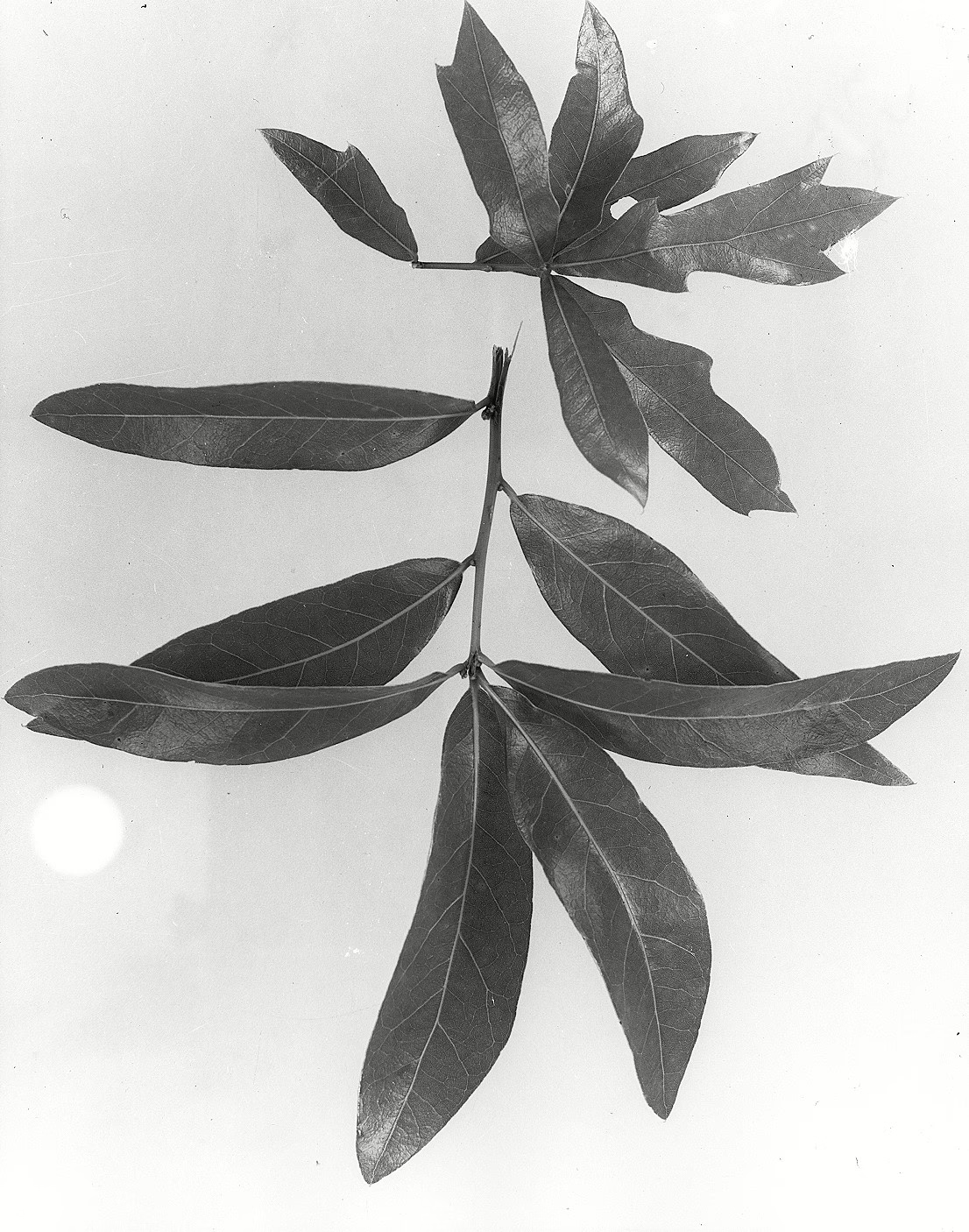
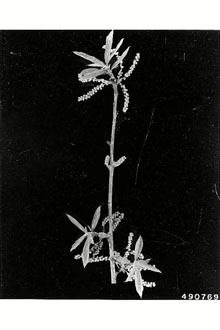
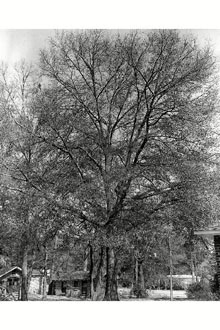
Blooms March-May. A short-lived, medium tree with a dense rounded crown. The bark is dark brown, turning black with deep furrows and broad flat ridges as it ages. Twigs are smooth, reddish- brown. Buds are ovoid, pointed and covered with shiny chestnut-brown scales. Leaves are broadly elliptical and thin, 1 1⁄4 – 4 3⁄4 inches long, 5⁄8 – 1 3⁄4 inches, with bristle tips. The may be irregularly 3-lobed, shiny green on the upper surface and pale green below with a yellow midrib. Inconspicuous flowers are clustered on male and female catkins. The fruit is an nearly round, dark brown acorn, 5⁄8 inch in length acorn, with a saucer-like cup and pubescent scales.
Previous Scientific Name(s): Quercus hemisphaerica, Quercus obtusa, Quercus phellos var. laurifolia, Quercus succulenta
Material Treatment Method Collection References
Seed No Treatment Best if sown immediately as acorns lose viability quickly in storage. Plant outdoors or in deep containers to accommodate long initial taproot. Many oaks require cold temperatures to initiate shoot development. Acorns to be sown immediately can be soaked in hot water for 15 min. to prevent weevil infestation. Best quality acorns are picked or shaken from the tree. Collect when color has changed to brown. Short-term storage in moist, shaded saw dust or sand. 1) https://www.wildflower.org/plants/result.php?id_plant=QULA3 2) http://www.perenual.finalfees.com/plant-species-database-search-finder/species/6502
Semi-harwood Cutting Remove leaves from the lower half of each cutting, leaving some at the top for photosynthesis. Dip the cut end into a rooting hormone powder to encourage root growth. Fill a pot with a well-draining soil mix, such as half perlite and half peat. Plant the cuttings about 2 inches deep into the soil. Gently firm the soil around the cuttings. Cover the pot with a clear plastic bag or place it inside a mini greenhouse to maintain high humidity levels. Make sure there is some air circulation to prevent mold growth. Keep the soil consistently moist but not waterlogged. Place the pot in indirect sunlight. The cuttings should root in about 6-8 weeks. Check periodically for root development. Once rooted, gradually acclimate the young plants of laurel oak to less humid conditions before transplanting them outdoors. Select a planting location with well-drained soil and partial to full sun exposure. Regular watering is crucial in their first year, tapering off as they establish and adapt to natural rainfall. Choose semi-hardwood cuttings from healthy branches of laurel oak in early fall. Cuttings should be 6-8 inches long with several leaf nodes. 1) https://www.picturethisai.com/care/propagate/Quercus_laurifolia.html#:~:text=Sterile%20Potting%20Mix,Step%202 2) http://www.perenual.finalfees.com/plant-species-database-search-finder/species/6502

About the Region

2026 Fall Symposium Logo

This low-elevations region of Texas extends inland from the barrier islands, about 60 or so miles, and stretches from Brownsville to Louisiana. In total, it covers about 9.5 million acres, with a high point of 150 feet in elevation. More than 1000 species of plants can be found in this region. On the southern end, species more common in Mexico (such as Sabal mexicana) and Central America occur.

The barrier islands provide us with dune systems, and clay flats to the inland side, which have species found in these areas alone. Many plants here, such as Ipomoea pes-caprae (beach morning glory), can be found throughout tropical regions of the globe. I’ve encountered the same species on the beaches of Guam.

Once inland, vast marshes and wet prairies occur. Occasionally, oak (Quercus fusiformis) groves can be found. Common grasses include species of Bothriochloa, Paspalum, and Sporobolus; eastern gamagrass (Tripsacum dactyloides); and switchgrass (Panicum species). Many rivers and creeks cut through the Gulf Prairies, and along these riparian areas various species of trees, Sabal minor, and other plants adapted to clay soils can be found. Due to overgrazing, farming, and fire suppression, woody species such as mesquite (Prosopis glandulosa) and huisache (Acacia farnesiana), and invasive species such as chinaberry (Melia azedarach), Brazilian pepper (Schinus terebinthifolius), and Chinese tallow (Sapium sebiferum) have increased and displaced our native flora.

Source: Wildflowers of Texas by Michael Eason