
Mohr's Oak

Quercus mohriana

Other common name(s):

Shin Oak, Scrub Oak

Family:

Fagaceae (Beech Family)

Plant Ecoregion Distribution Map

This map uses data from the US EPA. EPA  servers have been offline frequently so maps may not display. We are working on a solution.

Chihuahuan Deserts, Edwards Plateau, Southwestern Tablelands
Chihuahuan Basins and Playas, Chihuahuan Desert Grasslands, Chihuahuan Montane Woodlands, Low Mountains and Bajadas, Stockton Plateau
Llano Uplift, Semiarid Edwards Plateau
Canadian/Cimarron Breaks, Caprock Canyons Badlands Breaks, Flat Tablelands and Valleys, Semiarid Canadian Breaks

Plant Characteristics

Growth Form

Shrub, Tree

Height

15
to
20
ft.

Spread

15
to
20
ft.

Leaf Retention

Semi Evergreen

Lifespan

Perennial

Habitat and Care Requirements

Soil Type(s)

Calcareous, Dry, Limestone, Sand

Light Requirement

Part Shade

Water Requirement

Low

Native Habitat

Desert, Savanna, Shrubland

Bloom and Attraction

Bloom Color

Red

Bloom Season

Spring

Seasonal Interest

Nesting Material, Nuts

Wildlife Benefit

Birds, Small Mammals

Maintenance

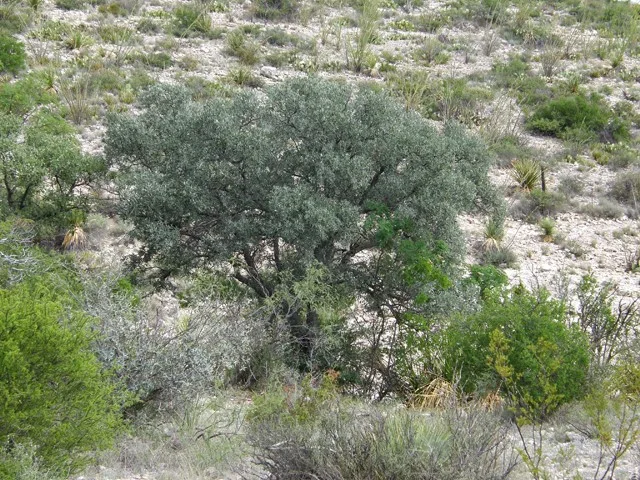
This small live oak is more drought tolerant than escarpment live oak. Slow growing. Makes a good accent tree or shrub. If you leave Mohr Oak alone, it will form a small grove, but you will get a bigger tree if you prune off the suckers. It is in the white oak group and therefore less susceptible to oak wilt. Native habitat: limestone hills and slopes, calcareous substrates, chaparral. desert scrub, savanna.

Description

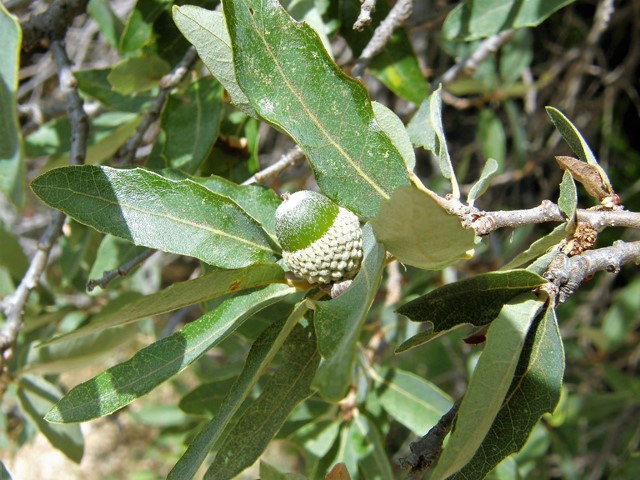
Blooms March-May. A fire resistant, tree or shrub. The bark is thick and gray with rough scaly ridges. Leaf margins are usually wavy, may have a few teeth, shiny dark green above, grayish pubescence beneath, and oblong. Tiny flowers are arranged in catkins. The fruit is an acorn that has a deep cup with hairy scales, that encloses 1⁄2 of nut.

About the Region

2026 Fall Symposium Logo

This low-elevations region of Texas extends inland from the barrier islands, about 60 or so miles, and stretches from Brownsville to Louisiana. In total, it covers about 9.5 million acres, with a high point of 150 feet in elevation. More than 1000 species of plants can be found in this region. On the southern end, species more common in Mexico (such as Sabal mexicana) and Central America occur.

The barrier islands provide us with dune systems, and clay flats to the inland side, which have species found in these areas alone. Many plants here, such as Ipomoea pes-caprae (beach morning glory), can be found throughout tropical regions of the globe. I’ve encountered the same species on the beaches of Guam.

Once inland, vast marshes and wet prairies occur. Occasionally, oak (Quercus fusiformis) groves can be found. Common grasses include species of Bothriochloa, Paspalum, and Sporobolus; eastern gamagrass (Tripsacum dactyloides); and switchgrass (Panicum species). Many rivers and creeks cut through the Gulf Prairies, and along these riparian areas various species of trees, Sabal minor, and other plants adapted to clay soils can be found. Due to overgrazing, farming, and fire suppression, woody species such as mesquite (Prosopis glandulosa) and huisache (Acacia farnesiana), and invasive species such as chinaberry (Melia azedarach), Brazilian pepper (Schinus terebinthifolius), and Chinese tallow (Sapium sebiferum) have increased and displaced our native flora.

Source: Wildflowers of Texas by Michael Eason