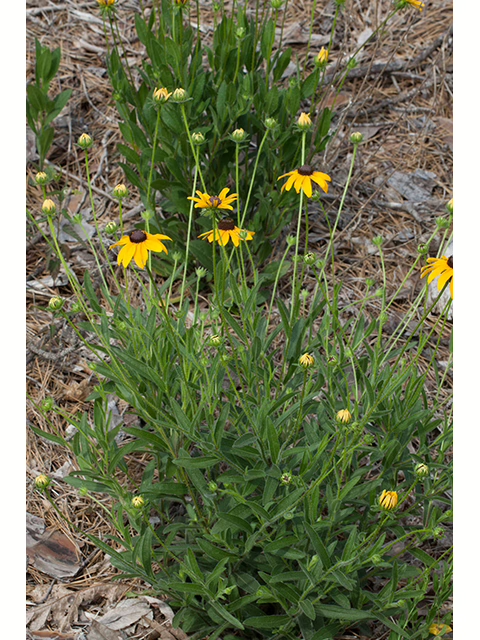

Missouri Coneflower

Rudbeckia missouriensis

Other common name(s):

Missouri Orange Coneflower

Family:

Asteraceae (Aster Family)

Plant Ecoregion Distribution Map

This map uses data from the US EPA. EPA  servers have been offline frequently so maps may not display. We are working on a solution.

Western Gulf Coastal Plain
Flatwoods

Plant Characteristics

Growth Form

Herbaceous

Height

2
to
3
ft.

Spread

1
to
2
ft.

Leaf Retention

Deciduous

Lifespan

Perennial

Habitat and Care Requirements

Soil Type(s)

Sand, Loam, Clay, Well Drained, Moist, Dry

Light Requirement

Sun

Water Requirement

Low, Medium

Native Habitat

Grassland

Bloom and Attraction

Bloom Color

Orange, Yellow, Brown

Bloom Season

Summer, Fall

Seasonal Interest

Seeds, Nectar, Pollen

Wildlife Benefit

Butterflies, Birds, Bees

Maintenance

Tolerates hot and humid summers and some drought. Plant in perennial borders, cut flower gardens, meadows and prairies. and pollinator gardens. Native habitat: dry, rock prairies.

Description

Blooms June-October. Multi-branched stems with narrow green leaves. And it has large basal leaves that often remain green through winter. Both leaves and stems are covered with abundant hairs. Disc flower appearing purplish-brown; ray flowers orange, yellow.
Previous Scientific Name(s): Rudbeckia fulgida var. missouriensis
Material Treatment Method Collection References
Root Division Gently dig around the base of the plant and loosen the root system. Try to keep it as one intact ball. Get as deep as your spade will reach. Carefully remove the entire plant from the hole. Using a soil knife, old kitchen knife, or garden spade, divide the root ball in half, leaving good numbers of sprouts on both pieces. If your root ball is large, you may be able to cut it into thirds. Transplant these new plant-root pieces to their new home in the garden, planting at the same depth as before. Don’t bury the crown. They were drought-tolerant before being dug up when they had a fully developed root system. However, they will need some watering now until they are re-established. 1) https://www.gardendesign.com/flowers/black-eyed-susan.html 2) https://gardening.org/ways-to-propagate-rudbeckia/#ways-to-propagate-rudbeckia

About the Region

2026 Fall Symposium Logo

This low-elevations region of Texas extends inland from the barrier islands, about 60 or so miles, and stretches from Brownsville to Louisiana. In total, it covers about 9.5 million acres, with a high point of 150 feet in elevation. More than 1000 species of plants can be found in this region. On the southern end, species more common in Mexico (such as Sabal mexicana) and Central America occur.

The barrier islands provide us with dune systems, and clay flats to the inland side, which have species found in these areas alone. Many plants here, such as Ipomoea pes-caprae (beach morning glory), can be found throughout tropical regions of the globe. I’ve encountered the same species on the beaches of Guam.

Once inland, vast marshes and wet prairies occur. Occasionally, oak (Quercus fusiformis) groves can be found. Common grasses include species of Bothriochloa, Paspalum, and Sporobolus; eastern gamagrass (Tripsacum dactyloides); and switchgrass (Panicum species). Many rivers and creeks cut through the Gulf Prairies, and along these riparian areas various species of trees, Sabal minor, and other plants adapted to clay soils can be found. Due to overgrazing, farming, and fire suppression, woody species such as mesquite (Prosopis glandulosa) and huisache (Acacia farnesiana), and invasive species such as chinaberry (Melia azedarach), Brazilian pepper (Schinus terebinthifolius), and Chinese tallow (Sapium sebiferum) have increased and displaced our native flora.

Source: Wildflowers of Texas by Michael Eason