
Tall Goldenrod

Solidago altissima

Other common name(s):

Canada Goldenrod, Late Goldenrod, Canadian Goldenrod

Family:

Asteraceae (Aster Family)

Plant Ecoregion Distribution Map

This map uses data from the US EPA. EPA  servers have been offline frequently so maps may not display. We are working on a solution.

Chihuahuan Deserts, East Central Texas Plains, Edwards Plateau, Gulf Coast Prairies and Marshes, Texas Blackland Prairies, Western Gulf Coastal Plain
Chihuahuan Basins and Playas, Low Mountains and Bajadas
Bastrop Lost Pines, Floodplains and Low Terraces2, Northern Post Oak Savanna, Northern Prairie Outliers, San Antonio Prairie, Southern Post Oak Savanna
Balcones Canyonlands
Northern Humid Gulf Coastal Prairies
Floodplains and Low Terraces1, Northern Blackland Prairie, Southern Blackland Prairie
Flatwoods, Floodplains and Low Terraces3, Pleistocene Fluvial Terraces, Red River Bottomlands, Southern Tertiary Uplands, Tertiary Uplands

Plant Characteristics

Growth Form

Herbaceous

Height

3
to
6
ft.

Spread

2
to
3
ft.

Leaf Retention

Deciduous

Lifespan

Perennial

Habitat and Care Requirements

Soil Type(s)

Caliche, Clay, Dry, Loam, Moist, Sand

Light Requirement

Sun, Part Shade

Water Requirement

Medium

Native Habitat

Disturbed Areas, Grassland, Woodland

Bloom and Attraction

Bloom Color

Yellow

Bloom Season

Summer, Fall

Seasonal Interest

Larval Host, Nectar, Pollen, Seeds

Wildlife Benefit

Bees, Birds, Butterflies, Beetles, Nectar Insects

Maintenance

Height is determined mostly by the fertility and moisture content of the soil. This plant will tolerate some drought, but may drop some of its lower leaves. It also tolerates a variety of soils, seeming to prefer a heavier soil with some clay content. The root system is fibrous, producing creeping rhizomes that spread and form colonies, therefore give lots of space. Canadian Goldenrod produces allelopathic compounds that suppress the growth of other plants and therefore can crowd them out. A patch of goldenrod can be beautiful addition to your garden if you have the space. Although goldenrod is often blamed for hay fever because it is in bloom during that season, ragweed is actually the cause. Native habitat: dry to moist roadsides, thickets, prairies, open woods, disturbed habitats.

Description

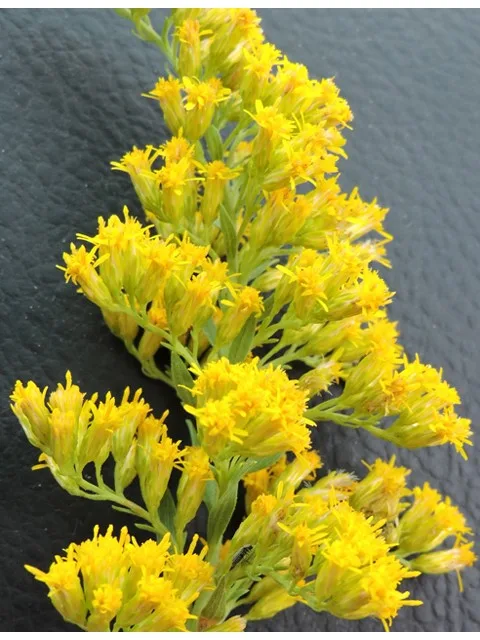
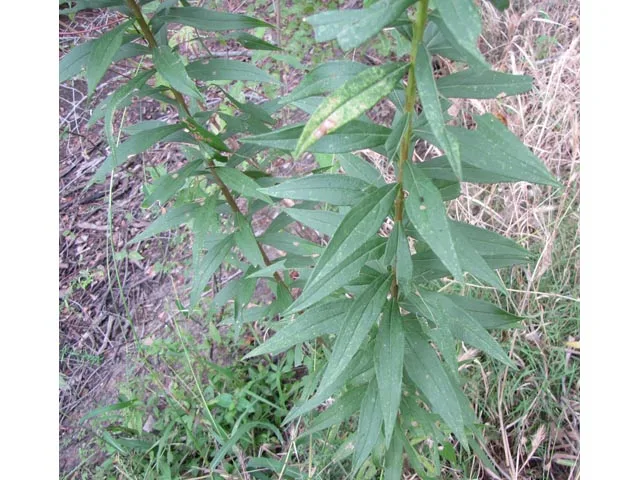
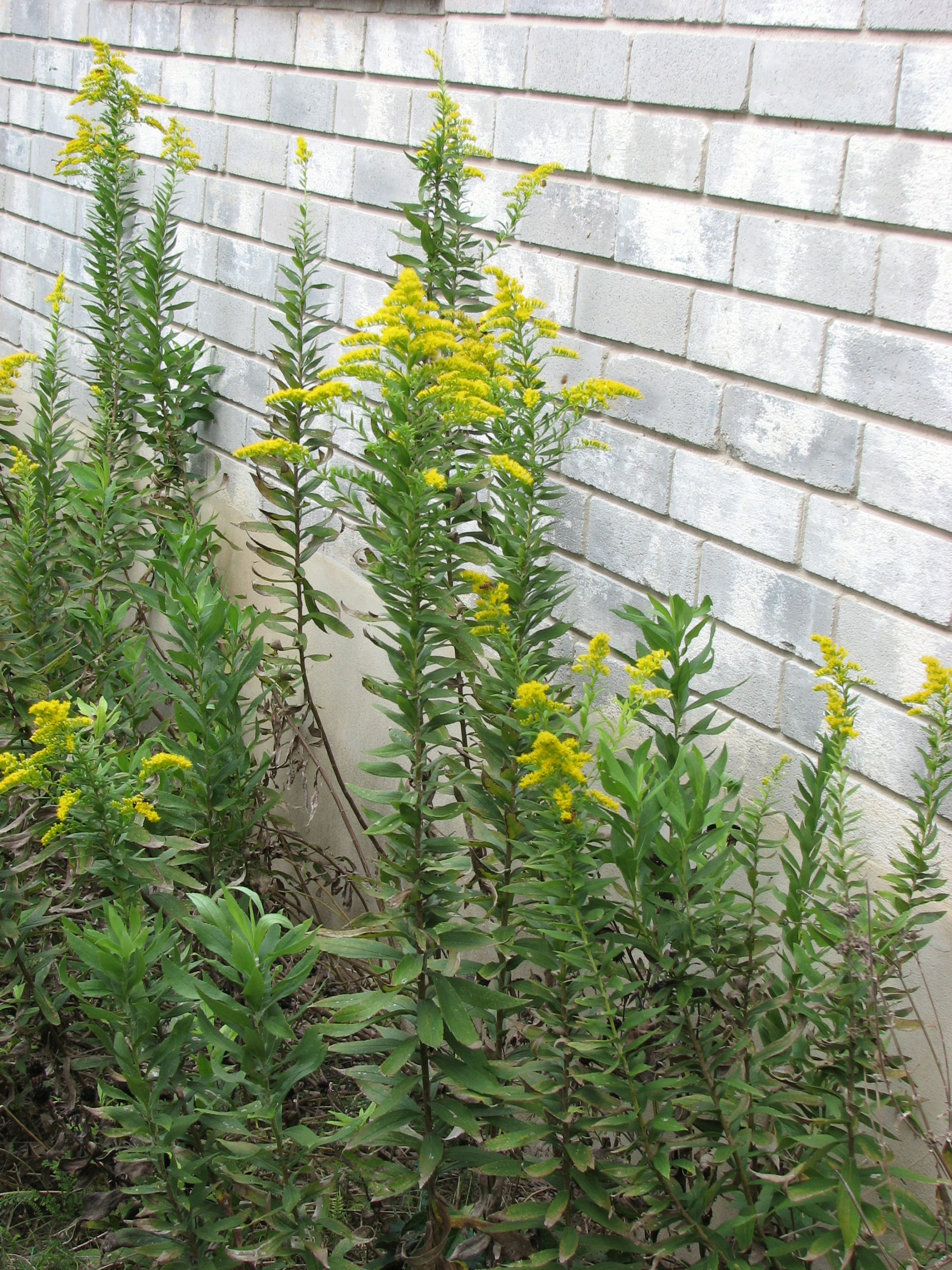
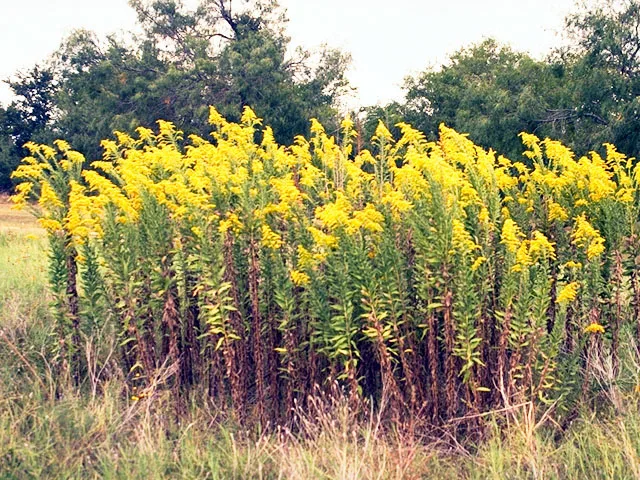
Blooms August-November. Tall, erect, rough stems that occur singularly or in clusters. Lance shaped leaves become smaller towards the top of the plant. The short hairs on the leaves give a gray-green tone. The small, yellow flowers are arranged along the upper side of branches, forming a feathery, plume-shaped inflorescence. The fruit is a cypsela: a dry, one-seeded fruit, usually topped by pappus. Larval host: Wavy-lined Emerald (Synchlora aerata), Goldenrod Gall Fly (Eurosta solidaginis) and the Goldenrod Bunch Gall Midge (Rhopalomyia solidaginis).
Previous Scientific Name(s): Solidago altissima var. altissima, Solidago altissima var. pluricephala, Solidago altissima var. procera, Solidago canadensis var. scabra, Solidago hirsutissima, Solidago lunellii
Material Treatment Method Collection References
Seed No Treatment Sow the seeds directly in the garden in early spring or fall. Plants grown from seed will usually bloom in their second or third year. After the flowers have dried, collect the seeds from the seed heads and store the seeds in a cool, dry location. 1) https://propagate.one/how-to-propagate-solidago-altissima/ 2) https://plantiary.com/plant/solidago-altissima_4181.html
Stem Cutting Remove the leaves from the bottom inch or two of the stem. Dip the cut end of the stem in a rooting hormone to encourage root growth. Plant the cuttings in a well-drained soil mixture and water thoroughly, then keep them consistently moist and shaded. This is best done in the late spring or early summer. Select healthy stems that are about 6 inches long. Cut the stems at a 45-degree angle just below a node (the point where leaves grow from the stem). https://propagate.one/how-to-propagate-solidago-altissima/
Clump Division Plant the divisions in a well-drained location with plenty of sunlight. This is one of the easiest ways to propagate Solidago altissima and works best in the spring or early fall when the plant is actively growing. Carefully dig a trench around a well-established plant with multiple stems, being mindful of the roots. Using a sharp spade or garden knife, carefully divide the root ball into smaller sections, ensuring each division has healthy roots and shoots. https://propagate.one/how-to-propagate-solidago-altissima/
Root Division The divided sections are then planted in soil that has been amended with compost or organic matter. The plant is dug up in the early spring or late fall and the roots carefully separated into smaller sections, each section being at least 4 inches long with at least one growth bud. https://plantiary.com/plant/solidago-altissima_4181.html

About the Region

2026 Fall Symposium Logo

This low-elevations region of Texas extends inland from the barrier islands, about 60 or so miles, and stretches from Brownsville to Louisiana. In total, it covers about 9.5 million acres, with a high point of 150 feet in elevation. More than 1000 species of plants can be found in this region. On the southern end, species more common in Mexico (such as Sabal mexicana) and Central America occur.

The barrier islands provide us with dune systems, and clay flats to the inland side, which have species found in these areas alone. Many plants here, such as Ipomoea pes-caprae (beach morning glory), can be found throughout tropical regions of the globe. I’ve encountered the same species on the beaches of Guam.

Once inland, vast marshes and wet prairies occur. Occasionally, oak (Quercus fusiformis) groves can be found. Common grasses include species of Bothriochloa, Paspalum, and Sporobolus; eastern gamagrass (Tripsacum dactyloides); and switchgrass (Panicum species). Many rivers and creeks cut through the Gulf Prairies, and along these riparian areas various species of trees, Sabal minor, and other plants adapted to clay soils can be found. Due to overgrazing, farming, and fire suppression, woody species such as mesquite (Prosopis glandulosa) and huisache (Acacia farnesiana), and invasive species such as chinaberry (Melia azedarach), Brazilian pepper (Schinus terebinthifolius), and Chinese tallow (Sapium sebiferum) have increased and displaced our native flora.

Source: Wildflowers of Texas by Michael Eason