Texas Native Plants Magazine

Latest Issues

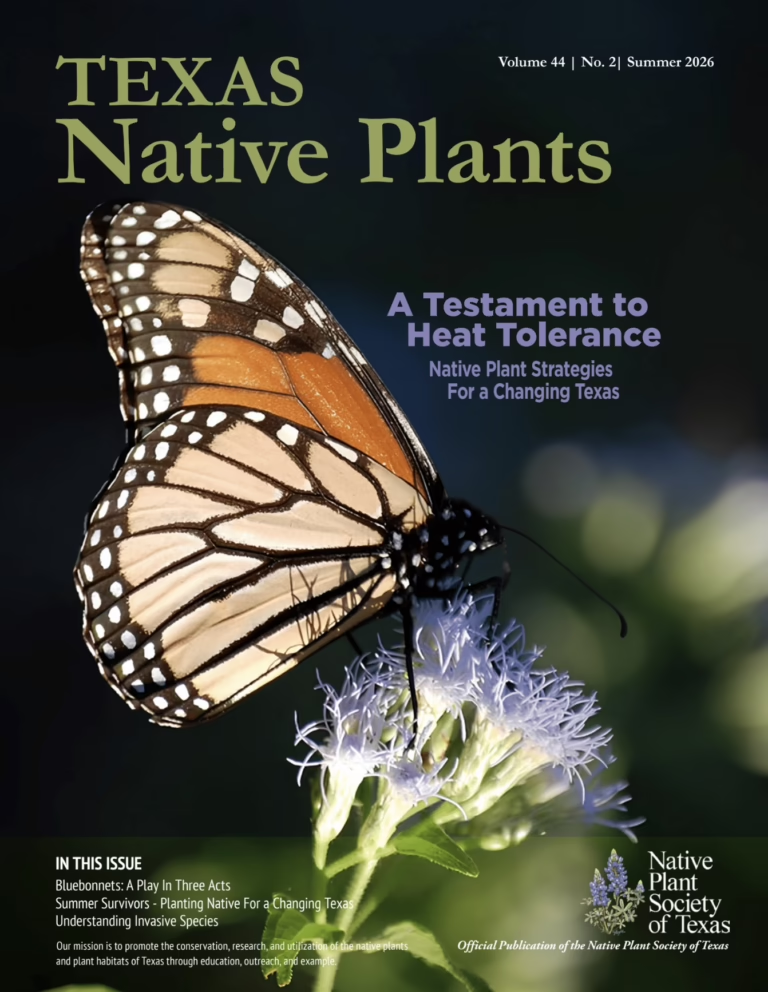
Summer 2026 Member Magazine

Texas Bluebonnets: A Play In Three Acts | What Bison Did For Bees | What’s Growing Isn’t Always What’s Best | Summer Survivors | Member News | A Thorny Dilemma | Barking Up the Right Tree
Read More »

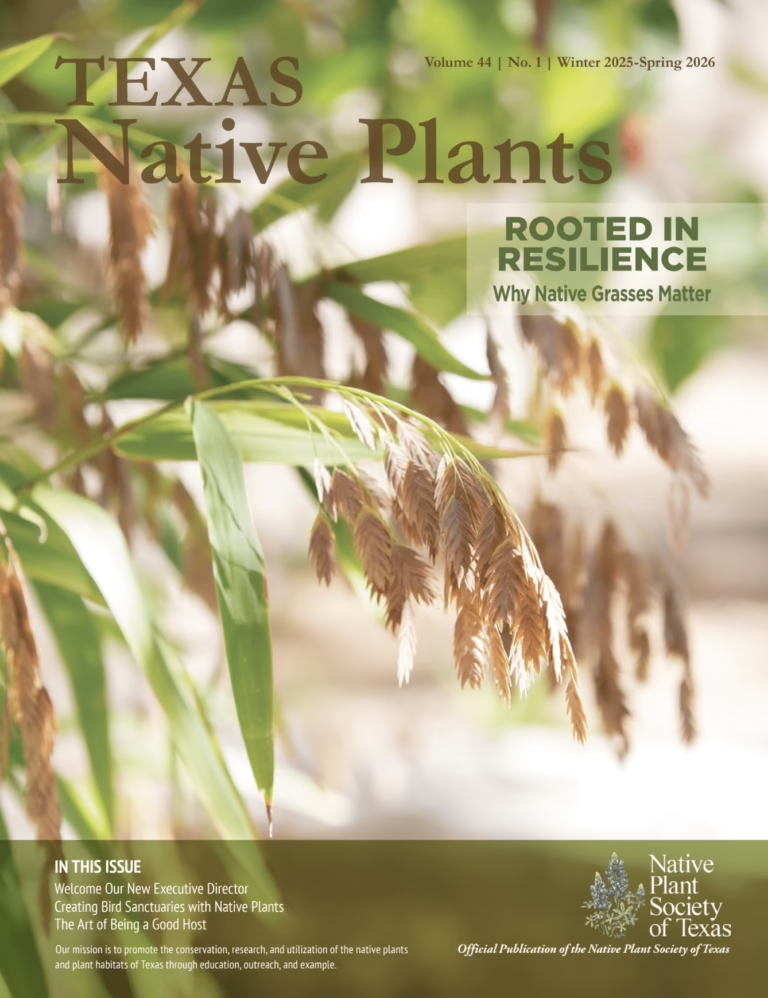
Winter 2026 Member Magazine

Executive Update | Symposium Recap | Native Plant Database | Good Host | Bird Sanctuaries | Native Grasses | Making Peace with HOA | Member News | Early Spring Care

Read More »

Fall 2025 Member Magazine

President’s Message | Executive Update | Celebrating Leadership | Curb Appeal with a Cause | Grant Recipients | Autumn’s Perfect Pairing | Native Plant Database | Sustainable Landscaping | Winterizing Tips

Read More »

Distribution

  • Texas Native Plants is published quarterly and the digital version is distributed free to all Society members in current standing.
  • The digital version is also available in our library below.
  • Print versions are mailed at no cost to Society members in current standing who select to receive a print copy when they join/renew.
  • Libraries, educational institutions and other organizations may qualify to receive the publication for a $5 annual fee.
  • Contact the membership coordinator.
  • Many of our chapters publish their own newsletters and websites.
  • These have their own deadlines and guidelines. See list of chapters.

History

Since its founding the Society has provided a news periodical to its members. there have been a variety of names and formats. The Texas Wildfower Newsletter edited by Carroll Abbott served as the first newsletter. He advocated the formation of the Native Plant Society of Texas in his quarterly publication Texas Wildflower Newsletter. After the Society was created in 1980, a free subscription to Abbott’s newsletter was provided as a benefit to all members. His declining health eventually prompted Abbott to request that the Society start its own newsletter. Lean more about the Carroll Abbott story.

Beginning in 1983 our own official publication has documented the evolution of the native plant movement and the Native Plant Society of Texas. The publication has had several slightly different names and formats over the years. By 2005 it had evolved into a full-color glossy magazine.

The Native Plant Society of Texas encourages submission of articles, photos, pertinent news or other interesting information for publication.

  • Submit articles or written items as email attachments.
  • Send photos as email attachments in JPG, RAW or TIFF format.
  • Larger file size and best quality are preferable.
  • Contact the Editor for more information.
 

We reserve the right to edit all submissions for accuracy, relevance, length, grammar or for other reason. In matters of style our print publication generally follows the Chicago Manual of Style.

Unless prior arrangements with the editor are made, submissions may also appear on our website and linked on our social media pages. We do not accept outside advertising in any of our publications.

Publications Library

Click below to view issues by year/editor. Or visit our online archive.

  • Sort

2016 – Spring

Volume 34, No. 2
Editor: Stephen Brueggerhoff
  • Texas Native Plant Art Exhibition
  • Modern Tools for Field Identification
  • A First-Timers Account at the Fall Symposium
  • San Antonio River Authority and the NLCP

2016 – Winter

Volume 34, No. 1
Editor: Stephen Brueggerhoff
  • Annual Awards
  • Monarch Butterfly Rest Areas
  • Encouraging Youth Programs
  • Photo Contest Winners

2015 – Fall

Volume 33, No. 4
Editor: Stephen Brueggerhoff
  • Anouncing Board Nominees
  • Among Natives and Exotics in San Antonio
  • Texas Native Plant Week
  • Youth Outreach

2015 – Summer

Volume 33, No 3
Editor: Stephen Brueggerhoff
  • Using Biomicmicry in Landscape Design
  • The “Magic Words” to Use with HOAs
  • More than Milkweeds: A Panhandle Perspective
  • Scholarship Recpients

2015 – Spring

Volume 33, No 2
Editor: Stephen Brueggerhoff
  • Fall Symposium Call For Papers
  • Remembering Kate Hillhouse
  • Wetlands’ Role In Our Native Landscape
  • Water Gardening At Home

2015 – Winter

Volume 33, No. 1
Editor: Stephen Brueggerhoff
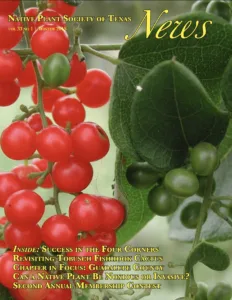
  • Success In the Four Corners: Symposium In Review
  • Revisiting Tobusch Fishhook Cactus
  • Can a Native Plant Be Noxious or Invasive
  • Chapter Tool Chest: Aids to Chapter Success

2014 – Fall

Volume 32, No. 4
Editor: Stephen Brueggerhoff
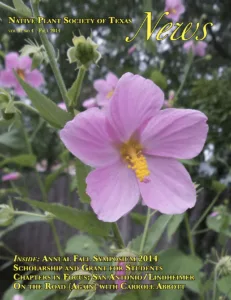
  • 2014 Symposium
  • On the Road (Again) With Carroll Abbott
  • Scholarship and Grants For Students
  • Chapters in Focus: San Antonio & Lindheimer

2014 – Summer

Volume 32, No. 3
Editor: Stephen Brueggerhoff
  • Rejuvenated Spring Symposium
  • Benny J. Simpson Fellows Nominees
  • Seed Banking Texas Ash Species
  • Lawther Deer Park Prairie

2014 – Spring

Volume 32, No. 2
Editor: Stephen Brueggerhoff
  • Tribute to Carroll Abbott
  • Spring Symposium: Keynote by Dr Tallamy
  • Enchanting Spring Ephemerals: Trout Lily
  • Eye on Education

2014 – Winter

Volume 32, No. 1
Editor: Stephen Brueggerhoff
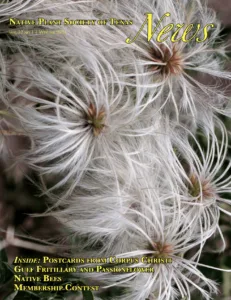
  • Postcards form Corpus Christi
  • Gulf Fritillary and Passionflower
  • Native Bees
  • Membership Contest

2013 – Fall

Volume 31, No. 4
Editor: Bill Hopkins
  • How a purple thistle taught children ecology
  • An appreciation of winter’s strip show

2013 – Summer

Volume 31, No. 3
Editor: Bill Hopkins
  • The A.E. Leonard Native Plant Garden
  • A Trip to Big Bend
  • Anisacanthus
  • Fragrant Mimosa

2013 – Spring

Volume 31, No. 2
Editor: Bill Hopkins
  • Reintroduction of Horned Toads
  • Little Bluestem
  • Serendipity of native “Symphs”
  • Buttonbush

2013 – Winter

Volume 31, No. 1
Editor: Bill Hopkins
  • Let’s bring the Monarchs back to Texas
  • Believe the leaves (usually)
  • Celebrating 30 years of newsletters
  • Snailseed vine
  • Post wildfire regeneration in Bastrop State Park

2012 – Fall

Volume 30, No. 4
Editor: Bill Hopkins
  • Andy Wasowski dies
  • Some favorite cacti
  • Design techniques for natural landscapes

2012 – Summer

Volume 30, No. 3
Editor: Bill Hopkins
  • Yellow peril!
  • Native bees in Texas
  • Rain barrels

2012 – Spring

Volume 30, No. 2
Editor: Bill Hopkins
  • Attracting monarchs
  • Some native milkweeds
  • Romancing the Land
  • Healing hands help heal the land

2012 – Winter

Volume 30, No. 1
Editor: Bill Hopkins
  • Rising from the ashes – Bastrop State Park
  • Mexican plum
  • Comanche Peak Prairie Clover
  • Think like a plant

2011 – Fall

Volume 29, No. 4
Editor: Bill Hopkins
  • Desert Willow
  • A society of garden clubs – Not!
  • Toothleaf goldeneye
  • Why hire an executive director?

2011 – Summer

Volume 29, No. 3
Editor: Bill Hopkins
  • Lantana urticoides
  • Citizen scientists make a difference
  • Going native in Lufkin

About the Region

2026 Fall Symposium Logo

This low-elevations region of Texas extends inland from the barrier islands, about 60 or so miles, and stretches from Brownsville to Louisiana. In total, it covers about 9.5 million acres, with a high point of 150 feet in elevation. More than 1000 species of plants can be found in this region. On the southern end, species more common in Mexico (such as Sabal mexicana) and Central America occur.

The barrier islands provide us with dune systems, and clay flats to the inland side, which have species found in these areas alone. Many plants here, such as Ipomoea pes-caprae (beach morning glory), can be found throughout tropical regions of the globe. I’ve encountered the same species on the beaches of Guam.

Once inland, vast marshes and wet prairies occur. Occasionally, oak (Quercus fusiformis) groves can be found. Common grasses include species of Bothriochloa, Paspalum, and Sporobolus; eastern gamagrass (Tripsacum dactyloides); and switchgrass (Panicum species). Many rivers and creeks cut through the Gulf Prairies, and along these riparian areas various species of trees, Sabal minor, and other plants adapted to clay soils can be found. Due to overgrazing, farming, and fire suppression, woody species such as mesquite (Prosopis glandulosa) and huisache (Acacia farnesiana), and invasive species such as chinaberry (Melia azedarach), Brazilian pepper (Schinus terebinthifolius), and Chinese tallow (Sapium sebiferum) have increased and displaced our native flora.

Source: Wildflowers of Texas by Michael Eason