Texas Native Plants Magazine

Latest Issues

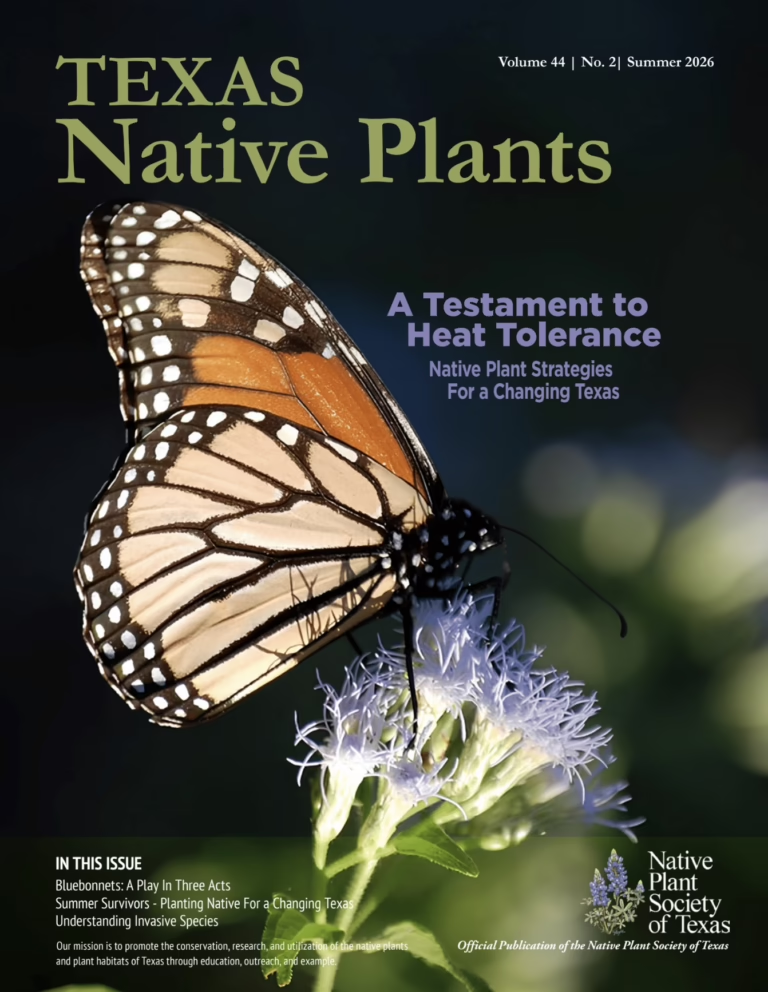
Summer 2026 Member Magazine

Texas Bluebonnets: A Play In Three Acts | What Bison Did For Bees | What’s Growing Isn’t Always What’s Best | Summer Survivors | Member News | A Thorny Dilemma | Barking Up the Right Tree
Read More »

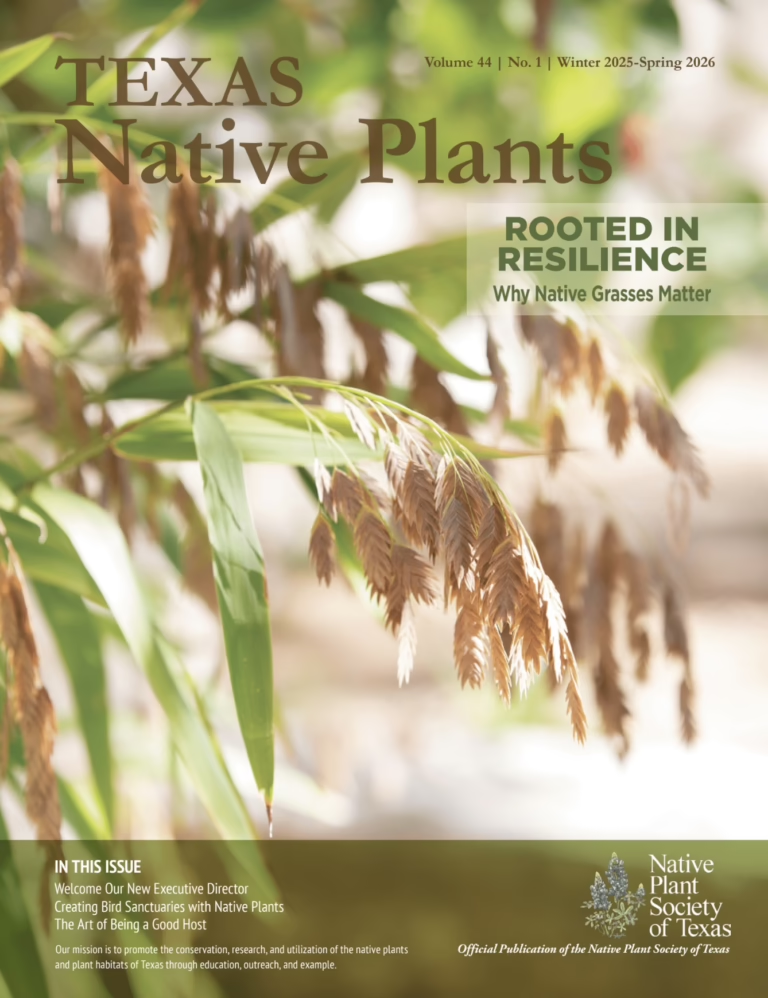
Winter 2026 Member Magazine

Executive Update | Symposium Recap | Native Plant Database | Good Host | Bird Sanctuaries | Native Grasses | Making Peace with HOA | Member News | Early Spring Care

Read More »

Fall 2025 Member Magazine

President’s Message | Executive Update | Celebrating Leadership | Curb Appeal with a Cause | Grant Recipients | Autumn’s Perfect Pairing | Native Plant Database | Sustainable Landscaping | Winterizing Tips
Read More »

Distribution

  • Texas Native Plants is published quarterly and the digital version is distributed free to all Society members in current standing.
  • The digital version is also available in our library below.
  • Print versions are mailed at no cost to Society members in current standing who select to receive a print copy when they join/renew.
  • Libraries, educational institutions and other organizations may qualify to receive the publication for a $5 annual fee.
  • Contact the membership coordinator.
  • Many of our chapters publish their own newsletters and websites.
  • These have their own deadlines and guidelines. See list of chapters.

History

Since its founding the Society has provided a news periodical to its members. there have been a variety of names and formats. The Texas Wildfower Newsletter edited by Carroll Abbott served as the first newsletter. He advocated the formation of the Native Plant Society of Texas in his quarterly publication Texas Wildflower Newsletter. After the Society was created in 1980, a free subscription to Abbott’s newsletter was provided as a benefit to all members. His declining health eventually prompted Abbott to request that the Society start its own newsletter. Lean more about the Carroll Abbott story.

Beginning in 1983 our own official publication has documented the evolution of the native plant movement and the Native Plant Society of Texas. The publication has had several slightly different names and formats over the years. By 2005 it had evolved into a full-color glossy magazine.

The Native Plant Society of Texas encourages submission of articles, photos, pertinent news or other interesting information for publication.

  • Submit articles or written items as email attachments.
  • Send photos as email attachments in JPG, RAW or TIFF format.
  • Larger file size and best quality are preferable.
  • Contact the Editor for more information.
 

We reserve the right to edit all submissions for accuracy, relevance, length, grammar or for other reason. In matters of style our print publication generally follows the Chicago Manual of Style.

Unless prior arrangements with the editor are made, submissions may also appear on our website and linked on our social media pages. We do not accept outside advertising in any of our publications.

Publications Library

Click below to view issues by year/editor. Or visit our online archive.

  • Sort

1998 – Sep/Oct

Volume 16, No. 5
Editor: Pat Ploegsma
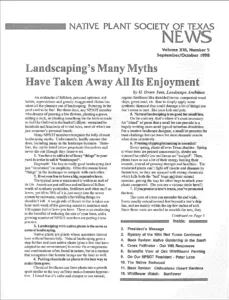
  • Myths of Landscaping
  • Letters in response: Hesperaloe parviflora
  • Research: Oak Wilt & Wound Painting
  • Taxodium mucronatum, Helianthus annuus

1998 – July/Aug

Volume 16, No. 4
Editor: Pat Ploegsma
  • Hesperaloe parviflora, Ziziphus obtusifolia, Gaillardia pulchella
  • Oak Wilt & Wound Painting
  • Research: Native Grapes at Texas Tech
  • Palo Duro Canyon

1998 – May/June

Volume 16, No. 3
Editor: Pat Ploegsma
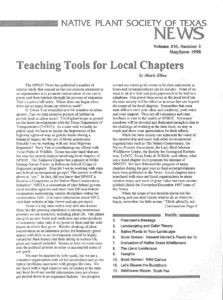
  • Teaching Tools for Local Chapters
  • Landscaping & Color Theory
  • Native Plants In Your Landscape
  • Evaluation of Native TX Wildflowers
  • The Llano Landscape
  • Opuntia leptocaulis, Rhamnus caroliniana, Baptisia sphaerocarpa

1998 – Mar/Apr

Volume 16, No. 2
Editor: Pat Ploegsma
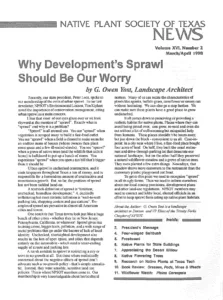
  • Development Sprawl
  • Atriplex canescens, Verbesina virginica, Chilopsis linearis
  • Native Plants for State Buildings
  • Native Flowering Trees
  • Research at Texas Tech U.
  • Coreopsis tinctoria

1998 – Jan/Feb

Volume 16, No. 1
Editor: Pat Ploegsma
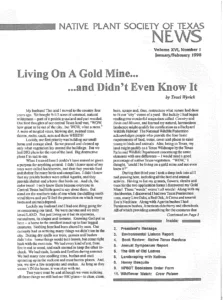
  • Living On a Gold Mine…
  • Mulch w/ Leaves
  • Landscaping w/ Natives
  • Prosopis glandulosa, Nothoscordum bivalve

1997 – Nov/Dec

Volume 15, No. 6
Editor: Pat Ploegsma
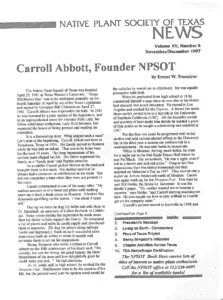
  • Profile: Carroll Abbott
  • Living On Earth
  • Flora of Texas Project

1997 – Sep/Oct

Volume 15, No. 5
Editor: Bill Bisbee
  • Lynn Lowrey Memorial
  • What’s In a Successful Nursery?
  • How Do You Measure Success?
  • Euphorbia bicolor

1997 – Jul/Aug

Volume 15, No. 4
Editor: Bill Bisbee
  • Yucca torreyi, Ipomoea trichocarpa
  • Landscaping w/ Natives
  • Water-wise Landscaping
  • Group Activities: Spread the Word
  • Ecological Restoration
  • Greenbelts Along TX Highways?

1997 – May/June

Volume 15, No. 3
Editor: Bill Bisbee
  • Brush Up on the Brush Country
  • Texas In Bloom!
  • Environmental Partnering
  • The Hunt for Chisos Red Oak
  • Lycium berlandieri, Ipomopsis rubra

1997 – Mar/Apr

Volume 15, No. 2
Editor: Bill Bisbee
  • Benny Simpson Memorial
  • More Geologic Comments
  • Natural Predator Control
  • Sassafras albidum, Oenothera speciosa
  • Ornamental Native Grasses

1997 – Jan/Feb

Volume 15, No. 1
Editor: Bill Bisbee
  • Legumes of Rio Grande Plains
  • Kidscapes at Houston Zoo
  • Smilax smallii, Taraxacum officinale
  • Ornamental Native Grasses
  • How Plant Distribution Relates to Geology
  • Conservation: Hibiscus dasycalyx

1996 – Nov/Dec

Volume 14, No. 6
Editor: Bill Bisbee
  • Early Naturalists – Part II
  • Creating Your Own Wildlife Habitat
  • Thelesperma megapotamicum
  • Focus: SFA Arboretum
  • Spiranthes cernua

1996 – Sep/Oct

Volume 14, No. 5
Editor: Bill Bisbee
  • The Chihuahuan Desert, Right?
  • Demo Gardens on Property Controlled by Others
  • Is Your Chapter Wilting?
  • Community Partnerships for Native Plants
  • Early Naturalists
  • Centaurea americana
  • Solidago canadensis var. scabra

1996 – July/Aug

Volume 14, No. 4
Editor: Bill Bisbee
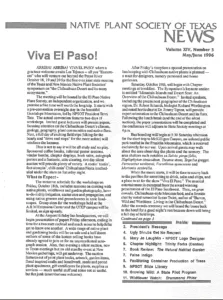
  • Native Plants of El Paso
  • John Riddell, Naturalist
  • Gilia rigidula
  • Outdoor Classrooms
  • Focus: Center for Plant Conservation
  • A Desert Oasis
  • Eustoma grandiflorum

1996 – May/June

Volume 14, No. 3
Editor: Bill Bisbee
  • Viva El Paso!
  • Ugly Shrubs Get No Respect
  • Mary Jo Laughlin Memorial
  • Amorpha fruticosa
  • Container Production of Native Trees for Urban/Suburban Landscapes
  • Growing Wild: State Pilot Program
  • Phlox drummondii

1996 – Mar/Apr

Volume 14, No. 2
Editor: Bill Bisbee
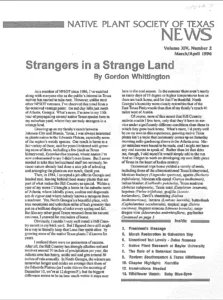
  • Strangers In a Strange Land
  • Marsh Restoration In Galveston Bay
  • Dalea formosa
  • Native Plant Research at Baylor U.
  • Role of Botanical Garden in Plant Conservation
  • Callirhoe scabriuscula

1996 – Jan/Feb

Volume 14, No 1
Editor: Bill Bisbee
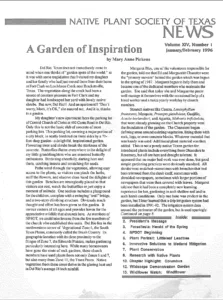
  • A Garden of Inspiration
  • Forsellia: Herald of the Spring
  • Beginnings of the Society
  • Leucaena retusa
  • Solutions to Wetland Mitigation/Preservation
  • Native Plant Research at Universities
  • Wildscape Demo Garden

1995 – Nov/Dec

Volume 13, No. 6
Editor: Bill Bisbee
  • Native Plants for Suburbia
  • Seedlings: A Tall Grass Meadow

1995 – Sep/Oct

Volume 13, No. 5
Editor: Carol Hendricks
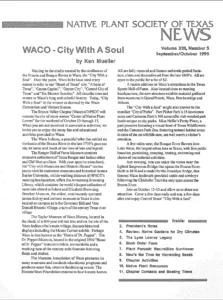
  • Waco – City w/ a Soul
  • The Lynn Lowry Legacy
  • Helianthus maximiliani, Manihot walkerae

1995 – Jul/Aug

Volume 13, No. 4
Editor: Carol Hendricks
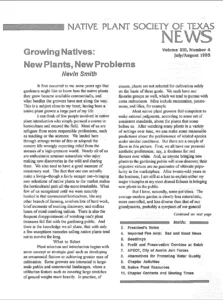
  • Growing Natives: New Plants, New Problems
  • Imported Fire Ant Control
  • NPSOT, City of Austin Median Beautification

About the Region

2026 Fall Symposium Logo

This low-elevations region of Texas extends inland from the barrier islands, about 60 or so miles, and stretches from Brownsville to Louisiana. In total, it covers about 9.5 million acres, with a high point of 150 feet in elevation. More than 1000 species of plants can be found in this region. On the southern end, species more common in Mexico (such as Sabal mexicana) and Central America occur.

The barrier islands provide us with dune systems, and clay flats to the inland side, which have species found in these areas alone. Many plants here, such as Ipomoea pes-caprae (beach morning glory), can be found throughout tropical regions of the globe. I’ve encountered the same species on the beaches of Guam.

Once inland, vast marshes and wet prairies occur. Occasionally, oak (Quercus fusiformis) groves can be found. Common grasses include species of Bothriochloa, Paspalum, and Sporobolus; eastern gamagrass (Tripsacum dactyloides); and switchgrass (Panicum species). Many rivers and creeks cut through the Gulf Prairies, and along these riparian areas various species of trees, Sabal minor, and other plants adapted to clay soils can be found. Due to overgrazing, farming, and fire suppression, woody species such as mesquite (Prosopis glandulosa) and huisache (Acacia farnesiana), and invasive species such as chinaberry (Melia azedarach), Brazilian pepper (Schinus terebinthifolius), and Chinese tallow (Sapium sebiferum) have increased and displaced our native flora.

Source: Wildflowers of Texas by Michael Eason