Texas Native Plants Magazine

Latest Issues

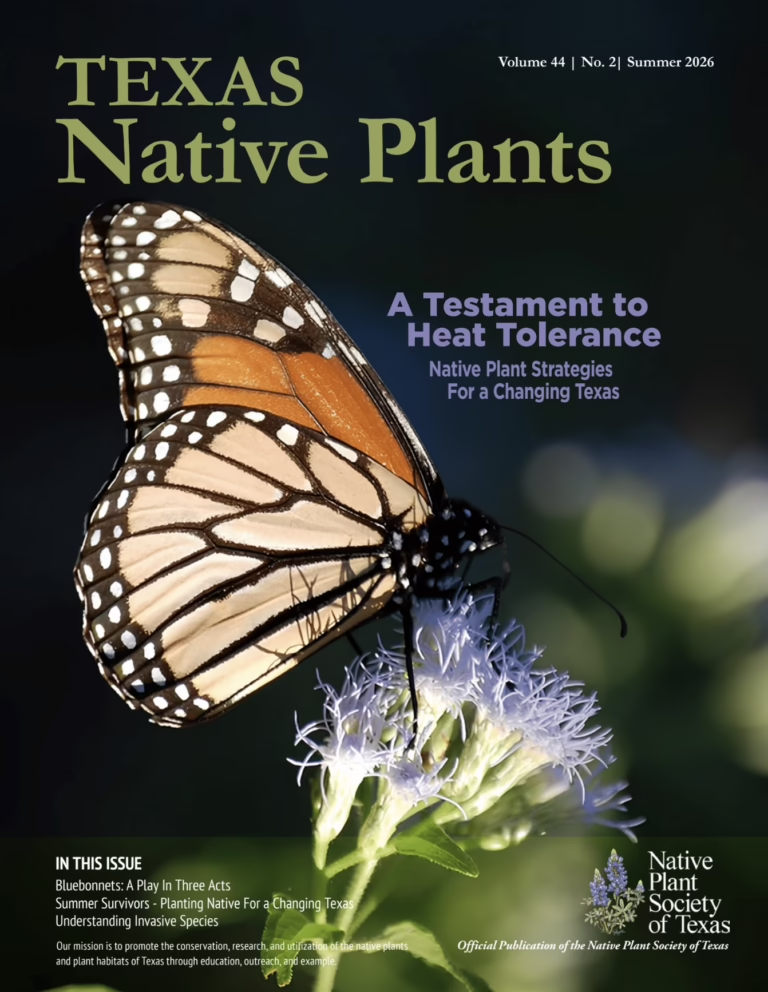
Summer 2026 Member Magazine

Texas Bluebonnets: A Play In Three Acts | What Bison Did For Bees | What’s Growing Isn’t Always What’s Best | Summer Survivors | Member News | A Thorny Dilemma | Barking Up the Right Tree
Read More »

Winter 2026 Member Magazine

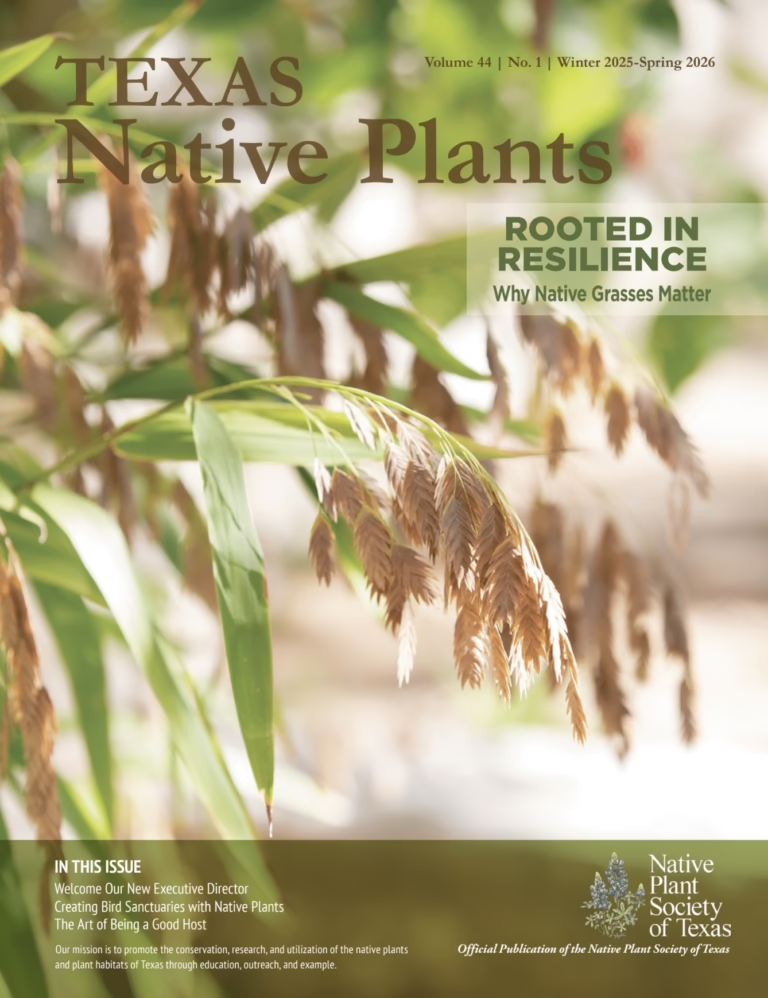
Executive Update | Symposium Recap | Native Plant Database | Good Host | Bird Sanctuaries | Native Grasses | Making Peace with HOA | Member News | Early Spring Care

Read More »

Fall 2025 Member Magazine

President’s Message | Executive Update | Celebrating Leadership | Curb Appeal with a Cause | Grant Recipients | Autumn’s Perfect Pairing | Native Plant Database | Sustainable Landscaping | Winterizing Tips
Read More »

Distribution

  • Texas Native Plants is published quarterly and the digital version is distributed free to all Society members in current standing.
  • The digital version is also available in our library below.
  • Print versions are mailed at no cost to Society members in current standing who select to receive a print copy when they join/renew.
  • Libraries, educational institutions and other organizations may qualify to receive the publication for a $5 annual fee.
  • Contact the membership coordinator.
  • Many of our chapters publish their own newsletters and websites.
  • These have their own deadlines and guidelines. See list of chapters.

History

Since its founding the Society has provided a news periodical to its members. there have been a variety of names and formats. The Texas Wildfower Newsletter edited by Carroll Abbott served as the first newsletter. He advocated the formation of the Native Plant Society of Texas in his quarterly publication Texas Wildflower Newsletter. After the Society was created in 1980, a free subscription to Abbott’s newsletter was provided as a benefit to all members. His declining health eventually prompted Abbott to request that the Society start its own newsletter. Lean more about the Carroll Abbott story.

Beginning in 1983 our own official publication has documented the evolution of the native plant movement and the Native Plant Society of Texas. The publication has had several slightly different names and formats over the years. By 2005 it had evolved into a full-color glossy magazine.

The Native Plant Society of Texas encourages submission of articles, photos, pertinent news or other interesting information for publication.

  • Submit articles or written items as email attachments.
  • Send photos as email attachments in JPG, RAW or TIFF format.
  • Larger file size and best quality are preferable.
  • Contact the Editor for more information.
 

We reserve the right to edit all submissions for accuracy, relevance, length, grammar or for other reason. In matters of style our print publication generally follows the Chicago Manual of Style.

Unless prior arrangements with the editor are made, submissions may also appear on our website and linked on our social media pages. We do not accept outside advertising in any of our publications.

Publications Library

Click below to view issues by year/editor. Or visit our online archive.

  • Sort

1992 – Jan/Feb

Volume 10, No. 1
Editor: Melinda Larsen
  • Amy Shelton McNutt Memorial
  • Toward a Healthy Soil
  • Propagation Notes: Pecan Tree/Wax Myrtle

1991 – Nov/Dec

Volume 9, No. 6
Editor: Melinda Larsen
  • On the Trail of the Silky Camellia
  • “Fallout” Habitat for Neotropical Migratory Birds
  • Aquatic Plants: Helpful Hints
  • Propagation Notes: Native Grasses

1991 – Sep/Oct

Volume 9, No. 5
Editor: Melinda Larsen
  • Prairie Management: Key to Survival
  • Hummingbird Habitat
  • Buffalo Grass & Blue Grama: Lawn Alternatives
  • Propagation Notes: Quercus macrocarpa

1991 – Jul/Aug

Volume 9, No. 4
Editor: Melinda Larsen
  • Wounds, Pruning & Oak Wilt Control
  • Native Plants to Assist in Eradication of Hemp Broomrape
  • Mounting Plant Specimens
  • Propagation Notes: Common Persimmon/Mexican Persimmon

1991 – May/June

Volume 9, No. 3
Editor: Melinda Larsen
  • Mulching
  • The Strawberry Bush, A Native of Merit
  • Lupinus sp.: History of State Flower Designation
  • Propagation Notes: Podophyllum peltatum

1991 – Mar/Apr

Volume 9, No. 2
Editor: Melinda Larsen
  • Tenth Anniversary
  • Wildflowers on the Cotton Belt Railroad
  • Collecting Botanical Specimens
  • Propagation Notes: Witch Hazel/Purple Coneflower

1991 – Jan/Feb

Volume 9, No. 1
Editor: Melinda Larsen
  • Mix It Up When Landscaping!
  • Ecology, Horticulture, & Native Plant Landscaping
  • Propagation Notes: Tagetes sp.

1990 – Nov/Dec

Volume 8, No. 6
Editor: Melinda Larsen
  • Qué Es Mas Macho?
  • Wild Collecting Endangered Natives
  • Propagation Notes: Eustoma grandiflorum
  • Endangered Species & Austin, Texas

1990 – Sep/Oct

Volume 8, No. 5
Editor: Patty Leslie
  • Guayule–Texas Rubber Plant
  • Save a Wild Texas Native

1990 – Jul/Aug

Volume 8, No. 4
Editor: Patty Leslie
  • Texas Native Palms North of the Rio Grande
  • Threatened Hinckley Oak
  • Texas Needs Plant Plan

1990 – May/June

Volume 8, No. 3
Editor: Patty Leslie
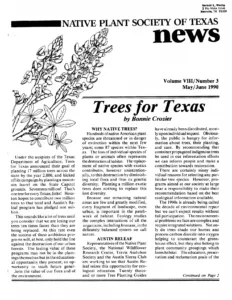
  • Trees for Texas
  • Sweetspire: Itea sp.
  • Knox City Plant Materials Center

1990 – Mar/Apr

Volume 8, No. 2
Editor: Patty Leslie
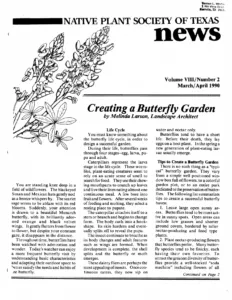
  • Creating a Butterfly Garden

1990 – Jan/Feb

Volume 8, No. 1
Editor: Patty Leslie
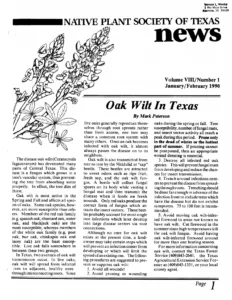
  • Oak Wilt in Texas
  • Plant Alert: Wild Collected Orchids
  • Hardwood cuttings

1989 – Nov/Dec

Volume 7, No. 6
Editor: Patty Leslie
  • Stratifying Seeds

1989 – Sep/Oct

Volume 7, No. 5
Editor: Patty Leslie
  • Planting for the Birds

1989 – Jul/Aug

Volume 7, No. 4
Editor: Patty Leslie
  • Our Native Bamboo: Arundinaria gigantea
  • Germinating Native Cactus Seeds
  • Perennials for Texas Landscapes

1989 – May/June

Volume 7, No. 3
Editor: Patty Leslie
  • On Ballmoss – Tillandsia recurvata

1989 – Mar/Apr

Volume 7, No. 2
Editor: Patty Leslie
  • Texas Barrel Cacti
  • Three Native Edible “Spinaches”

1989 – Jan/Feb

Volume 7, No. 1
Editor: Patty Leslie
  • Texas Cacti
  • The Chihuahuan Woods

1988 – Nov/Dec

Volume 6, No. 6
Editor: Patty Leslie
  • Keys to the Kingdom: Botany for Laypersons

About the Region

2026 Fall Symposium Logo

This low-elevations region of Texas extends inland from the barrier islands, about 60 or so miles, and stretches from Brownsville to Louisiana. In total, it covers about 9.5 million acres, with a high point of 150 feet in elevation. More than 1000 species of plants can be found in this region. On the southern end, species more common in Mexico (such as Sabal mexicana) and Central America occur.

The barrier islands provide us with dune systems, and clay flats to the inland side, which have species found in these areas alone. Many plants here, such as Ipomoea pes-caprae (beach morning glory), can be found throughout tropical regions of the globe. I’ve encountered the same species on the beaches of Guam.

Once inland, vast marshes and wet prairies occur. Occasionally, oak (Quercus fusiformis) groves can be found. Common grasses include species of Bothriochloa, Paspalum, and Sporobolus; eastern gamagrass (Tripsacum dactyloides); and switchgrass (Panicum species). Many rivers and creeks cut through the Gulf Prairies, and along these riparian areas various species of trees, Sabal minor, and other plants adapted to clay soils can be found. Due to overgrazing, farming, and fire suppression, woody species such as mesquite (Prosopis glandulosa) and huisache (Acacia farnesiana), and invasive species such as chinaberry (Melia azedarach), Brazilian pepper (Schinus terebinthifolius), and Chinese tallow (Sapium sebiferum) have increased and displaced our native flora.

Source: Wildflowers of Texas by Michael Eason