
Texas Ecoregion Map

Find your Texas ecoregion in the map below. Knowing your ecoregion will help you select native plants that are best suited to your local soil, climate, and rainfall patterns.

  • Hover over a region with your mouse to see the name of the ecoregion (desktop only)
  • Click on the map to get information about each ecoregion
  • See lists of plants from our Native Plant Database for that ecoregion
  • Zoom in and out on the map to see which ecoregion you live in
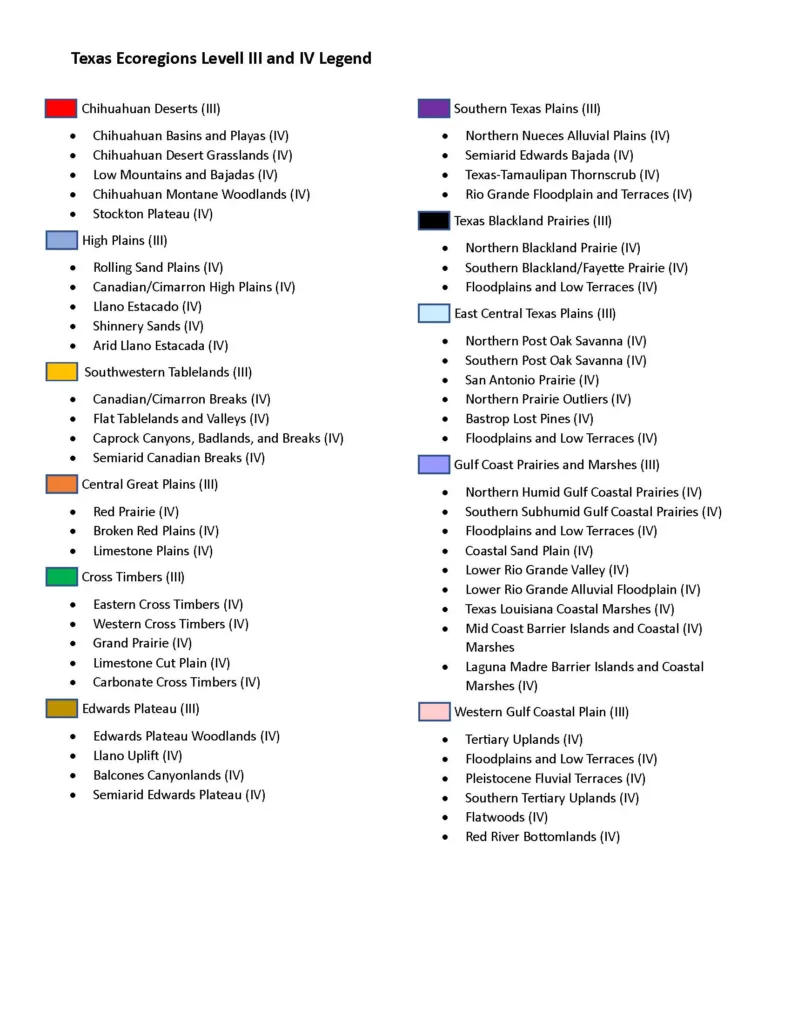
  • Scroll below for a full legend of all the ecoregions
  • The map references USDA and Texas Parks & Wildlife ecoregion borders

Ecoregions are geographic areas that have similarities in the type, quality, and quantity of environmental resources. These regions are primarily defined by factors such as soil types, average rainfall, and temperature ranges. Ecoregion frameworks serve as invaluable tools for environmental research, assessment, management, and ecosystem monitoring. They are instrumental in setting resource management goals, developing biological criteria, and establishing water quality standards.

Texas is a vast expanse covering 266,807 square miles, ranking second only to Alaska in land area. Its sheer size and geographical location contribute to an impressive diversity in climate and landscapes, shaping a rich mosaic of habitats. This state includes, deserts, forests, mountains, marshes, prairies, plains, riparian areas, and more.

Located at a crossroads, Texas is where eastern habitats meet western ones, and southern subtropical zones blend into northern temperate regions. The state’s annual rainfall varies dramatically—from as little as 8 inches in the arid deserts of far west Texas to a lush 56 inches per year in the swamps of east Texas.

About the Region

2026 Fall Symposium Logo

This low-elevations region of Texas extends inland from the barrier islands, about 60 or so miles, and stretches from Brownsville to Louisiana. In total, it covers about 9.5 million acres, with a high point of 150 feet in elevation. More than 1000 species of plants can be found in this region. On the southern end, species more common in Mexico (such as Sabal mexicana) and Central America occur.

The barrier islands provide us with dune systems, and clay flats to the inland side, which have species found in these areas alone. Many plants here, such as Ipomoea pes-caprae (beach morning glory), can be found throughout tropical regions of the globe. I’ve encountered the same species on the beaches of Guam.

Once inland, vast marshes and wet prairies occur. Occasionally, oak (Quercus fusiformis) groves can be found. Common grasses include species of Bothriochloa, Paspalum, and Sporobolus; eastern gamagrass (Tripsacum dactyloides); and switchgrass (Panicum species). Many rivers and creeks cut through the Gulf Prairies, and along these riparian areas various species of trees, Sabal minor, and other plants adapted to clay soils can be found. Due to overgrazing, farming, and fire suppression, woody species such as mesquite (Prosopis glandulosa) and huisache (Acacia farnesiana), and invasive species such as chinaberry (Melia azedarach), Brazilian pepper (Schinus terebinthifolius), and Chinese tallow (Sapium sebiferum) have increased and displaced our native flora.

Source: Wildflowers of Texas by Michael Eason